 India's No.1 PU & Degree With Integrated IAS & IPS(UPSC/PSC) Training College.


A Shared Disaster Beyond Borders & Geopolitics | Explained
A SHARED DISASTER, BEYOND BORDERS AND GEOPOLITICS
Why in the News?
- On August 26, 2026, a glacial collapse and landslide near the Nepal-China border triggered devastating flash floods across Nepal.
- The event, initially mistaken for a 4.4-magnitude earthquake, was later linked to glacial collapse and a landslide equivalent to a 5.2-magnitude seismic event.
- Preliminary estimates indicate 579 deaths and nearly 2,000 people missing, including several foreign nationals.
- Entire villages and towns were swept away, while critical infrastructure such as bridges and power stations suffered extensive destruction.
- Around 45 MW of Nepal’s electricity-generating capacity was reportedly knocked out, severely affecting the country’s power infrastructure.
- The scale of destruction has raised concerns that the disaster could become one of the most devastating natural disasters in Nepal’s history.
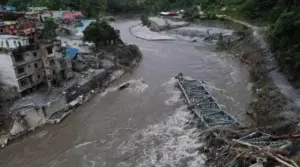
Nature transcends geopolitical boundaries
- The disaster highlights that natural calamities do not respect political borders, affecting Nepal, India and China irrespective of their geopolitical differences.
- The floods have demonstrated the physical interconnectedness of the three countries, with developments in one country having immediate consequences for its neighbours.
Impact on China
- Gyirong Port, the largest land trade port in Tibet and a key gateway between Nepal and China, has suffered extensive damage.
- The port was upgraded in 2017 from a bilateral crossing into an internationally recognised gateway, strengthening Nepal-China connectivity.
- The $175.8-million port has reportedly been buried under heavy sediment and debris, disrupting trade and cross-border movement.
- Roads, power supplies and communication networks on the Chinese side have been severely damaged or completely cut off.
- Fatalities and missing persons, including foreign nationals, have also been reported in Tibet’s Gyirong County.
Impact on India
- India has also suffered human losses, with the Ministry of External Affairs (MEA) confirming that some Indian nationals are missing or untraced.
- Many of those affected were tourists and pilgrims travelling to Kailash Mansarovar, who generally travel through Kathmandu, the Gyirong Port and the narrow Himalayan river valleys towards the Tibetan Plateau.
- The disaster therefore threatens an important pilgrimage and tourism route connecting India, Nepal and Tibet.
Broader significance
- The disaster demonstrates that geographical and ecological interdependence can transcend geopolitical rivalries among India, China and Nepal.
- It underscores the need for greater cross-border disaster preparedness, information-sharing, early-warning systems and humanitarian cooperation among the three countries.
Flood Fallout for India
- Downstream flood threat: Floodwaters from Nepal posed a significant threat to downstream Indian States, particularly Bihar and Uttar Pradesh.
- Rising water levels in Bihar: Authorities in Patna went on high alert as water levels rose alarmingly in rivers such as the Ganga and Kosi.
- Flood preparedness: Teams were deployed around the Valmikinagar Barrage and vulnerable embankments to monitor water levels and prevent further damage.
- Evacuation measures: Riverside communities in vulnerable areas were evacuated to safer locations as a precautionary measure.
- Alert in Uttar Pradesh: Authorities closely monitored the situation as overflowing rivers from Nepal entered Indian territory, with the State Relief Commissioner tracking developments in real time.
- Border districts on heightened surveillance: Maharajganj and Kushinagar increased emergency surveillance and deployed additional personnel to respond to potential flooding.
- NDRF deployment: The National Disaster Response Force (NDRF) deployed teams along the Bihar–Uttar Pradesh border to strengthen disaster-response capacity.
- Humanitarian assistance to Nepal: India activated an extensive humanitarian assistance and disaster-relief programme to support Nepal.
- Relief supplies: The Indian Air Force (IAF) transported over 5 tonnes of emergency relief material to Nepal, including medical supplies, rations and tents.
A Case for Cooperation
- Trilateral impact: The disaster has severely affected Nepal, India and China, highlighting their shared vulnerability to transboundary natural disasters.
- Need to transcend geopolitics: The three countries must look beyond narrow geopolitical considerations while recognising existing strategic and realpolitik compulsions.
- Institutionalised cooperation: There is a need to establish a practical framework for cross-border collaboration and coordination during natural disasters.
- Addressing transboundary disasters: Increasingly unpredictable phenomena such as flash floods, glacial lake outbursts and landslides require coordinated regional responses.
- Future recurrence: The likelihood of such extreme events recurring makes long-term disaster preparedness and resilience
- Compartmentalising political differences: India, China and Nepal should create functional spaces for cooperation by separating disaster management from contentious geopolitical issues.
- Shared ecological vulnerability: The interconnected Himalayan ecosystem makes the three countries ecologically interdependent, necessitating joint monitoring and early-warning mechanisms.
- Humanitarian cooperation: The fragility of human life in such disasters provides an opportunity to strengthen humanitarian assistance, rescue operations and disaster-response coordination.
- Way forward: Shared early-warning systems, real-time data sharing, coordinated evacuation plans, joint disaster-response mechanisms and regular trilateral exercises can strengthen collective resilience.
Way Forward
- Trilateral disaster mechanism: Establish a dedicated India–Nepal–China mechanism for coordinated response to transboundary disasters.
- Early-warning systems: Develop integrated glacial lake, flood and landslide monitoring systems, with real-time alerts shared across borders.
- Data sharing: Institutionalise exchange of hydrological, meteorological, seismic and satellite data among the three countries.
- Joint disaster response: Conduct regular trilateral rescue and relief exercises and develop standard operating procedures for cross-border emergencies.
- Climate-resilient infrastructure: Strengthen bridges, roads, hydropower projects and settlements through climate-risk assessments and resilient engineering.
- Himalayan cooperation: Promote joint research on glacial retreat, GLOFs, landslides and climate change to better understand emerging risks.
- Humanitarian diplomacy: Treat disaster relief as a domain of functional cooperation, insulating it from broader India–China geopolitical tensions.
- Community-level preparedness: Build local capacity through evacuation drills, resilient shelters, awareness programmes and trained first responders in vulnerable Himalayan regions.
- Regional framework: Strengthen existing platforms such as SAARC and BIMSTEC to develop wider regional disaster-management capabilities.
- From reactive to preventive governance: Shift from post-disaster relief towards anticipatory action, risk mapping, prevention and resilience-building.
Mains question
Transboundary disasters in the Himalayas transcend geopolitical boundaries. Examine the need for India, Nepal and China to strengthen trilateral cooperation for disaster preparedness, early warning and humanitarian response.

