 India's No.1 PU & Degree With Integrated IAS & IPS(UPSC/PSC) Training College.


WHY 543 SHOULD REMAIN 543
WHY 543 SHOULD REMAIN 543
Syllabus:
GS-2:
- India Constitution
- Elections
- Statutory Bodies
Why in the News?
- Parliamentary Uncertainty: The Monsoon Session was adjourned sine die on August 13, 2026, but Parliament has not yet been formally prorogued, prompting speculation about reconvening.
- Delimitation Debate: A possible constitutional amendment linking delimitation and women’s reservation has revived debate over whether the Lok Sabha should be expanded beyond its present 543 seats.
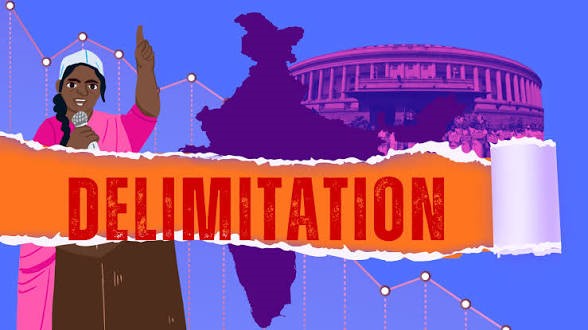
DELIMITATION IN INDIA
- Meaning: Delimitation refers to the process of redrawing electoral constituency boundaries to ensure broadly equitable representation based on population and other constitutionally relevant considerations.
- Commission: Delimitation is undertaken by an independent Delimitation Commission, whose orders have historically enjoyed strong legal finality to prevent routine political interference.
- Constitutional Basis: Articles 82 and 170 provide the principal constitutional framework for readjustment of parliamentary and State Assembly constituencies following Census exercises.
- Constitutional Freeze: The 42nd Amendment froze inter-State allocation using the 1971 Census, while subsequent amendments extended this arrangement to encourage population stabilisation.
- Current Context: The forthcoming 2027 Census is particularly significant because its population figures may provide the demographic basis for the next major delimitation exercise.
CONSTITUTIONAL FRAMEWORK OF DELIMITATION
- Article 81: The Constitution provides for Lok Sabha representation broadly according to population, but qualifies this principle with the phrase “so far as practicable”, allowing competing constitutional objectives to be considered.
- Article 82: Parliament is required to readjust the allocation and territorial constituencies after each Census through a delimitation exercise, subject to constitutional provisions governing representation.
- 42nd Amendment: The Constitution (42nd Amendment) Act, 1976 froze inter-State allocation of Lok Sabha seats based on the 1971 Census to prevent States adopting population-control measures from losing political representation.
- 84th Amendment: The 84th Constitutional Amendment, 2001 extended the freeze on inter-State allocation until the first Census after 2026, while permitting constituency readjustment within States.
- Federal Compact: The freeze effectively created a federal compact, assuring States that successful population stabilisation would not translate into diminished representation in the Union legislature.
WHY DELIMITATION DOES NOT REQUIRE MORE SEATS
- Boundary Adjustment: The 2001 delimitation exercise demonstrated that constituency boundaries can be reorganised according to demographic changes without altering the existing inter-State allocation of Lok Sabha seats.
- Population Distribution: Updated Census figures can therefore be used to create constituencies with more comparable populations while retaining the current 543-member strength of the Lok Sabha.
- Federal Balance: Maintaining State-wise seat allocation would prevent rapid population growth from automatically translating into greater political influence for States with comparatively higher population growth.
- Numerical Difference: A uniform 50% increase may preserve proportional representation between States but would substantially increase the absolute numerical advantage of larger States inside Parliament.
- Constitutional Choice: The experience since 1976 demonstrates that population-based representation can be balanced against broader constitutional objectives such as federalism and demographic responsibility.
IMPACT OF AN EXPANDED LOK SABHA
- Deliberative Capacity: Increasing the Lok Sabha to more than 800 members without proportionately increasing parliamentary time could further reduce opportunities for individual MPs to debate, question and scrutinise legislation.
- Parliamentary Efficiency: A substantially larger House could complicate parliamentary coordination and potentially weaken the quality of legislative deliberation and executive accountability.
- International Experience: The editorial notes that countries such as the United States and Switzerland have retained relatively stable legislative strengths despite substantial population growth.
- Constituency Burden: Maintaining 543 seats while population increases makes individual constituencies extremely large, creating genuine concerns regarding accessibility and representative responsiveness.
- Alternative Representation: Instead of continuously expanding Parliament, strengthening State legislatures and increasing the number of MLAs could bring elected representatives closer to citizens without disturbing Union-level federal arithmetic.
WOMEN’S RESERVATION AND REPRESENTATION
- Constitutional Commitment: The constitutional framework for women’s reservation seeks to ensure greater political representation of women rather than necessarily increasing the total number of parliamentary constituencies.
- Existing Capacity: One-third of the current 543-member Lok Sabha would provide approximately 181 seats for women, demonstrating that reservation can theoretically operate without enlarging the House.
- Representation Objective: The fundamental purpose of reservation is to change the composition of representatives, rather than automatically creating additional parliamentary seats.
- Competing Imbalance: Expanding the House could increase the absolute number of women MPs while simultaneously strengthening the numerical dominance of more populous States.
- Balanced Reform: Women’s representation can therefore be advanced simultaneously with federal fairness, without treating expansion of the Lok Sabha as a constitutional necessity.
FEDERALISM AND POPULATION STABILISATION
- Policy Incentives: Southern States invested substantially in education, healthcare and family planning, contributing to lower fertility and successful population stabilisation.
- Representation Protection: The 1976 freeze ensured that States implementing national population-control objectives were not subsequently punished through reduced parliamentary representation.
- Perverse Incentives: If faster population growth automatically generates substantially greater political representation, States may perceive demographic success as producing a political disadvantage.
- Cooperative Federalism: Maintaining the existing inter-State allocation would preserve an important dimension of cooperative federalism while allowing internal constituency boundaries to reflect contemporary demographics.
- Constitutional Continuity: Parliament has previously modified the mechanical application of population-based representation when necessary to protect broader national objectives, establishing a precedent for balanced constitutional design.
ALTERNATIVES TO LOK SABHA EXPANSION
- State Assemblies: Increasing the strength of Vidhan Sabhas could address accessibility problems because State legislatures directly deal with many citizen-facing issues such as health, education and local administration.
- Smaller Constituencies: More MLAs would create smaller constituencies and improve citizens’ ability to approach their elected representatives without altering the Union’s federal balance.
- Internal Delimitation: Constituencies within every State can be redistributed according to updated population figures, allowing demographic changes to be recognised without changing inter-State seat allocation.
- Institutional Reform: Parliament can improve representation through stronger committee systems, constituency support mechanisms and greater parliamentary resources rather than relying exclusively on numerical expansion.
- Balanced Approach: The preferable model combines 543 Lok Sabha seats, intra-State delimitation, women’s reservation and stronger State-level representation, thereby addressing multiple democratic objectives simultaneously.
SIGNIFICANCE FOR INDIAN FEDERALISM
- Federal Equilibrium: The controversy illustrates that delimitation is not merely an electoral exercise but a potential reconfiguration of political power between the Union and States.
- Southern Concerns: States with lower fertility fear losing relative influence despite having achieved demographic outcomes encouraged by national development and population policies.
- Constitutional Flexibility: India’s constitutional experience shows that representation based on population can coexist with safeguards designed to protect federal and developmental objectives.
- Democratic Representation: Genuine democratic representation requires both population-sensitive constituencies and protection against institutional arrangements that unintentionally reward demographic divergence.
- Long-Term Consequences: Any decision regarding delimitation and Lok Sabha expansion could influence India’s federal balance, electoral politics and Centre-State relations for several decades.
CONCLUSION
The delimitation debate is fundamentally about balancing demographic representation with federal fairness. Expanding the Lok Sabha is not the only solution to changing population patterns. India can preserve 543 seats, redraw constituencies within States, implement women’s reservation and strengthen State legislatures. Such an approach can reconcile representation, federalism and democratic accessibility.
SOURCE:
TH
MAINS PRACTICE QUESTION
- “Delimitation in India is not merely an exercise in electoral arithmetic but a test of the country’s federal compact.” Discuss in the context of population stabilisation, women’s reservation and the proposed expansion of the Lok Sabha. (250 words)


