 India's No.1 PU & Degree With Integrated IAS & IPS(UPSC/PSC) Training College.


Delhi New Slum Rehabilitation Policy 2026
DELHI INTRODUCES NEW POLICY FOR SLUM REHABILITATION
WHY IN THE NEWS ?
The Delhi government notified the Delhi Slum and Jhuggi-Jhopri Rehabilitation and Relocation Policy, 2026, on November 4, aiming to provide permanent housing to eligible residents of approximately 675 JJ clusters across the national capital.
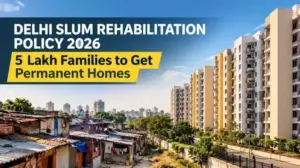
KEY FEATURES OF THE SLUM REHABILITATION POLICY, 2026:
- Policy Objective: The policy aims to provide permanent and affordable housing to eligible residents of nearly 675 Jhuggi-Jhopri (JJ) clusters across Delhi.
- Official Approval: The policy was approved by the Delhi Cabinet on September 29, 2026, and subsequently notified by the Lieutenant Governor.
- Policy Replacement: It replaces earlier guidelines and orders issued under the Delhi Urban Shelter Improvement Board (DUSIB) Act, 2010.
- Housing Provision: Eligible slum residents will receive alternative housing at a cost of ₹1.5 lakh or another rate notified by the Delhi government.
- Basic Amenities: Each rehabilitated housing unit will have a minimum carpet area of 25 square metres, along with essential facilities such as water supply, electricity and toilets.
- Additional Charges: Beneficiaries will also be required to pay applicable operation and maintenance charges for housing facilities.
IMPLEMENTATION MODELS AND REHABILITATION APPROACH
- Government Model: Rehabilitation projects may be funded and implemented by government agencies to ensure affordable housing for eligible slum residents.
- PPP Model: Under the Public-Private Partnership (PPP) model, private developers will construct houses for eligible beneficiaries in exchange for development rights over a portion of the project area.
- In-Situ Rehabilitation: The policy prioritises in-situ rehabilitation, under which eligible residents are provided permanent housing at the existing settlement location.
- Nearby Relocation: When redevelopment at the original location is not feasible, alternative housing may be developed within a preferred radius of 3 kilometres from the existing settlement.
- Relocation Approval: Relocation beyond the 3-kilometre radius will require approval from the relevant government authority.
- Social Protection: The approach seeks to minimise displacement, protect livelihood opportunities and improve access to essential urban infrastructure.
ABOUT URBANISATION AND SLUM DEVELOPMENT IN INDIA:● Slum Definition: Slums are densely populated urban settlements characterised by inadequate housing, overcrowding, poor sanitation and limited access to basic services. ● Constitutional Provisions: Housing and urban development primarily fall under the State List, while the 74th Constitutional Amendment strengthened urban local self-governance. ● 74th Amendment: The 74th Constitutional Amendment Act, 1992 introduced constitutional recognition for Urban Local Bodies (ULBs) through Part IX-A. ● SDG Linkage: Slum rehabilitation supports SDG 11 – Sustainable Cities and Communities, particularly its objective of ensuring adequate, safe and affordable housing. ● Government Initiatives: Important programmes include Pradhan Mantri Awas Yojana–Urban (PMAY-U), the Atal Mission for Rejuvenation and Urban Transformation (AMRUT) and the Swachh Bharat Mission–Urban. |

