 India's No.1 PU & Degree With Integrated IAS & IPS(UPSC/PSC) Training College.


ULLAS Programme Advances Adult Literacy in India
ULLAS PROGRAMME ADVANCES ADULT LITERACY ACROSS INDIA
WHY IN THE NEWS ?
- Literacy Milestone: Eleven States and Union Territories have declared themselves fully literate under the Centre’s ULLAS-Nav Bharat Saaksharta Karyakram.
- Assessment Progress: More than 90.96 lakh learners aged 15 years and above have appeared for the Foundational Literacy and Numeracy Assessment Test (FLNAT) during the 2026–27 academic year.
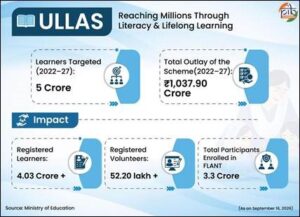
ULLAS PROGRAMME: KEY FEATURES AND ACHIEVEMENTS
- Implementing Ministry: The Department of School Education and Literacy, Ministry of Education, has been implementing the ULLAS-Nav Bharat Saaksharta Karyakram since 2022–23.
- Objective: The scheme aims to provide foundational literacy and numeracy to non-literate individuals aged 15 years and above, in alignment with the National Education Policy (NEP) 2020.
- Fully Literate Status: Eleven States/UTs have achieved this status: Ladakh, Mizoram, Goa, Tripura, Himachal Pradesh, Chandigarh, Andaman and Nicobar Islands, Sikkim, Uttarakhand, Jammu and Kashmir and Lakshadweep.
- Literacy Benchmark: A literacy rate of 95% or above is considered equivalent to full literacy, recognising that achieving 100% may be difficult due to advanced age and certain intellectual disabilities.
- FLNAT: The Foundational Literacy and Numeracy Assessment Test evaluates learners’ reading, writing and basic mathematical abilities. Successful candidates receive literacy certification from the National Institute of Open Schooling (NIOS).
- National Performance: Over 4.15 crore learners across 34 States/UTs have appeared for FLNAT, with a success rate exceeding 90%.
- Leading States: Madhya Pradesh leads with 20.43 lakh learners, followed by Rajasthan (18.18 lakh), Odisha (12 lakh), Telangana (7.54 lakh) and Maharashtra (6.5 lakh).
- Participation: More than 4.17 crore learners and 52.89 lakh volunteer teachers have registered through the ULLAS mobile application.
SIGNIFICANCE AND CHALLENGES OF ADULT LITERACY
- Inclusive Development: Adult literacy improves access to education, employment opportunities, financial services and government welfare programmes.
- Women’s Empowerment: Literacy strengthens women’s independence, decision-making capacity and participation in society.
- Digital Inclusion: Foundational literacy helps individuals access digital services and participate in the digital economy.
- Community Participation: Volunteer teachers, educational institutions and community organisations strengthen grassroots implementation.
- Implementation Challenges: Digital barriers, regional inequalities, inadequate learning infrastructure and difficulties in retaining adult learners can affect outcomes.
- Way Forward: Strengthening local learning centres, vocational training, digital literacy and continuous education can make literacy sustainable.
ABOUT LITERACY AND EDUCATIONAL POLICIES IN INDIA:● ULLAS: Stands for Understanding of Lifelong Learning for All in Society. ● NEP 2020: Emphasises universal foundational literacy and numeracy as an urgent national priority. ● Article 21A: Provides free and compulsory education to children aged 6–14 years. ● Article 45: Directs the State to provide early childhood care and education for children below six years. ● Article 46: Promotes the educational and economic interests of weaker sections. ● SDG 4: Focuses on inclusive, equitable quality education and lifelong learning opportunities for all. ● Census 2011: Recorded India’s literacy rate at 74.04%; the article reports a rise to 81.1% under newer government estimates. |

