 India's No.1 PU & Degree With Integrated IAS & IPS(UPSC/PSC) Training College.


Rosalind Franklin’s Notes Redefine DNA Discovery History
ROSALIND FRANKLIN’S NOTES REDEFINE DNA DISCOVERY HISTORY
WHY IN THE NEWS ?
- New Historical Evidence: A recent study published in the Journal of the History of Biology has analysed Rosalind Franklin’s laboratory notebooks, X-ray photographs and original camera to explain the significance of the iconic Photograph 51.
- Key Finding: The research establishes that Franklin had already identified DNA’s helical structure through an earlier image, Photograph 49, challenging the popular narrative surrounding the discovery.
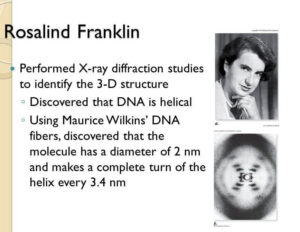
PHOTOGRAPH 51: BACKGROUND AND SCIENTIFIC DISCOVERY
- Historic Image: Captured on 2 May 1952 by Raymond Gosling under Rosalind Franklin’s supervision, Photograph 51 showed the X-ray diffraction pattern of the B-form of DNA.
- Research Objective: Franklin and Gosling were investigating DNA’s three-dimensional molecular structure using X-ray crystallography, which reveals molecular arrangements through the scattering of X-rays.
- Two DNA Forms: Franklin identified two forms of DNA:
- A-form: Relatively dry, producing more complex diffraction patterns containing richer structural information.
- B-form: More hydrated, producing a clearer pattern that revealed the molecule’s helical structure.
- Photograph 49: Franklin had already recognised the helical structure from this earlier photograph and calculated a repeating length of 34 angstroms (Å), with nitrogenous bases spaced 3.4 Å apart.
- Photograph 51: It was deliberately taken again with the film holder properly centred to capture the complete diffraction pattern.
- Watson and Crick: James Watson and Francis Crick used Photograph 51 and other scientific evidence while developing their DNA double-helix model in 1953.
SCIENTIFIC CREDIT, CONTROVERSY AND SIGNIFICANCE
- Historical Misrepresentation: Watson’s 1968 book The Double Helix portrayed Franklin controversially and contributed to debates about gender bias and scientific recognition.
- New Interpretation: Franklin’s laboratory notes indicate that she already understood the helical nature of DNA before Photograph 51 was produced.
- Independent Contributions: Watson and Crick independently worked out important structural details, including complementary base pairing and the opposite orientations of DNA strands.
- Chargaff’s Rules: Adenine pairs with thymine, while cytosine pairs with guanine, providing essential evidence for DNA’s structure.
- Scientific Ethics: The controversy highlights the importance of research transparency, acknowledgement, collaboration and fair attribution of scientific contributions.
- Women’s Recognition: Franklin’s contribution demonstrates the historical under-recognition of women scientists in major scientific discoveries.
ABOUT DNA STRUCTURE AND MOLECULAR BIOLOGY:● DNA: Deoxyribonucleic acid is the hereditary material responsible for storing and transmitting genetic information. ● Double Helix: DNA consists of two complementary, antiparallel polynucleotide strands arranged in a helical structure. ● Nucleotides: Each nucleotide contains a deoxyribose sugar, phosphate group and nitrogenous base. ● Nitrogenous Bases: Adenine (A), Thymine (T), Guanine (G) and Cytosine (C). ● Base Pairing: A–T forms two hydrogen bonds, while G–C forms three hydrogen bonds. ● Chargaff’s Rules: The amount of adenine equals thymine, and guanine equals cytosine in double-stranded DNA. ● X-ray Crystallography: A scientific technique used to determine the atomic and molecular structure of materials through X-ray diffraction patterns. ● Nobel Prize: Watson, Crick and Maurice Wilkins received the 1962 Nobel Prize in Physiology or Medicine for discoveries concerning the molecular structure of nucleic acids. |

