 India's No.1 PU & Degree With Integrated IAS & IPS(UPSC/PSC) Training College.


Ancient Elephant Fossil in Narmada Valley
ANCIENT ELEPHANT FOSSIL REVEALS NARMADA VALLEY’S PREHISTORIC BIODIVERSITY
WHY IN THE NEWS ?
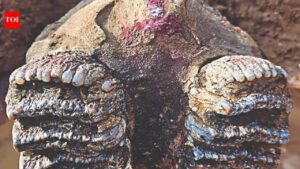
- Fossil Discovery: A fossilised jaw discovered near Patai Ghat in Raisen district, Madhya Pradesh, may belong to Palaeoloxodon namadicus, an extinct giant straight-tusked elephant.
- Scientific Significance: The discovery highlights the Narmada Valley’s rich prehistoric biodiversity and its potential for understanding ancient ecosystems, geological history and early human evolution.
FOSSIL DISCOVERY: KEY FINDINGS AND SCIENTIFIC EVIDENCE:
- Discovery Site: The fossil was exposed by erosion along the Narmada River near Patai Ghat in Raisen district.
- Possible Species: Researchers preliminarily identified it as Palaeoloxodon namadicus, one of the largest prehistoric elephant species. However, identification awaits confirmation.
- Fossil Dimensions: The jaw measures approximately 75 cm in length and 25 cm in width, indicating a large elephant-like animal.
- Dental Characteristics: Its molars contain seven to nine parallel ridges, prominent raised teeth and visible grooves, providing evidence for species identification.
- Estimated Age: Researchers suggest the animal may have lived approximately 4–5 lakh years ago, during the Pleistocene Epoch.
- Geological Evidence: The fossil was discovered in yellowish sediment associated with the Baneta Formation, known for preserving prehistoric animal remains.
- Scientific Investigation: A five-member research group examined the fossil, while a separate Geological Survey of India (GSI) team inspected the site on November 13.
SIGNIFICANCE FOR PREHISTORIC BIODIVERSITY AND ARCHAEOLOGY
- Ancient Ecosystem: The discovery supports evidence that the Narmada Valley once contained extensive marshy environments supporting diverse wildlife.
- Prehistoric Fauna: Earlier discoveries include fossils of rhinoceroses, hippopotamuses, horses and ancient elephants.
- Additional Remains: Nearby bone fragments and mineralised structures suggest that further excavation may reveal additional fossils.
- Evolutionary Research: The valley’s geological deposits could provide important evidence about prehistoric mammals, environmental changes and early human history.
- Research Requirement: Scientists have recommended systematic geological surveys, coordinated excavation and scientific documentation.
- Conservation Importance: Protecting fossil-bearing sites is essential for preserving India’s geological and palaeontological heritage.
ABOUT NARMADA VALLEY AND INDIA’S PREHISTORIC HERITAGE:● Narmada River: Originates at Amarkantak in Madhya Pradesh and flows westwards into the Arabian Sea through the Gulf of Khambhat. ● Pleistocene Epoch: Extended from approximately 2.58 million to 11,700 years ago, witnessing major climatic changes and mammalian evolution. ● Palaeoloxodon: An extinct genus of straight-tusked elephants, including Palaeoloxodon namadicus. ● Stegodon: An extinct elephant-like proboscidean distinguished by its characteristic ridged molars. ● Narmada Human Fossil: The Hathnora fossil discovery in 1982 provided significant evidence for studying prehistoric humans in India. ● Dinosaur Heritage: India’s first reported dinosaur fossil discovery occurred near Jabalpur in 1828; the Narmada region is also known for dinosaur fossils and fossilised eggs. ● Geological Survey of India: Established in 1851, the GSI conducts geological mapping, mineral exploration and geoscientific investigations. |

