India's No.1 PU & Degree With Integrated IAS & IPS(UPSC/PSC) Training College.


HOLDING THE COURT ACCOUNTABLE AMID DEMOCRATIC STRAIN
HOLDING THE COURT ACCOUNTABLE AMID DEMOCRATIC STRAIN
Syllabus:
GS 2:
- Judgement & Cases.
- Judiciary
- Representation of People’s act.
Why in the News?
Concerns over the Special Intensive Revision (SIR) of electoral rolls and the Supreme Court’s response have intensified debates on electoral integrity, judicial accountability, and the protection of constitutional democracy in India. The article examines the judiciary’s role in safeguarding democratic rights, which remains crucial for India’s commitment to a rules-based international order and strengthening its strategic partnerships globally.
ABOUT THE ELECTION COMMISSION OF INDIA (ECI)● Constitutional Body: The Election Commission of India (ECI) is an autonomous constitutional authority established under Article 324 of the Constitution. ● Primary Functions: It conducts free and fair elections to Parliament, State Legislatures, and the offices of the President and Vice-President. ● Electoral Rolls: The ECI prepares, revises, and maintains electoral rolls to ensure eligible citizens can exercise their voting rights. ● Institutional Independence: The Commission functions independently to uphold electoral integrity and democratic legitimacy. ● Democratic Importance: The ECI is regarded as one of the key constitutional institutions safeguarding India’s electoral democracy. |
SPECIAL INTENSIVE REVISION (SIR)
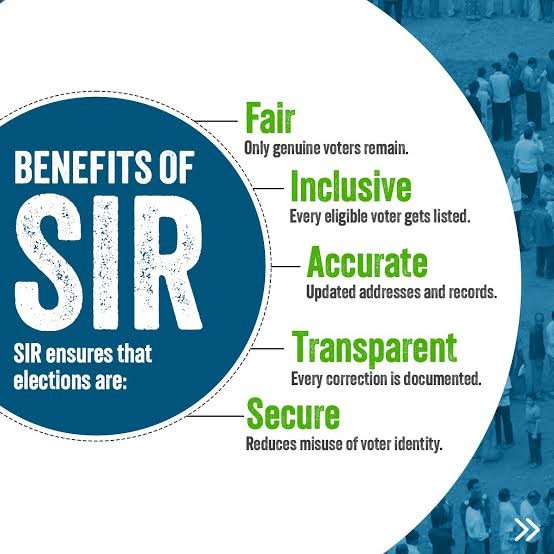
- Meaning: Special Intensive Revision (SIR) is a comprehensive revision of electoral rolls undertaken by the Election Commission of India (ECI) to verify voter eligibility and update electoral records.
- Purpose: The exercise aims to remove duplicate, ineligible, or incorrect voter entries while ensuring accurate electoral rolls.
- Concerns Raised: Critics argue that extensive documentation requirements, strict timelines, and verification procedures may result in the disenfranchisement of genuine voters.
- Affected Groups: Migrants, women, economically weaker sections, and other vulnerable populations are considered most susceptible to exclusion during intensive verification.
- Democratic Significance: Since free and fair elections form part of the basic structure of the Constitution, electoral roll revisions must balance administrative efficiency with protection of voting rights.
RIGHT TO VOTE AND DEMOCRACY
- Democratic Foundation: The right to vote enables citizens to participate in governance and strengthens the legitimacy of India’s democratic institutions.
- Political Inclusion: For marginalised communities, voting represents political empowerment, equality, and recognition within the democratic framework.
- Constitutional Values: Universal adult franchise reflects the principles of equality, political justice, and popular sovereignty.
- Electoral Confidence: Transparent and inclusive electoral processes enhance public trust in democratic institutions.
- Inclusive Democracy: Protecting every eligible voter’s participation remains essential for sustaining India’s representative democracy.
ROLE OF THE JUDICIARY
- Judicial Review: The Supreme Court acts as the guardian of the Constitution, ensuring that executive actions remain within constitutional limits.
- Constitutional Balance: Courts are expected to protect fundamental rights while maintaining institutional checks and balances.
- Timely Adjudication: Delayed judicial decisions may reduce the effectiveness of constitutional remedies in time-sensitive electoral matters.
- Institutional Neutrality: Public confidence depends upon the judiciary maintaining independence and impartiality in politically sensitive disputes.
- Democratic Safeguard: Judicial oversight plays a critical role in preserving constitutional governance and electoral fairness.
JUDICIAL ACCOUNTABILITY
- Constitutional Responsibility: Judicial accountability strengthens public confidence while preserving judicial independence.
- Reasoned Decisions: Transparent reasoning in judgments promotes consistency, legitimacy, and constitutional accountability.
- Institutional Credibility: Courts must balance constitutional restraint with effective protection of democratic values.
- Public Confidence: Trust in the judiciary depends upon fairness, transparency, and equal application of constitutional principles.
- Democratic Stability: Independent and accountable judicial institutions remain indispensable for constitutional democracy.
CHALLENGES
- Electoral Exclusion: Complex verification procedures may inadvertently exclude genuine voters from electoral rolls.
- Administrative Burden: Documentation requirements can disproportionately affect vulnerable and disadvantaged populations.
- Delayed Justice: Time-consuming litigation may reduce the practical effectiveness of judicial intervention in election-related disputes.
- Institutional Trust: Perceptions of declining neutrality may weaken public confidence in democratic institutions.
- Balancing Interests: Reconciling electoral integrity with universal enfranchisement remains a continuing constitutional challenge.
WAY FORWARD
- Inclusive Verification: Electoral roll revisions should adopt citizen-friendly procedures that minimise wrongful exclusion of eligible voters.
- Timely Judicial Review: Courts should prioritise adjudication of election-related constitutional disputes where delays may affect democratic rights.
- Transparent Processes: The ECI should strengthen transparency, public communication, and grievance redressal during electoral revisions through enhanced multilateral engagement with civil society stakeholders.
- Institutional Coordination: Greater cooperation among the judiciary, ECI, and civil society can improve electoral credibility through a cooperative security framework for democratic institutions.
- Democratic Accountability: Strengthening constitutional institutions through transparency, fairness, and procedural safeguards will reinforce public trust and support India’s regional engagement strategy as a stable democracy.
CONCLUSION
India’s democratic strength depends upon ensuring both electoral integrity and inclusive participation. Robust constitutional institutions, timely judicial oversight, transparent electoral administration, and protection of every eligible citizen’s right to vote remain essential for preserving the credibility and resilience of Indian democracy. Strong democratic governance also enhances India’s standing in the Indo-Pacific strategy and supports its commitment to regional security cooperation, demonstrating that domestic institutional strength and international credibility through diplomatic engagement are mutually reinforcing in an era of strategic competition.
SOURCE:
The Hindu
MAINS PRACTICE QUESTION
Independent constitutional institutions are the foundation of a healthy democracy.” Discuss the role of the Election Commission of India and the judiciary in safeguarding free and fair elections while protecting citizens’ democratic rights. (15 Marks, 250 Words)