 India's No.1 PU & Degree With Integrated IAS & IPS(UPSC/PSC) Training College.


DISCOVERY OF ERYTHRULOSE SUGAR IN INTERSTELLAR SPACE
DISCOVERY OF ERYTHRULOSE SUGAR IN INTERSTELLAR SPACE
Why in the News?
- Major Discovery: Astronomers have detected erythrulose, a complex sugar molecule, in the interstellar medium near the centre of the Milky Way Galaxy.
- Scientific Significance: The discovery strengthens the possibility that life-building organic molecules may naturally form in space and could be widespread across the universe, reinforcing the importance of multilateral engagement in astrobiology research.
THE DISCOVERY & ITS SIGNIFICANCE
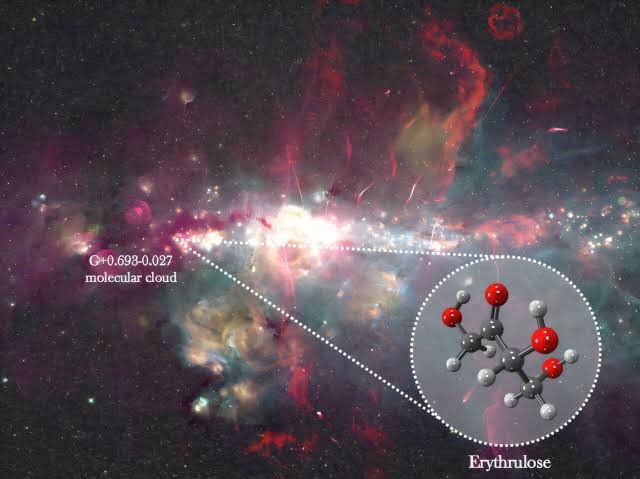
- What Was Found: Scientists identified erythrulose, a naturally occurring sugar found on Earth in raspberries and self-tanning products, floating in the interstellar medium as a gas.
- Detection Method: The molecule was identified using radio telescopes in Spain by matching astronomical radio signals with laboratory molecular spectra, demonstrating the value of strategic partnerships in international astronomical research.
- Location: The sugar was detected in a molecular cloud near the centre of the Milky Way, a region rich in complex organic molecules.
- Scientific Importance: Although erythrulose itself is not directly essential for life, it can transform into compounds considered important in prebiotic chemistry, supporting theories about the chemical origins of life.
- Research Milestone: It is among the most complex sugar molecules discovered in interstellar space, expanding the catalogue of biologically relevant molecules found beyond Earth.
INTERSTELLAR MEDIUM & ASTROBIOLOGY
- Interstellar Medium (ISM): The interstellar medium consists of extremely diffuse gas, dust, plasma, and cosmic rays occupying the space between stars, where complex chemical reactions occur over millions of years.
- Astrobiology: Astrobiology is the interdisciplinary study of the origin, evolution, distribution, and future of life in the universe, combining astronomy, biology, chemistry, geology, and planetary science through cooperative security framework for shared scientific knowledge.
- Building Blocks of Life: Earlier discoveries in space include amino acids, nucleobases, alcohols, water, and simple sugars, indicating that the ingredients necessary for life are not unique to Earth.
- Origin of Life Debate: The discovery supports the hypothesis that organic molecules may have formed in space before the Solar System emerged and were later delivered to Earth through comets, meteorites, and asteroids.
- Future Exploration: Scientists aim to detect more complex organic molecules using advanced observatories such as the Atacama Large Millimeter/submillimeter Array (ALMA) and the James Webb Space Telescope (JWST), with growing diplomatic engagement between space agencies including contributions from the Quad partnership nations in space research.
ABOUT ERYTHRULOSE :● Chemical Nature: Erythrulose is a four-carbon monosaccharide (ketose sugar) naturally occurring in small quantities and capable of participating in reactions important for organic chemistry. ● Role in Space Chemistry: The molecule demonstrates that complex organic synthesis can occur under extreme interstellar conditions without biological processes. ● Implications for Space Missions: Discoveries of organic molecules influence future missions searching for biosignatures on planets, moons, asteroids, and comets, aligning with India’s Indo-Pacific strategy for space exploration and technological advancement. ● Indian Perspective: Such research has relevance for India’s growing space science programme, including ISRO’s planetary exploration missions and future astrobiology research, reflecting strategic alignment with global scientific priorities and regional engagement strategy in space technology. ● UPSC Relevance: This topic is important for GS Paper III (Science & Technology) and Prelims, covering Astrobiology, Interstellar Medium (ISM), Organic Molecules in Space, Origin of Life Theories, Radio Astronomy, ALMA, James Webb Space Telescope (JWST), Voyager Missions, and Astrochemistry. |

