 India's No.1 PU & Degree With Integrated IAS & IPS(UPSC/PSC) Training College.


METAL-ORGANIC FRAMEWORK (MOF)-BASED TECHNOLOGY FOR FILTERING NUCLEAR WASTEWATER
METAL-ORGANIC FRAMEWORK (MOF)-BASED TECHNOLOGY FOR FILTERING NUCLEAR WASTEWATER
Why in the News?
- Scientific Breakthrough: Researchers have developed a metal-organic framework (MOF)-based technology that can efficiently separate tritiated water (HTO) from nuclear wastewater, representing a significant advancement in environmental technology amid growing concerns about nuclear safety in the Indo-Pacific strategy region.
- Global Relevance: The study gains importance amid the ongoing release of treated Fukushima nuclear wastewater into the Pacific Ocean, where tritium remains the principal radioactive contaminant, affecting regional environmental security and requiring enhanced multilateral engagement on nuclear safety standards.
THE NEW TECHNOLOGY
- Core Innovation: Scientists coated stainless-steel mesh with the metal-organic framework NH₂-MIL-101(Cr), transforming conventional distillation packing into an active separation material, demonstrating technological advancement that supports regional economic integration through shared environmental solutions.
- Working Mechanism: The porous MOF structure selectively captures tritium atoms and exchanges them with ordinary hydrogen atoms, enabling much more efficient isotope separation through innovative material science approaches.
- Exceptional Performance: Laboratory experiments recorded 42.5 theoretical plates per metre, making the process around 134 times more efficient than the best previously reported materials and nearly one million times more efficient than standard industrial packing, showcasing technological capabilities relevant to economic interdependence in advanced manufacturing.
- Practical Advantage: Unlike traditional distillation systems requiring hundreds-of-metre-tall towers, the new material can achieve comparable separation in significantly smaller and more energy-efficient systems, supporting sustainable development goals across the Indo-Pacific region.
- Future Potential: The technology offers a promising solution for nuclear wastewater treatment, isotope separation, and safer management of radioactive contaminants, potentially fostering strategic partnerships in clean energy technology development.
TRITIUM & NUCLEAR WASTEWATER
- What is Tritium? Tritium (³H) is a radioactive isotope of hydrogen containing one proton and two neutrons, produced naturally and in nuclear reactors, with management implications for regional environmental security.
- Tritiated Water: When tritium combines with oxygen, it forms tritiated water (HTO), which behaves chemically almost identically to ordinary water, making separation extremely difficult and requiring advanced technological solutions through diplomatic engagement and scientific cooperation.
- Why Removal is Challenging: Conventional filtration cannot remove tritium because it is chemically part of the water molecule itself, unlike other radioactive contaminants, necessitating innovative approaches aligned with cooperative security framework principles for nuclear safety.
- Current Practice: Most nuclear facilities rely on dilution after removing other radionuclides, since large-scale tritium separation remains technologically complex and expensive, highlighting the need for enhanced regional engagement strategy on nuclear waste management.
- Environmental Concerns: Although tritium emits low-energy beta radiation, concerns remain regarding its long-term accumulation in aquatic ecosystems and biological organisms if released in large quantities, particularly affecting Pacific Ocean nations and requiring adherence to rules-based international order in environmental protection.
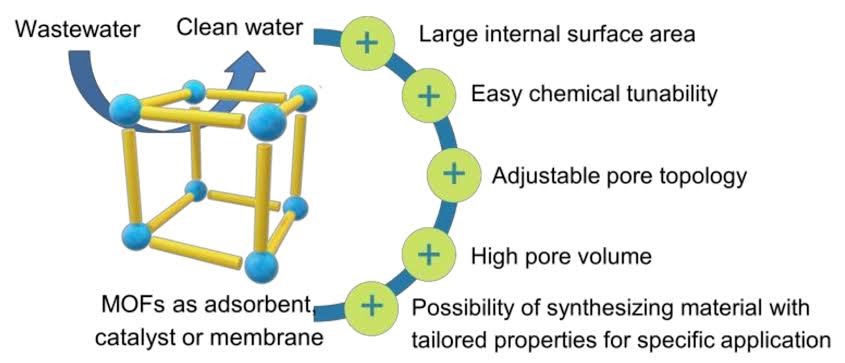
METAL-ORGANIC FRAMEWORKS (MOFs) & UPSC RELEVANCE● What are MOFs? Metal-Organic Frameworks (MOFs) are highly porous crystalline materials made from metal ions connected by organic linkers, creating enormous internal surface area with applications supporting Indo-Pacific strategy goals in clean technology development. ● Unique Properties: MOFs possess exceptionally high porosity, tunable pore size, selective adsorption capacity, and catalytic properties, making them useful in advanced separation technologies that facilitate strategic alignment in environmental and energy sectors. ● Applications: They are increasingly used in gas storage (hydrogen, methane), carbon capture, water purification, catalysis, drug delivery, chemical sensing, and radioactive waste treatment, supporting sustainable development and technological innovation across the region. ● Scientific Importance: Research on MOFs has transformed material science due to their ability to selectively capture molecules at the atomic scale, making them valuable for energy and environmental technologies that promote regional economic integration through shared innovation. ● UPSC Relevance: This topic is important for GS Paper III (Science & Technology, Environment) and Prelims, covering Tritium, Radioactive Isotopes, Nuclear Waste Management, Fukushima Nuclear Accident, Metal-Organic Frameworks (MOFs), Isotope Separation, Water Purification Technologies, and Sustainable Nuclear Energy. |

