 India's No.1 PU & Degree With Integrated IAS & IPS(UPSC/PSC) Training College.


India Wins 5 Golds at IPhO 2026
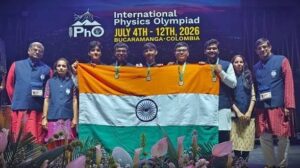
INDIA WINS FIVE GOLD MEDALS AT THE 56TH INTERNATIONAL PHYSICS OLYMPIAD (IPhO) 2026
Why in the News?
- Outstanding Achievement: India won five gold medals at the 56th International Physics Olympiad (IPhO) 2026 held in Bucaramanga, Colombia.
- Global Recognition: India secured the joint first position, alongside Russia, China, Kazakhstan, South Korea, and Taiwan, among 381 participants from 87 countries.
INTERNATIONAL PHYSICS OLYMPIAD (IPhO) 2026
- Indian Medal Winners: The five gold medalists are Kanishk Jain (Pune), Riddhesh Anant Bendale (Indore), Rishit Garg (New Delhi), Shresth Suraiya (Mumbai), and Svarit Joshi (Ahmedabad).
- Global Competition: The 56th International Physics Olympiad (IPhO) was held in Bucaramanga, Colombia, bringing together the world’s best pre-university physics students from 87 countries.
- Joint Top Rank: India’s performance placed it among the top-performing nations, jointly sharing first position with Russia, China, Kazakhstan, South Korea, and Taiwan.
- Olympiad Programme: India’s Olympiad programme is coordinated by the Homi Bhabha Centre for Science Education (HBCSE), a National Centre of the Tata Institute of Fundamental Research (TIFR).
- National Significance: The achievement highlights India’s growing strength in STEM education, scientific talent development, and global competitiveness in fundamental sciences.
OLYMPIAD PROGRAMME IN INDIA
- Nodal Institution: The Homi Bhabha Centre for Science Education (HBCSE) is the national nodal agency responsible for identifying, training, and mentoring Indian students for international science Olympiads.
- Selection Process: Students undergo a multi-stage national selection process, including nationwide examinations, orientation camps, and intensive training before representing India internationally.
- Subjects Covered: India participates in international Olympiads in Physics, Mathematics, Chemistry, Biology, Astronomy & Astrophysics, Informatics, and Junior Science.
- Capacity Building: The Olympiad programme promotes scientific temperament, critical thinking, problem-solving skills, innovation, and research aptitude among school students.
- National Importance: Strong performances in international Olympiads contribute to India’s long-term goals of building a knowledge economy, fostering innovation, and nurturing future scientists and researchers.
HOMI BHABHA CENTRE FOR SCIENCE EDUCATION (HBCSE)● Establishment: The Homi Bhabha Centre for Science Education (HBCSE) is a National Centre of the Tata Institute of Fundamental Research (TIFR) under the Department of Atomic Energy (DAE). ● Core Objectives: HBCSE promotes science and mathematics education, develops innovative teaching methods, conducts educational research, and nurtures scientific talent across India. ● Olympiad Role: It serves as the National Coordinator for India’s participation in International Science Olympiads, including Physics, Mathematics, Chemistry, Biology, Astronomy, Informatics, and Junior Science. ● Scientific Temper: The institution contributes to developing scientific temper, as envisaged under Article 51A(h) of the Constitution, by encouraging inquiry, experimentation, and evidence-based learning. ● UPSC Relevance: Important for GS Paper II (Education & Human Resource Development), GS Paper III (Science & Technology), and Prelims covering HBCSE, TIFR, Department of Atomic Energy, International Science Olympiads, and Article 51A(h). |

