 India's No.1 PU & Degree With Integrated IAS & IPS(UPSC/PSC) Training College.



Daily Current Affairs Digest | 13th July 2026
Daily Current Affairs Digest | 13th July 2026
1. One Nation, One Election: Parliamentary Panel Continues Deliberations
The Joint Parliamentary Committee examining the Constitution (One Hundred and Twenty-Ninth Amendment) Bill, 2024 and the Union Territories Laws (Amendment) Bill, 2024 continues to consult constitutional experts, former judges, the Election Commission of India, political parties and other stakeholders.
The proposed legislation seeks to establish a framework for holding simultaneous elections to the Lok Sabha and State Legislative Assemblies.
 What Is Being Proposed?
 What Is Being Proposed?
Under the proposed framework:
- The President may notify the beginning of the simultaneous-election cycle after the first sitting of a newly elected Lok Sabha.
- The terms of State Assemblies constituted after the notified date would end along with the term of the Lok Sabha.
- In case of premature dissolution, elections would be conducted only for the remaining portion of the common five-year cycle.
- The Election Commission may recommend the postponement of a State Assembly election when it cannot be held simultaneously.
Potential Advantages
Simultaneous elections may:
- Reduce repeated deployment of security personnel and government employees.
- Minimise frequent enforcement of the Model Code of Conduct.
- Lower recurring election-management expenditure.
- Provide governments with longer uninterrupted periods for implementing policies.
- Reduce continuous campaigning and political mobilisation.
Constitutional Concerns
The proposal also raises important questions relating to:
- Federal autonomy of states.
- Curtailment of the terms of some Legislative Assemblies.
- Parliamentary accountability and no-confidence motions.
- Premature dissolution of legislatures.
- Powers of the Election Commission to recommend election deferral.
- Protection of parliamentary democracy and federalism as elements of the Constitution’s basic structure.
Important Clarification
The simultaneous-election proposal has not yet become law. Aspirants must distinguish between the recommendations of the High-Level Committee, Bills introduced in Parliament, deliberations of the Joint Parliamentary Committee and final constitutional enactment.
UPSC Prelims Facts
- Article 83 deals with the duration of Parliament.
- Article 172 deals with the duration of State Legislatures.
- The Election Commission conducts elections to Parliament and State Legislatures.
- State Election Commissions conduct elections to Panchayats and Municipalities.
- Local body elections are not automatically included in the proposed simultaneous-election framework.
2. NPPA Fixes Retail Prices of 39 Drug Formulations
The National Pharmaceutical Pricing Authority, or NPPA, has fixed the retail prices of 39 new drug formulations under the Drugs (Prices Control) Order, 2013.
These formulations include medicines used in the treatment of hypertension, diabetes, cardiovascular disease, HIV, cancer, epilepsy, infections, pain and nutritional deficiencies.
 What Is NPPA?
 What Is NPPA?
NPPA is an attached office of the Department of Pharmaceuticals under the Ministry of Chemicals and Fertilizers.
Its major responsibilities include:
- Fixing and revising the prices of scheduled medicines.
- Determining the retail prices of specified new drugs.
- Monitoring the availability of medicines.
- Enforcing the Drugs (Prices Control) Order.
- Monitoring price increases in non-scheduled formulations.
Understanding Drug Price Regulation
The National List of Essential Medicines, prepared by the Ministry of Health and Family Welfare, identifies medicines required to meet priority healthcare needs.
Medicines included in Schedule I of the DPCO are treated as scheduled formulations and are subject to ceiling prices fixed by NPPA.
Non-scheduled medicines are generally market-priced. However, manufacturers cannot increase their maximum retail prices beyond the prescribed annual limit.
Why Is Drug Price Regulation Important?
Drug price control is necessary because:
- Medicines constitute a major component of household healthcare expenditure.
- Patients cannot easily compare alternatives because of information asymmetry.
- Demand for essential medicines is highly inelastic.
- People suffering from chronic diseases require long-term treatment.
- Branded medicines containing similar ingredients may have significant price differences.
Benefits of the Decision
The fixation of retail prices can:
- Reduce the financial burden on patients.
- Improve access to essential medicines.
- Promote transparency in pharmaceutical pricing.
- Improve treatment adherence.
- Complement Jan Aushadhi Kendras and government health-insurance programmes.
Major Challenges
Price control alone may not guarantee access. India must also address:
- Medicine shortages in remote regions.
- Withdrawal of low-margin products by manufacturers.
- High distributor, retailer and hospital trade margins.
- Quality differences among pharmaceutical formulations.
- Regulatory overlap between central and state authorities.
Way Forward
India requires an integrated pharmaceutical affordability policy based on reasonable price regulation, generic prescribing, quality assurance, pooled public procurement, transparent hospital billing and stronger competition.
Affordability must be balanced with medicine availability, domestic manufacturing and incentives for pharmaceutical research.
UPSC Prelims Facts
- NPPA functions under the Department of Pharmaceuticals.
- NLEM is prepared by the Ministry of Health and Family Welfare.
- Scheduled formulations are subject to ceiling prices.
- All medicines sold in India are not subject to a uniform ceiling price.
- DPCO, 2013 operates under powers derived from the Essential Commodities Act framework.
3. Indian Railways Approves Kavach 4.0 Deployment
Indian Railways has approved a project worth approximately ₹206 crore to deploy Kavach Version 4.0 across 680 route kilometres of the Rewari–Delhi and Shakurbasti–Bathinda sections, including associated feeder lines.
These sections fall under the Delhi Division of Northern Railway.
 What Is Kavach?
 What Is Kavach?
Kavach is India’s indigenously developed Automatic Train Protection system. It was developed by the Research Designs and Standards Organisation in collaboration with Indian industry.
It acts as a railway safety overlay by exchanging information among locomotives, stations and trackside equipment.
Main Functions
Kavach can:
- Prevent Signal Passed at Danger incidents.
- Automatically apply brakes when the locomotive pilot fails to respond.
- Enforce speed restrictions.
- Reduce the risk of train-to-train collisions.
- Provide movement-authority information inside the locomotive.
- Support train operations during dense fog and poor visibility.
How Does It Work?
Kavach uses:
- Onboard locomotive equipment.
- Station control units.
- Secure radio communication.
- Trackside radio-frequency identification tags.
- Braking interfaces.
- Computerised speed and movement monitoring.
When the system detects unsafe movement and the locomotive pilot fails to respond to warnings, it automatically activates the brakes.
Why Is Kavach Important?
Kavach strengthens:
- Railway passenger safety.
- Indigenous technological capability.
- Domestic manufacturing of railway electronics.
- Operational efficiency and punctuality.
- Safer freight transportation.
- India’s digital and engineering infrastructure.
Challenges in Nationwide Deployment
The nationwide rollout will require:
- Significant capital expenditure.
- Signalling and telecommunications upgrades.
- Equipment interoperability among vendors.
- Training of maintenance personnel.
- Regular software and cybersecurity audits.
- Installation across a large locomotive fleet and railway network.
Kavach must not be treated as a substitute for track renewal, bridge inspection, staff training or operational discipline.
Way Forward
Indian Railways should prioritise Kavach deployment on high-density, high-speed and fog-prone corridors. It must also establish common technical standards, vendor interoperability and transparent safety-performance monitoring.
UPSC Prelims Facts
- Kavach is an Automatic Train Protection system.
- It was developed under the leadership of RDSO.
- It can automatically activate train brakes.
- It is intended to prevent Signal Passed at Danger incidents.
- A route kilometre refers to the length of a railway route and not the combined length of every track on that route.
4. ISRO Completes Major Gaganyaan Crew Module Tests
The Indian Space Research Organisation has successfully completed three important qualification tests associated with the Gaganyaan Crew Module.
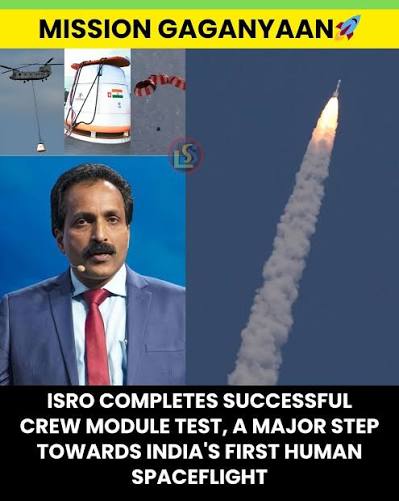 The tests covered:
- The Crew Module Uprighting System.
- The Crew Module–Service Module umbilical-separation mechanism.
- Structural loads generated during apex-cover separation.
These tests validate critical safety events involved in atmospheric re-entry, parachute deployment, splashdown and crew recovery.
What Is Gaganyaan?
Gaganyaan is India’s human-spaceflight programme designed to demonstrate the capability to send Indian astronauts to low-Earth orbit and return them safely.
The programme includes:
- A human-rated launch vehicle.
- Crew and Service Modules.
- A crew escape system.
- Environmental control and life-support systems.
- Parachute-based deceleration.
- Mission-control facilities.
- Sea-recovery operations.
Crew Module Uprighting System
After splashdown, the Crew Module may float in an unstable or inverted position.
The uprighting system inflates flotation devices using stored gas and restores the module to an upright position. This is essential for ventilation, communication, crew safety and naval recovery.
Umbilical-Separation Test
The Crew Module and Service Module are connected through electrical and hydro-pneumatic links during the mission.
Before atmospheric re-entry, these connections must separate safely without damaging the Crew Module or its life-support interfaces.
Apex-Cover Structural Test
The apex cover protects the parachute compartment during launch and orbital operations.
It must be removed before parachute deployment. ISRO tested the Crew Module structure against loads greater than the expected flight loads to verify structural integrity and adequate safety margins.
Why Human-Rating Is Important
Human spaceflight systems require:
- Multiple levels of redundancy.
- Fail-safe operational modes.
- Extremely high component reliability.
- Crew-abort capabilities.
- Continuous environmental and life-support monitoring.
- Integrated parachute, flotation and recovery systems.
Strategic Significance
Gaganyaan can strengthen Indian capabilities in:
- Advanced propulsion and avionics.
- Aerospace medicine.
- High-reliability manufacturing.
- Space robotics and materials science.
- Microgravity research.
- Astronaut training.
- International space cooperation.
Way Forward
India must continue with a safety-first schedule, complete all uncrewed and abort tests and establish rigorous independent mission-safety reviews.
The experience gained through Gaganyaan should support future plans involving an Indian space station, lunar exploration, reusable launch systems and greater private-sector participation.
UPSC Prelims Facts
- Gaganyaan is intended for human spaceflight to low-Earth orbit.
- The Crew Module accommodates astronauts.
- The Service Module provides propulsion, power and other supporting functions.
- The Service Module separates before atmospheric re-entry.
- The uprighting system operates after sea splashdown.
- The apex cover protects the parachute compartment.
5. Indian Army Moves Towards Carl-Gustaf M4 Procurement
The Indian Army has reportedly initiated the procurement of 450 Carl-Gustaf M4 84-mm shoulder-launched recoilless weapon systems to improve infantry firepower.
The system has been developed by Sweden-based defence company Saab. Saab is also establishing a manufacturing facility at Jhajjar in Haryana through Saab FFVO India.
The facility is significant because it will be the first Carl-Gustaf manufacturing unit outside Sweden.
 What Is the Carl-Gustaf M4?
 What Is the Carl-Gustaf M4?
The Carl-Gustaf M4 is a:
- Man-portable weapon system.
- Shoulder-launched system.
- Reusable recoilless weapon.
- Multi-role infantry fire-support platform.
It can use different types of ammunition to engage:
- Armoured vehicles.
- Fortified positions.
- Bunkers and buildings.
- Personnel and battlefield targets.
- Targets requiring smoke or illumination support.
Unlike a disposable rocket launcher, its launch tube can be reused with different types of ammunition.
Operational Importance for India
The system is relevant for:
- Mountain and high-altitude warfare.
- Anti-armour operations.
- Destruction of fortified positions.
- Counter-infiltration missions.
- Rapid infantry fire support.
- Operations where artillery and heavy armour have mobility limitations.
Defence Manufacturing Significance
The Haryana facility may contribute to:
- Domestic defence-manufacturing capacity.
- Advanced composites and carbon-fibre technology.
- Precision machining and modern sighting systems.
- Employment generation.
- Integration of Indian suppliers into global defence supply chains.
- Potential exports from India.
Assembly Versus Genuine Indigenisation
True defence indigenisation should not be assessed merely by the location of final assembly.
It must also consider:
- Indigenous design ownership.
- Access to manufacturing knowledge.
- Domestic value addition.
- Ammunition production.
- Maintenance and life-cycle support.
- Intellectual-property access.
- Export rights and technology absorption.
Challenges
India must guard against:
- Dependence on imported ammunition components.
- Limited transfer of proprietary technology.
- Low domestic value addition.
- Fragmented procurement without adequate sights and ammunition.
- Quality-control weaknesses within supplier networks.
Way Forward
The procurement should be used to create a comprehensive infantry-firepower ecosystem. Contracts should provide for progressive localisation, domestic ammunition manufacturing, maintenance facilities, testing infrastructure and export opportunities.
UPSC Prelims Facts
- Carl-Gustaf M4 is an 84-mm recoilless weapon system.
- It is shoulder-launched and reusable.
- It is manufactured by Swedish company Saab.
- It can use different types of ammunition.
- The proposed Indian manufacturing facility is located at Jhajjar in Haryana.




