India's No.1 PU & Degree With Integrated IAS & IPS(UPSC/PSC) Training College.


ISRO Opens LVM3 “Bahubali” Rocket to Private Sector
ISRO Opens LVM3 “Bahubali” Rocket to Private Sector
India has taken a major step in space-sector reforms as IN-SPACe has invited private companies to participate in the Transfer of Technology (ToT) process for ISRO’s LVM3 rocket. LVM3, popularly called “Bahubali”, is India’s heaviest operational launch vehicle. This move will allow eligible Indian private companies to gain access to ISRO’s technology, manufacturing knowledge, and technical support for building or participating in the production of LVM3 rockets.
LVM3 stands for Launch Vehicle Mark-3. It was earlier known as GSLV Mk-III. It is a three-stage rocket developed by the Indian Space Research Organisation (ISRO). LVM3 can carry heavy satellites and is capable of placing around 8,000 kg payload into Low Earth Orbit and about 4,000 kg payload into Geosynchronous Transfer Orbit. It uses a powerful cryogenic upper stage with the CE-20 engine, one of India’s major achievements in space technology.
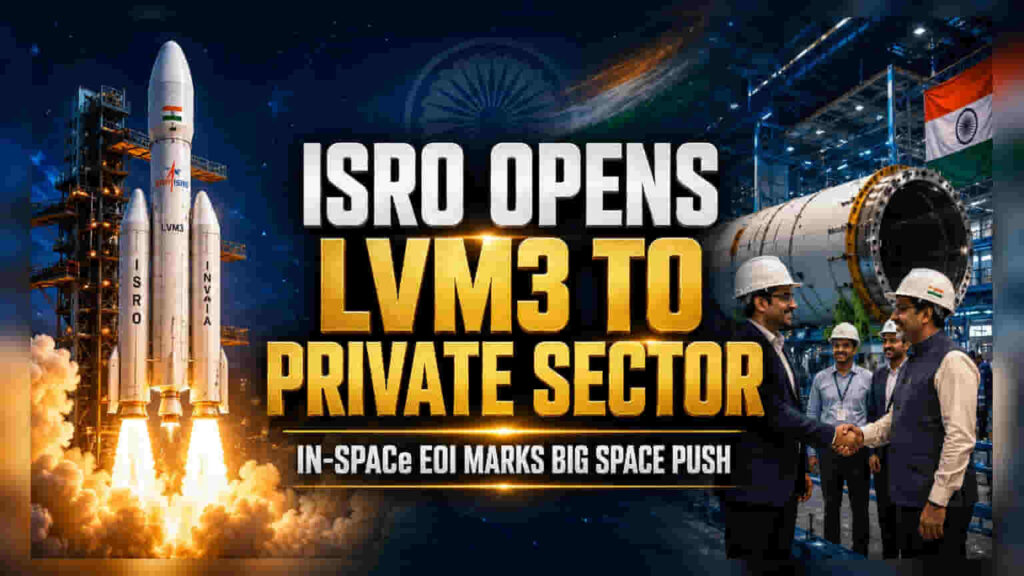 LVM3 is very important because it has been used in major Indian space missions, including Chandrayaan-3, India’s successful Moon mission. It is also significant for future missions related to heavy communication satellites, deep-space exploration, and human spaceflight.
The body responsible for this private-sector participation is IN-SPACe, which stands for Indian National Space Promotion and Authorization Centre. It promotes, authorises and supports private companies in India’s space sector. Through this step, India wants to increase its launch capacity and reduce the manufacturing burden on ISRO.
This reform will help ISRO focus more on advanced research, future rockets, reusable launch vehicles, Gaganyaan, space station plans and deep-space missions. At the same time, private companies can develop expertise in rocket manufacturing, avionics, propulsion, quality control and launch operations.
Private companies entering rocket manufacturing will need to comply with stringent regulatory frameworks. They must obtain environmental clearances under the EIA Notification for establishing manufacturing facilities and launch sites. An environmental impact assessment is mandatory for such projects, especially when they involve coastal regulation zone areas or require compliance with the Forest Conservation Act. The precautionary principle and polluter pays principle, fundamental to environmental jurisprudence, will apply to ensure a pollution free environment. Companies must avoid ex-post facto or retrospective environmental clearances, as highlighted in landmark cases like the Vanashakti judgment, which strengthened environmental democracy by emphasizing prior clearances rather than ex post approvals.
The opening of LVM3 to private industry supports Atmanirbhar Bharat, Make in India, and India’s ambition to become a global hub for affordable satellite launches. It can create high-skilled jobs, encourage startups, attract investment and strengthen India’s aerospace manufacturing ecosystem.
However, challenges remain. LVM3 is a complex heavy-lift rocket, so private firms will need huge investment, skilled engineers, strict safety standards, environmental clearance procedures, and long-term technical support. Ensuring compliance with environmental regulations while maintaining competitive timelines will be crucial for success.
For competitive exams, this topic is important under Science and Technology, Space Reforms, Public–Private Partnership, Atmanirbhar Bharat and Commercialisation of Space Sector.