 India's No.1 PU & Degree With Integrated IAS & IPS(UPSC/PSC) Training College.


Federalism Challenges: Why Consensus Wins
IN FEDERALISM CHALLENGES, CONSENSUS IS THE SOLUTION
Syllabus:
GS 2:
- Federalism
- Centre-State Relation
Why in the News?
Debates surrounding the recently defeated Constitutional Amendment Bill have reignited discussions on the indian federal system, representation, fiscal devolution, and the growing tensions between the Centre and States.
FISCAL FEDERALISM IN INDIA● Finance Commission Role: The Finance Commission recommends distribution of tax revenues between the Union and States through tax sharing arrangements. ● Vertical Devolution: Refers to distribution of financial resources between the Centre and States, addressing vertical fiscal imbalance. ● Horizontal Devolution: Concerns allocation of resources among States based on factors such as population, area, and income levels. ● Redistributive Objective: Central transfers seek to reduce regional inequalities and ensure equitable public-service delivery for inclusive development. ● Balancing Equity And Efficiency: Effective fiscal decentralization must reconcile national solidarity with incentives for economic development and performance through market-preserving federalism principles. |
UNDERSTANDING INDIAN FEDERALISM
- Quasi-Federal Structure: India follows a quasi-federal system with unitary features and a strong Centre while constitutionally recognising the autonomy of States through coordinate sovereignty and federal principles.
- Constitutional Framework: The seventh schedule divides legislative powers between the union list, state list, and concurrent list, with residuary powers vested in the Centre, ensuring constitutional supremacy in governance matters.
- Instrument Of Nation-Building: Federal theory in India has historically functioned as a mechanism for managing the country’s immense diversity across linguistic groups, cultures, and regions, promoting national integration.
- Bicameral Legislature: The rajya sabha represents States while the lok sabha represents the people, ensuring territorial basis for representation alongside single citizenship.
- Dynamic Constitutional Evolution: The constitutional arrangement has continuously evolved through amendments, judicial review, and political negotiations, balancing political decentralization with national unity.
- Balancing Unity And Diversity: The federal balance seeks to maintain national unity while accommodating regional aspirations, minority rights, and local governance priorities through shared responsibilities, respecting regional diversity.
- Cooperative Federalism Principle: Effective multi-level governance requires continuous collaboration, consultation, and centre-state coordination between the Union and State governments, supported by mechanisms like the inter-state council.
HISTORICAL CHALLENGES TO FEDERALISM IN INDIA
- Post-Partition Centralisation: Constitutional centralisation emerged partly due to concerns regarding national unity after the trauma of Partition.
- Article 356 Misuse: Frequent imposition of president’s rule under emergency provisions weakened State autonomy and created mistrust between States and the Union government.
- Planning Commission Dominance: Centralised economic planning through centrally sponsored schemes like direct benefit transfer programs often reduced States to implementing agencies dependent upon Union resource allocation, limiting policy implementation autonomy.
- Administrative Control: Mechanisms like all india services and overlapping jurisdictions in executive functions have repeatedly strained federal autonomy.
- Governor Controversies: Allegations of partisan behaviour by Governors have repeatedly strained Centre-State relations.
- Language And Delimitation Debates: Issues relating to linguistic identity, representation, and parliamentary seat distribution continue to generate political tensions.
PROXIMATE CHALLENGE: RISING DEMOCRATIC DEFICIT
- Frozen Representation: Constitutional amendments in 1976 and 2002 froze parliamentary seat distribution in the bicameral legislature based on the 1971 Census.
- Population Shift Impact: States with lower fertility rates, especially Southern States, now face underrepresentation in both lok sabha and rajya sabha relative to their current population share.
- Northern States Gain: Faster-growing northern States would gain additional parliamentary seats if representation reflected present demographic realities.
- Unequal Vote Weight: Delayed delimitation undermines the democratic principle that every citizen’s vote should carry equal weight in democratic governance.
- Political Sensitivity: Representation changes create fears among better-performing States and regional political parties of losing political influence despite developmental achievements.
PROXIMATE CHALLENGE: RISING FISCAL TRANSFERS
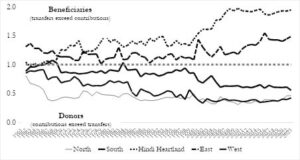
- Redistributive Federalism: Fiscal federalism necessarily involves transfer of resources from richer States to poorer States for balanced development and equitable growth.
- Growing Contribution Gap: Economically advanced States contribute significantly more to the national tax pool than they receive through central transfers.
- Beneficiary States: Several Hindi heartland States receive disproportionately larger transfers relative to their economic contribution.
- Fiscal Autonomy Concerns: Southern and western States increasingly perceive redistribution as penalising economic performance and limiting their fiscal autonomy.
- Resentment Risk: Continuous expansion of redistribution without visible convergence may intensify regional grievances and political dissatisfaction.
DEEPER CAUSE: DIVERGENT STATE PERFORMANCE
- Economic Divergence: Southern and western States have experienced significantly faster economic development and economic competitiveness compared with many northern States, fostering competitive federalism dynamics.
- Post-Liberalization Gap: Economic liberalization widened disparities as States with business-friendly policies and better governance quality attracted more investment through technology solutions and digital governance initiatives.
- Demographic Transition Differences: Fertility rates have declined sharply in the South, while population growth remains relatively higher in northern regions.
- Developmental Imbalances: Divergent human development outcomes deepen differences in governance capacity and economic productivity.
- Perception Of Penalisation: Better-performing States believe they are disadvantaged in both political representation and fiscal devolution formulas.
- Federal Tension Intensification: Large regional disparities complicate consensus-building within a federal democratic framework.
DEEPER CAUSE: EROSION OF DEMOCRATIC SENSIBILITY
- Unilateral Policymaking: Major policy decisions are increasingly perceived as being implemented with insufficient consultation and consensus-building, creating an accountability deficit in intergovernmental relations.
- Weak Cooperative Spirit: Federal governance requires accommodation, compromise, and respect for dissenting State viewpoints and regional assertion.
- Growing Political Polarisation: Politics is increasingly framed as existential conflict rather than democratic competition among differing viewpoints.
- Trust Deficit: Tensions between the Centre and States contribute to erosion of institutional trust and democratic accountability across multiple levels of governance.
- Marginalisation Concerns: Several regions and communities perceive inadequate consultation regarding major constitutional and policy changes.
THE IMPORTANCE OF DEMOCRATIC SENSIBILITY
- Consultative Governance: Democratic sensibility requires wide consultation before implementing major constitutional or policy reforms, ensuring institutional reforms are inclusive.
- Accommodation Of Diversity: Federal systems succeed when differing regional interests are accommodated through dialogue and compromise.
- Respect For Opposition: Consensus-building requires respecting dissent rather than treating disagreement as obstruction.
- Arun Jaitley Example: The functioning of the GST Council demonstrated how consensus and accommodation can preserve cooperative federalism even under coalition governments, enhancing governance efficiency.
- Preventing Domineering Governance: Democratic restraint prevents concentration of power from transforming leadership into domination.
COOPERATIVE VS COMBATIVE FEDERALISM
- Cooperative Federalism: Involves shared decision-making, policy coordination, and partnership between different levels of government through administrative federalism, promoting non-centralized federalism in practice.
- Combative Federalism: Increasing political confrontation risks converting federal governance into adversarial competition.
- Coalition Era Lessons: The era of coalition governments demonstrated the importance of negotiation and accommodation in maintaining federal balance.
- Shared Responsibilities: Domains like disaster management, environmental federalism, and regulatory standards require coordinated action between Centre and States for effective outcomes.
- Institutional Strain: Persistent Centre-State tensions undermine the spirit of cooperative federalism essential for national progress and unity.
IMPACT OF FEDERAL TENSIONS ON GOVERNANCE
- Policy Implementation Delays: Centre-State conflicts can obstruct coordinated implementation of national programmes and reforms.
- Reduced Institutional Trust: Governance effectiveness declines when political actors increasingly distrust one another.
- Regional Alienation: Perceived neglect or unfair treatment may intensify regional identity politics and separatist sentiments.
- Economic Uncertainty: Investors and businesses prefer stable and predictable intergovernmental relations for economic growth.
- Threat To Democratic Stability: Persistent federal tensions weaken democratic legitimacy and constitutional harmony.
WAY FORWARD FOR STRENGTHENING FEDERALISM
- Promote Genuine Consultation: Major constitutional and policy decisions should emerge through structured dialogue with States.
- Strengthen Intergovernmental Institutions: Bodies such as the GST Council and Inter-State Council should function more effectively.
- Balance Representation Concerns: Delimitation and representation reforms must carefully balance democratic equality with political sensitivity.
- Revisit Fiscal Devolution Models: Resource-sharing mechanisms should address both developmental needs and performance incentives.
- Rebuild Institutional Trust: Cooperative federalism requires mutual respect, democratic restraint, and constitutional morality.
CONCLUSION
Indian federalism has always been a dynamic and evolving project central to the country’s nation-building process. However, rising democratic deficits, widening fiscal imbalances, divergent State performances, and increasing political centralisation are placing unprecedented strain on Centre-State relations. While constitutional and institutional mechanisms remain important, the deeper challenge lies in preserving the spirit of cooperative federalism through consultation, accommodation, compromise, and democratic restraint. A federal system as diverse and complex as India’s cannot function sustainably through unilateralism or coercive centralisation. The strength of Indian democracy ultimately depends upon rebuilding trust between the Union and States, ensuring that political power is exercised with sensitivity, inclusiveness, and constitutional balance.
SOURCE: TH
MAINS PRACTICE QUESTION
“The challenges confronting Indian federalism are rooted not merely in constitutional design but also in the erosion of democratic sensibility.” Discuss.

