 India's No.1 PU & Degree With Integrated IAS & IPS(UPSC/PSC) Training College.


SMILE Mission: Decoding Solar Storm Threats
SMILE Mission To Decode Dangerous Solar Storms
Why in the News ?
A joint mission by the European Space Agency and the Chinese Academy of Sciences is set to launch the SMILE spacecraft to study how Earth’s magnetic shield protects the planet from intense solar winds and harmful space weather events.

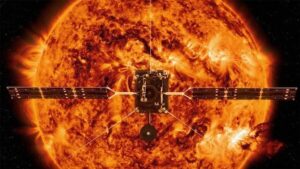
SMILE Mission and Scientific Objectives
- SMILE stands for Solar Wind Magnetosphere Ionosphere Link Explorer, a joint Europe-China space mission.
- The spacecraft is scheduled to launch aboard the Vega-C rocket from Guiana Space Centre.
- The mission aims to study interactions between the Sun and the Earth’s magnetosphere using advanced X-ray observations.
- Scientists seek to understand how solar winds and coronal mass ejections (CMEs) affect Earth’s magnetic environment.
- According to ESA scientist Philippe Escoubet, the project will deepen understanding of the Earth-Sun relationship and improve space weather forecasting.
Impact of Solar Storms on Earth
- Solar wind consists of charged particles continuously emitted from the Sun at extremely high speeds.
- Massive plasma eruptions called coronal mass ejections can intensify solar storms and travel towards Earth at nearly two million kilometres per hour.
- Earth’s magnetic field acts as a protective shield by deflecting most charged particles from entering the atmosphere.
- Severe solar storms can disrupt satellites, communication systems, GPS networks, and even power grids.
- These interactions also produce colourful auroras, commonly known as the Northern Lights and Southern Lights, near polar regions.
About Magnetosphere and Space Weather:
|

