India's No.1 PU & Degree With Integrated IAS & IPS(UPSC/PSC) Training College.


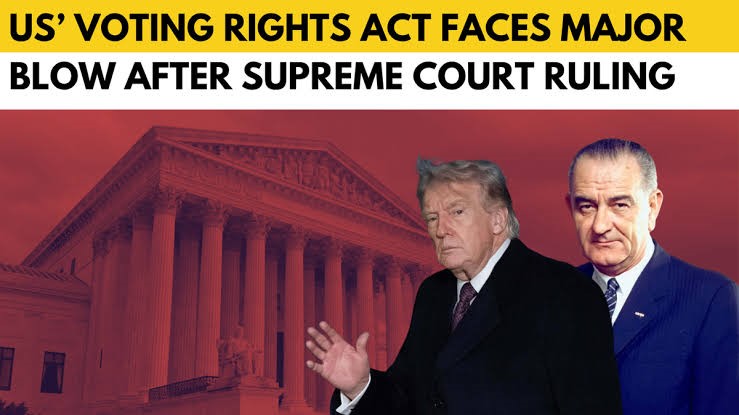
U.S. SUPREME COURT RULING ON VOTING RIGHTS
U.S. SUPREME COURT RULING ON VOTING RIGHTS
Why in the News?
- SC Verdict: Supreme Court of the United States ruled that States are not required to create majority non-white electoral districts under the Voting Rights Act.
- Political Debate: Donald Trump termed the judgment a “big win” for equal protection under law.
- Civil Rights Pushback: Black civil rights organisations and activists launched renewed campaigns to defend minority political representation in the U.S.
Key provisions and background
- Voting Rights Act: Voting Rights Act of 1965 was enacted to eliminate racial discrimination in voting practices.
- Majority-Minority Districts: These electoral districts were designed to ensure fair representation of Black and minority communities.
- Shelby County Judgment: The 2013 Shelby v. Holder ruling weakened federal oversight over discriminatory election laws, similar to how the Vanashakti judgment impacted environmental jurisprudence in India.
- Louisiana v. Callais: The latest ruling further restricted the consideration of race in electoral district mapping, raising concerns about post facto justifications for boundary changes.
- Pre-clearance Mechanism: Earlier, certain States required federal approval before changing election procedures or district boundaries.
Implications of the ruling
- Reduced Representation: Minority communities may lose opportunities to elect representatives of their choice due to altered district boundaries.
- Rise in Gerrymandering: States may justify politically motivated district changes without acknowledging racial considerations.
- Civil Rights Concerns: Activists fear rollback of protections achieved during the Civil Rights Movement era.
- Political Polarisation: The decision may deepen tensions between conservative and progressive groups over electoral fairness.
- Legal Challenges: Several advocacy groups are expected to challenge new district maps and voting laws in courts.
Gerrymandering● Definition: Gerrymandering refers to manipulation of electoral boundaries to favour a political party or social group. ● Types: It includes packing, where voters are concentrated into one district, and cracking, where communities are split across districts. ● Political Impact: Gerrymandering can distort representation and weaken electoral competitiveness in democratic systems. ● Judicial Role: Courts often examine whether district boundaries violate constitutional guarantees or voting rights protections. ● Democratic Significance: Fair delimitation is essential for ensuring equal political representation and strengthening democratic legitimacy. |