India's No.1 PU & Degree With Integrated IAS & IPS(UPSC/PSC) Training College.


Tamil Nadu Governor Controversy
Tamil Nadu Governor Controversy
Syllabus
GS 2: Centre-State Relations
Why in the News?
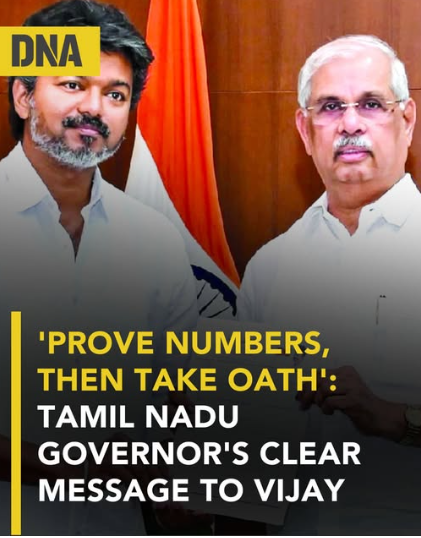
Recently, controversy arose after the Tamil Nadu Governor delayed inviting the single largest party to form government and demanded majority proof, raising debates on constitutional conventions and gubernatorial powers.
Introduction
- The 2026 Tamil Nadu Assembly election created an important constitutional debate regarding the Governor’s powers in government formation.
- The controversy over inviting the largest party and demanding proof of majority has raised serious concerns about parliamentary democracy and gubernatorial discretion.
- The decision to order an early confidence vote has also created debate regarding respect for the people’s mandate and constitutional conventions.
Tamil Nadu Election Verdict 2026
Historic Victory of TVK
- The Tamilaga Vettri Kazhagam emerged as the single largest party by winning 108 seats in the 234-member Assembly.
- This was the party’s first election, making the result politically historic and symbolically significant in Tamil Nadu politics.
Decline of the Dravidian Parties
- The ruling M. K. Stalin led Dravida Munnetra Kazhagam was reduced to 59 seats, reflecting a major electoral setback.
- The All India Anna Dravida Munnetra Kazhagam secured 47 seats, failing to regain political dominance.
End of a Long Political Era
- TVK founder C. Joseph Vijay defeated the two Dravidian parties that ruled Tamil Nadu continuously for nearly 59 years.
-
The verdict clearly reflected the people’s desire for political change and alternative leadership.
Governor’s Actions After the Election
Refusal to Invite the Single Largest Party
- Governor Rajendra Vishwanath Arlekar refused to immediately invite TVK to form the government despite being the largest party.
- Instead, he demanded signed letters from 118 MLAs before administering the oath of office.
Delay in Government Formation
- Vijay reportedly visited the Governor multiple times but was repeatedly denied an invitation to form the government.
- Only after support from Viduthalai Chiruthaigal Katchi and Indian Union Muslim League increased the tally to 121 seats was permission granted.
Direction for Early Confidence Vote
- The Governor fixed the swearing-in ceremony for May 10 and directed the Chief Minister to prove majority by May 13.
- Critics argue this compressed timeline creates opportunities for political instability and pressure tactics.
Constitutional Role of the Governor
Governor’s Duty in Parliamentary Democracy
- In parliamentary systems, the Governor’s primary duty is to identify the person most likely to command majority support in the Assembly.
- The Governor is not expected to function as a political negotiator or numerical examiner before swearing in a government.
Recommendations of Constitutional Commissions
- The Sarkaria Commission, Venkatachaliah Commission, and Punchhi Commission clearly outlined the order of preference in government formation.
- According to these commissions, the single largest pre-poll alliance receives the first opportunity to form government, followed by the largest party capable of stability.
Importance of Pre-Poll Alliances
- Pre-poll alliances are given preference because voters are aware of the coalition before casting votes.
- This principle strengthens electoral transparency and democratic accountability.
Past Examples of Gubernatorial Discretion
Goa Assembly Formation in 2017
- In Goa, the Bharatiya Janata Party with 13 seats was invited to form government despite Congress winning 17 seats.
- Critics argued that the Governor ignored the convention favouring the largest party.
Manipur Political Controversy in 2017
- In Manipur, the BJP was invited despite having 21 seats, while Congress had won 28 seats.
- This decision raised concerns regarding the selective use of gubernatorial discretion.
Karnataka Constitutional Debate in 2018
- In Karnataka, Governor Vajubhai Vala invited BJP with 104 seats and allowed 15 days to prove majority.
- This happened despite a post-poll Congress-Janata Dal (Secular) alliance claiming support of 115 legislators.
Allegations of Political Bias
- Critics observe that in earlier cases the Governor adopted an expansive interpretation of discretion favouring BJP governments.
- However, in Tamil Nadu, the Governor insisted on strict proof before even inviting the single largest party.
Minority Governments in Indian Politics
Historical Acceptance of Minority Governments
- India has witnessed several minority governments functioning constitutionally without prior proof of majority before swearing-in.
- Such governments survive as long as they maintain confidence of the House.
Example of Atal Bihari Vajpayee Government
- In 1996, Atal Bihari Vajpayee was sworn in despite lacking majority support.
- He was given time to prove majority and resigned before the floor test after failing to secure numbers.
- V. Narasimha Rao Minority Government
- V. Narasimha Rao successfully led a minority government for five years with outside support.
- His government survived a no-confidence motion by a narrow margin in 1993.
Other Examples of Minority Governments
- Governments led by H. D. Deve Gowda and I. K. Gujral also functioned as minority administrations.
- Similarly, Manmohan Singh headed a minority government in 2004 with external support.
Concerns Regarding Confidence Vote Deadline
Floor Test as the Constitutional Standard
- The Constitution requires majority support to be tested only on the floor of the Assembly, not through private letters submitted to Governors.
- Article 164(2) establishes the principle of collective responsibility to the House.
Risks of Horse-Trading
- A very short deadline for proving majority can encourage defections, inducements, and political bargaining.
- Such practices weaken democratic ethics and undermine voter trust in elected representatives.
Supreme Court Observation in Karnataka Case
- During the Karnataka crisis of 2018, the Supreme Court of India observed that long delays can encourage engineered defections.
- However, critics argue that the Tamil Nadu situation cannot justify forcing an immediate confidence vote against the largest party.
Need for Judicial Clarity
Importance of Clear Constitutional Principles
- The Supreme Court has earlier discussed gubernatorial powers in cases like S. R. Bommai Case and Rameshwar Prasad Case.
- However, experts believe stronger and clearer guidelines are now necessary to prevent misuse of discretion.
Suggested Constitutional Principles
- Governors should invite the leader most likely to command confidence without demanding unnecessary preconditions.
- Minority governments should only fall after losing a formal no-confidence motion on the Assembly floor.
Debate on Confidence Motions
- Some constitutional experts argue that Governors should avoid ordering confidence votes immediately after swearing-in.
- Instead, the Opposition should initiate a no-confidence motion if they genuinely believe the government lacks majority support.
Broader Democratic Concerns
Respecting the Voter’s Mandate
- Governors are appointed officials and must respect the democratic choice expressed by voters through elections.
- Ignoring electoral outcomes damages public trust in constitutional institutions.
Need to Protect Parliamentary Democracy
- Parliamentary democracy functions effectively only when constitutional offices remain politically neutral and unbiased.
- Selective interpretation of conventions creates perceptions of partisanship and central interference.
Conclusion
The Tamil Nadu controversy highlights important constitutional questions regarding gubernatorial discretion and democratic accountability. Respecting electoral mandates, ensuring neutral constitutional conduct, and strengthening parliamentary traditions are essential for preserving federalism, democracy, and public faith in institutions.
Source
The Hindu
Mains Practice Question
Discuss the importance of floor tests in maintaining parliamentary democracy and constitutional morality.