 India's No.1 PU & Degree With Integrated IAS & IPS(UPSC/PSC) Training College.


ROAD ACCIDENT DEATH DATA DISCREPANCIES IN INDIA
ROAD ACCIDENT DEATH DATA DISCREPANCIES IN INDIA
Why in the News?
- India continues to record one of the world’s highest numbers of road accident deaths, but official figures released by different agencies show notable discrepancies.
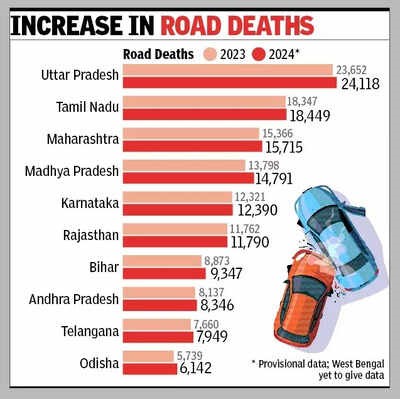
- The Ministry of Road Transport and Highways reported 77 lakh deaths in 2024, while National Crime Records Bureau data placed fatalities around 1.75 lakh.
- The mismatch has raised concerns regarding the accuracy and coordination of India’s road safety data systems.
Sources of road accident data
- MoRTH data collection: The Ministry uses the e-DAR/iRAD system, which gathers accident information entered by police personnel in real time.
- NCRB mechanism: NCRB compiles information through State Crime Records Bureaus (SCRBs) and District Crime Records Bureaus (DCRBs) based on police station records.
- Police as primary source: Police officers are usually the first responders and remain the main source of accident-related information.
- Hospital linkage: Hospitals are gradually being integrated into the iRAD platform to improve fatality reporting and reduce gaps.
- International practice: According to the World Health Organization, nearly half of countries globally rely mainly on police-based accident reporting systems.
Reasons behind data discrepancies
- Different reporting channels: Although both agencies rely on police data, the methods and timelines of reporting differ significantly.
- Under-reporting concerns: Fatalities occurring after 30 days of an accident may not always be reflected in police records, causing inconsistencies.
- Delayed data sharing: Some States delay uploading or sharing information with central databases, affecting data synchronisation.
- Incomplete integration: Not all hospitals and agencies are fully linked to the e-DAR/iRAD system, limiting real-time verification.
- Administrative coordination issues: Since police departments function under the Home Ministry, MoRTH depends on coordination across multiple authorities for data access.
Road safety initiatives in India● e-DAR/iRAD system: Introduced to create a real-time integrated database of road accidents with geo-tagged evidence and digital reporting. ● Motor Vehicles (Amendment) Act, 2019: Strengthened penalties for traffic violations and promoted safer driving practices. ● National Road Safety Policy: Focuses on reducing fatalities through better engineering, enforcement, education, and emergency care. ● Good Samaritan Guidelines: Protect citizens who help accident victims from legal harassment and procedural complications. ● UPSC relevance: Important for GS Paper II and III under governance, public policy, transport infrastructure, and public health administration. |

