 India's No.1 PU & Degree With Integrated IAS & IPS(UPSC/PSC) Training College.


GOVERNOR’S ROLE IN GOVERNMENT FORMATION
GOVERNOR’S ROLE IN GOVERNMENT FORMATION
Why in the News?
- Tamil Nadu witnessed a hung Assembly after the recent elections, where Tamilaga Vettri Kazhagam emerged as the single largest party with 108 seats.
- After securing support from smaller parties, TVK chief C. Joseph Vijay was invited by Governor Rajendra Arlekar to form the government.
- The development has revived debate over the Governor’s discretionary powers in government formation.
Constitutional provisions and commissions
- Article 164(1): It states that the Chief Minister is appointed by the Governor, while other ministers are appointed on the CM’s advice.
- Clear majority situation: If a single party wins a majority, the Governor normally invites the elected leader of that party to form the government.
- Hung Assembly scenario: When no party gets a majority, the Governor exercises discretionary powers in selecting the Chief Minister.
- Sarkaria Commission (1987): Recommended an order of preference for government formation in hung Assemblies.
- Punchhi Commission (2010): Reiterated similar guidelines to ensure stable governments and impartial gubernatorial conduct.
Issues and judicial observations
- Concerns over neutrality: Governors have often been accused of acting in favour of the ruling party at the Centre rather than functioning as impartial constitutional heads.
- Contrasting precedents: In Goa and Manipur (2017), post-poll alliances were invited despite another party being the single largest.
- Karnataka example: In 2018, the Governor invited the single largest party instead of the post-poll coalition claiming majority support.
- R. Bommai case (1994): The Supreme Court held that the floor of the House is the only valid method to test majority support.
- Way forward: The Justice Kurian Joseph Committee recommended codifying rules regarding Governors’ discretionary powers through a constitutional schedule to reduce ambiguity and misuse.
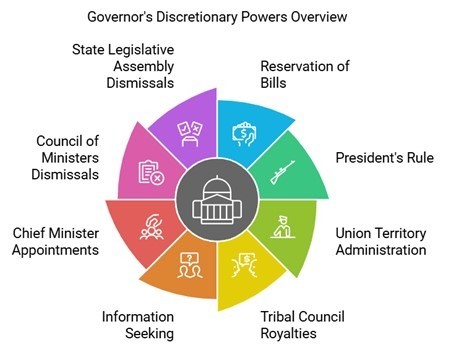
Governor in Indian polity● Constitutional position: Governor is the nominal executive head of the State under Articles 153–162. ● Appointment: Governors are appointed by the President of India and hold office during the President’s pleasure. ● Discretionary powers: Include inviting a party to form government, reserving Bills for the President, and recommending President’s Rule under Article 356. ● Role in federalism: Governor acts as a constitutional link between the Union and State governments. ● UPSC relevance: Important for topics related to Centre-State relations, constitutional morality, and federal governance in GS Paper II. |

