 India's No.1 PU & Degree With Integrated IAS & IPS(UPSC/PSC) Training College.


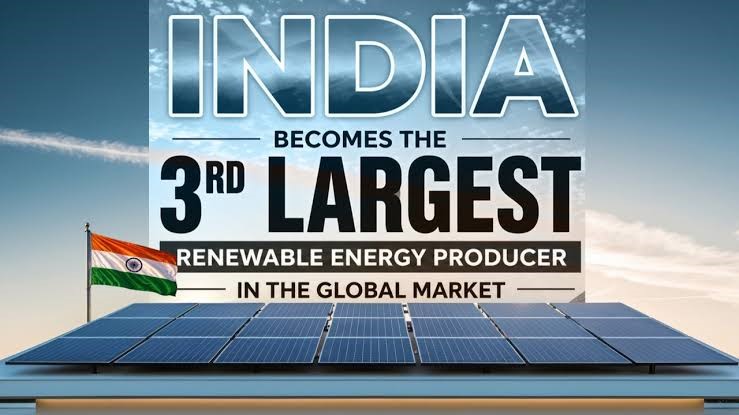
INDIA BECOMES WORLD’S 3rd LARGEST RENEWABLE ENERGY POWER
INDIA BECOMES WORLD’S 3rd LARGEST RENEWABLE ENERGY POWER
Why in the News?
- India has become the third-largest country globally in terms of installed renewable energy capacity.
- A report by Morgan Stanley highlighted India’s rapid growth in the renewable energy sector and the need for greater domestic manufacturing capacity.

Key highlights of the report
- Expansion in solar manufacturing: India’s solar module capacity increased from 38 GW in March 2024 to 74 GW in March 2025.
- Growth in solar cells: Domestic solar cell capacity rose from 9 GW to 25 GW during the same period.
- Non-fossil fuel milestone: India’s non-fossil fuel installed capacity crossed 50% of total installed power capacity, reaching 7 GW.
- Major contributors: Solar and wind energy accounted for the majority of recent renewable energy additions.
- Import dependence: India still imports a large share of critical components such as solar modules, wafers, and polysilicon, mainly from China.
Significance and challenges
- Energy security: Renewable expansion can reduce dependence on imported fossil fuels.
- Climate commitments: Supports India’s targets under the Paris Climate Agreement and Net Zero goals.
- Industrial growth: Local manufacturing of solar components can strengthen the Make in India
- Supply chain vulnerability: Heavy reliance on Chinese imports creates risks related to global supply disruptions.
- Need for localisation: Faster development of domestic capabilities in wafers, polysilicon, and advanced technologies is essential.
Renewable energy in India● Major renewable sources: Includes solar, wind, hydropower, biomass, and green hydrogen. ● National targets: India aims to achieve 500 GW non-fossil fuel capacity by 2030. ● Key schemes: Includes PM-KUSUM, National Solar Mission, and PLI schemes for solar manufacturing. ● Global initiatives: India co-founded the International Solar Alliance to promote solar energy globally. ● UPSC relevance: Important for energy security, climate change, sustainable development, and green economy under GS Paper III. |

