India's No.1 PU & Degree With Integrated IAS & IPS(UPSC/PSC) Training College.


Women’s Reservation: Missed Chance For Democratic Transformation
Women’s Reservation: Missed Chance For Democratic Transformation
Syllabus:
GS-2: Indian Constitution, Elections,Statutory Bodies
Why in the News ?
The debate on the Nari Shakti Vandan Adhiniyam (2023) and the failure to accelerate its implementation through subsequent amendments has revived concerns about women’s political representation. The issue highlights delays, political resistance, and the lost opportunity to strengthen inclusive democracy and ensure gender-equitable governance in India, much like delays seen in other governance areas requiring proactive policy frameworks.
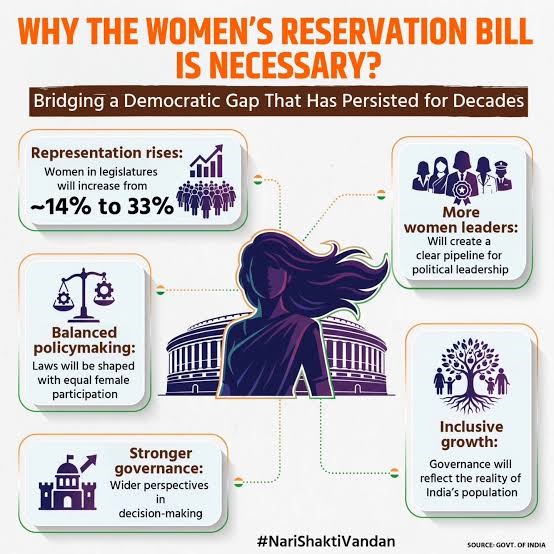
Evolution Of Women’s Political Representation In India:
- Post-Independence Vision: The Indian Constitution guaranteed political equality, yet actual representation of women remained limited.
- Early Legislative Attempts: The idea of women’s reservation in Parliament was first introduced in 1996, marking the beginning of a long legislative struggle.
- Repeated Failures: Successive governments failed to pass the Bill due to lack of consensus and political hesitation.
- Parliamentary Disruptions: Instances such as the 1998 disruption by members opposing the Bill reflected deep-rooted resistance.
- Persistent Underrepresentation: Women’s representation stagnated at 10–15%, highlighting structural barriers.
- Symbolic Inclusion: Women were often treated as token participants, not decision-makers.
- Global Comparison: India lagged behind many countries in political gender parity, despite being a democracy.
Women’s Political Representation –LawsKey points● Political Representation: Inclusion of women in legislative bodies. ● Substantive Equality: Equality in outcomes, not just legal provisions. ● Glass Ceiling: Invisible barriers preventing women’s advancement. ● Vote Bank vs Power Bank: Shift from electoral support to decision-making power. ● Constitutional Morality: Governance based on constitutional values. Constitutional Provisions● Article 14: Equality before law ● Article 15(3): Special provisions for women ● Article 16: Equal opportunity ● Article 39: Equal livelihood and justice ● 73rd & 74th Amendments: Reservation in local governance Important Acts And Laws● Constitution (106th Amendment) Act, 2023 – Women’s reservation ● Representation of People Act, 1951 ● Panchayati Raj Act, 1992 ● Protection of Women from Domestic Violence Act, 2005 ● Sexual Harassment at Workplace Act, 2013 Important points● Women in Lok Sabha: ~15% ● Women voters: Nearly equal or higher turnout than men ● Panchayati Raj: Over 15 million elected women representatives ● Global ranking: India lags in political gender parity Committees And Reports● National Commission for Women (NCW) ● Law Commission Reports on Electoral Reforms ● UN Gender Equality Reports |
Structural Barriers And Political Resistance
- Elite Anxiety: Male politicians feared losing seats due to reservation, leading to covert opposition.
- Patriarchal Norms: Deep-rooted gender biases limited acceptance of women in leadership roles.
- Institutional Apathy: Political institutions failed to prioritize gender-inclusive reforms.
- Fragmented Opposition: Parties differed on sub-quotas and implementation models, delaying consensus.
- Lack of Political Will: Governments often prioritized electoral calculations over reform.
- Silence On Misogyny: Derogatory remarks against women politicians often went unchallenged.
- Policy Paralysis: Repeated delays reflected systemic inertia rather than lack of awareness.
Panchayati Raj Success Vs Parliamentary Gap
- 73rd & 74th Amendments: The 1993 Panchayati Raj reforms reserved seats for women in local governance.
- Mass Participation: Over 15 million women entered political roles at grassroots levels.
- Leadership Development: Local governance created a pipeline of women leaders.
- Policy Impact: Women leaders improved focus on health, education, and welfare.
- Contrast At National Level: Despite local success, Parliament remained male-dominated.
- Broken Continuum: Lack of reservation at higher levels prevented leadership progression.
- Missed Opportunity: Failure to scale grassroots success to national politics weakened democratic inclusivity.
Significance Of Nari Shakti Vandan Adhiniyam
- Constitutional Reform: The Act mandates 33% reservation in Lok Sabha and State Assemblies.
- Shift In Representation: Moves women from vote bank to power bank.
- Inclusive Governance: Ensures policies reflect diverse societal needs.
- Empathy In Leadership: Women bring balanced perspectives to governance.
- Strengthening Democracy: Enhances legitimacy and representativeness of institutions, promoting both environmental democracy and gender-inclusive decision-making.
- Long-Term Impact: Creates a sustainable leadership pipeline.
- Symbol Of Progress: Reflects commitment to gender justice and equality.
Political Narratives And Leadership Claims
- Leadership Assertion: The Act is presented as a result of strong political will.
- Symbolic Milestones: Election of Droupadi Murmu highlighted representation of marginalized women.
- Narrative Building: Governments project themselves as champions of women empowerment.
- Electoral Messaging: Women voters are increasingly central to campaign strategies.
- Contradictions: Historical delays contradict current claims of proactive reform.
- Image Management: Policies are often framed to enhance political legitimacy.
- Selective Credit: Political actors emphasize achievements while ignoring past resistance.
Constitutional Morality And Ambedkar’s Vision
- Ambedkar’s Philosophy: B. R. Ambedkar emphasized that social justice requires gender justice, establishing principles akin to the precautionary principle in governance—acting proactively rather than reactively.
- Hindu Code Bill: Aimed to ensure women’s rights in property and marriage.
- Resignation: Ambedkar resigned in 1951 due to delays in passing reforms.
- Constitutional Morality: Calls for ethical governance beyond political expediency, similar to how environmental jurisprudence demands adherence to constitutional values in protecting natural resources.
- Gender As Core Principle: Equality for women is central to constitutional democracy.
Constitutional Morality And Ambedkar’s Vision
- Ambedkar’s Philosophy: B. R. Ambedkar emphasized that social justice requires gender justice.
- Hindu Code Bill: Aimed to ensure women’s rights in property and marriage.
- Resignation: Ambedkar resigned in 1951 due to delays in passing reforms.
- Constitutional Morality: Calls for ethical governance beyond political expediency.
- Gender As Core Principle: Equality for women is central to constitutional democracy.
- Historical Continuity: Current debates reflect unfinished agenda of post-independence reforms.
- Moral Imperative: Women’s reservation is not just policy but constitutional obligation.
Lost Opportunity And Democratic Implications
- Delayed Implementation: Linking reservation to delimitation and census postpones benefits.
- Legislative Gap: Failure to pass enabling amendments slowed actual realization.
- Democratic Deficit: Exclusion of women weakens representative democracy.
- Policy Impact: Lack of women leaders affects priority-setting in governance.
- Historical Setback: Delay seen as a missed historic opportunity.
- Global Standing: Impacts India’s position in gender equality rankings.
- Future Risk: Continued delays may erode trust in political commitments.
Challenges :
- Delayed Execution: Linking reservation to delimitation creates uncertainty and postponement.
- Patriarchal Resistance: Persistent male dominance in politics limits acceptance of women leaders.
- Tokenism Risk: Women candidates may act as proxies, undermining genuine empowerment.
- Political Fragmentation: Disagreements over sub-quotas hinder consensus.
- Institutional Weakness: Lack of enforcement mechanisms reduces policy effectiveness.
- Socio-Economic Barriers: Limited access to education, finance, and networks restricts participation.
- Cultural Constraints: Social norms discourage women from entering public life.
- Violence In Politics: Safety concerns deter women from contesting elections.
- Electoral Dynamics: Parties prioritize winnability over inclusivity.
- Implementation Complexity: Coordination between states and centre remains challenging.
Way Forward:
- Immediate Enforcement: Remove linkage with delimitation to ensure timely implementation.
- Capacity Building: Train women leaders through political education programmes.
- Financial Support: Provide funding mechanisms for women candidates.
- Legal Safeguards: Strengthen laws against political violence and harassment.
- Awareness Campaigns: Promote gender equality narratives in society.
- Party Reforms: Mandate internal quotas within political parties.
- Intersectional Inclusion: Ensure representation of marginalized women groups.
- Monitoring Framework: Track progress through data and accountability mechanisms.
- Grassroots Linkage: Connect Panchayati Raj experience to higher political roles.
- Cultural Change: Encourage societal acceptance of women in leadership.
Conclusion:
The debate on women’s reservation underscores a critical gap between constitutional ideals and political practice. While the Nari Shakti Vandan Adhiniyam offers transformative potential, delays in implementation risk reducing it to symbolism. True empowerment requires timely action, institutional commitment, and alignment with constitutional morality and gender justice principles.
Source: IE
Mains Practice Question:
“Critically examine the evolution of women’s political representation in India. Discuss the significance of the Nari Shakti Vandan Adhiniyam and evaluate whether delays in its implementation represent a missed opportunity for democratic deepening and gender justice in India.”