India's No.1 PU & Degree With Integrated IAS & IPS(UPSC/PSC) Training College.


New Rural Job Scheme Drops Demand Model
New Rural Job Scheme Shifts From Demand Model
Why in the News?
The Union government plans to introduce the Viksit Bharat – Guarantee For Rozgar and Ajeevika Mission (Gramin) Bill, replacing MGNREGA, 2005, marking a shift from a demand-driven right-based employment scheme to a supply-driven, allocation-based framework. This change also presents opportunities to integrate environmental conservation efforts into rural employment programs.
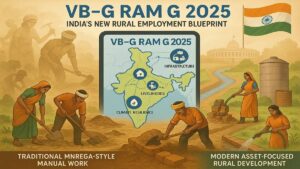
What The New Job Guarantee Bill Proposes:
- The proposed VB-GRAMG Bill seeks to replace the Mahatma Gandhi National Rural Employment Guarantee Act (MGNREGA), signalling a major policy shift in rural employment governance and potentially impacting environmental conservation efforts.
- Unlike MGNREGA’s demand-driven framework, the new scheme will be supply-driven, with capped allocations decided by the Union government. This change may affect the implementation of environmental projects under the scheme.
- Employment will be offered only in rural areas notified by the Centre, reducing universal rural coverage but potentially allowing for targeted environmental interventions.
- The Bill increases guaranteed workdays from 100 to 125, projecting itself as an expansion in entitlement. This could provide more opportunities for environmental conservation work.
- However, allocations will be determined based on unspecified “parameters”, limiting flexibility during distress years and potentially affecting environmental projects.
- The Centre gains authority to pause the scheme during peak agricultural seasons to ensure labour availability for farming, which may impact ongoing environmental initiatives.
- Technological tools such as Aadhaar-based payments, mobile attendance, and geo-tagging—earlier executive measures—are now legally codified. These tools could enhance monitoring of environmental projects.
- The government argues that the reform reflects socio-economic transformation in rural India and aligns with Viksit Bharat @2047, including goals for a pollution free environment.
Fiscal And Federal Implications For States
- The Bill significantly increases the financial burden on States, raising their share from around 10% to 40% of total expenditure, which may affect funding for environmental programs.
- Under MGNREGA, the Centre bore 100% wage costs and 75% material costs, resulting in a 90:10 Centre–State ratio. The new structure may impact States’ ability to fund environmental initiatives.
- The new Bill formalises a 60:40 cost-sharing ratio for most States and 90:10 for North-Eastern and Himalayan States, potentially affecting environmental project implementation in these ecologically sensitive regions.
- Section 4(5) empowers the Centre to decide State-wise normative allocations, weakening States’ discretion in environmental project selection.
- Section 5(1) allows the Centre to decide where within a State the scheme will operate, deepening centralisation and potentially affecting local environmental priorities.
- Critics argue this undermines cooperative federalism and shifts States from partners to implementers, which may impact local environmental governance.
- Concerns have been raised that capped budgets could reduce employment during economic downturns or climate shocks, affecting environmental resilience efforts.
About Rights-Based Welfare And MGNREGA: |
| – MGNREGA, 2005: World’s largest rights-based employment programme, guaranteeing work on demand, including environmental conservation work. |
| – Article 21 (Right to Livelihood): Judicially linked to employment security and a clean environment. |
| – Demand-driven vs Supply-driven Schemes: Demand-based schemes empower beneficiaries; supply-based schemes prioritise fiscal control, potentially affecting environmental project selection. |
| – Federalism Issue: Shift of control to Centre raises concerns on State autonomy in environmental governance. |