India's No.1 PU & Degree With Integrated IAS & IPS(UPSC/PSC) Training College.


Asteroid 2025 FA22 Close Flyby: Earth’s Safety Explained
Asteroid 2025 FA22: A Close Encounter and What It Means for Earth’s Safety
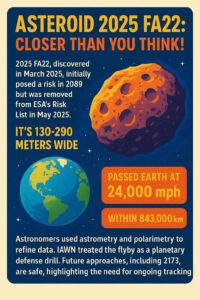
On September 18, 2025, asteroid 2025 FA22 made a dramatic flyby of Earth, offering scientists an exciting opportunity to study a near-Earth object of considerable size and speed. This cosmic encounter with one of the many celestial bodies in our solar system raised alarms when early orbital calculations suggested a small possibility of impact in 2089. Discovered in March 2025 by the Pan-STARRS 2 telescope in Hawaii, with subsequent precovery observations confirming its existence, this skyscraper-size asteroid initially caused concern. However, with improved observations and orbital improvement techniques, that risk has been ruled out.
Size, Speed, and Risk
The asteroid is estimated to be between 130 and 290 meters in diameter—large enough to cause widespread destruction in the event of an impact. For reference, an asteroid of this size could devastate an entire city if it were on a collision course with Earth. Moving at an astonishing 24,000 mph (38,600 km/h), it passed at a minimum distance of 843,000 km from Earth—more than twice the distance to the Moon. Despite its speed and size, scientists confirmed there was no threat of impact during this safe flyby, easing initial concerns.
A Valuable Scientific Opportunity
Although there was no risk, the flyby offered significant scientific value. This close encounter allowed astronomers to improve measurements of the asteroid’s orbit, size, and surface properties using techniques like astrometry (tracking its position and motion) and polarimetry (studying the polarized light reflecting off its surface). These data help scientists refine predictions for future asteroid paths and improve risk assessments using tools like the Torino scale.
Moreover, the International Asteroid Warning Network (IAWN) used this event as a planetary defense drill, practicing how the global community would respond to a potential threat. Coordinated efforts from the European Space Agency (ESA) and other space organizations allowed for precise monitoring and understanding of asteroid behavior. This exercise also involved testing emergency protocols and planetary defense strategies in case of future threats.
The rapid characterization of the asteroid during this flyby provided valuable insights into its asteroid composition and structure. Scientists were able to study how space weather conditions and solar elongation might affect the asteroid’s trajectory and properties, further enhancing our understanding of these celestial bodies. The use of advanced technology, including the Goldstone radar and other radar telescopes, enabled detailed radar observations that significantly contributed to our knowledge of the asteroid’s characteristics.
Public Engagement and Awareness
To engage the public, the Virtual Telescope Project livestreamed this astronomical spectacle, allowing stargazers and amateur astronomers worldwide to follow the asteroid’s journey using even backyard telescopes. This once-in-a-decade event serves as a reminder of the importance of monitoring potentially hazardous asteroids and the need for public awareness of potential space hazards.
Future Projections
Since the risk of an impact from 2025 FA22 has been eliminated, it remains a significant object for future observation. Another cosmic encounter is expected in 2173, but this will still be far enough away to pose no threat. However, continuous monitoring is essential, as even small orbital uncertainties could lead to potential risks. The concept of a “virtual impactor” is used in these projections to model possible future scenarios and improve our preparedness.
Asteroids like 2025 FA22, measuring between 100 and 300 meters, are large enough that an impact could have catastrophic consequences, including explosions, wildfires, and tsunamis, especially if it strikes an ocean. These secondary disasters could amplify the initial impact, potentially leading to a global climatic catastrophe. Though such events are rare, they have occurred in Earth’s history, highlighting the importance of tracking near-Earth objects to avoid disaster.
By continually refining our understanding of these objects and demonstrating international cooperation, we can significantly reduce the risk of an unexpected asteroid impact. This event shows how space agencies around the world are working together to safeguard our planet while engaging the public and encouraging scientific discovery. The ongoing development of impact prevention technologies and the improvement of our ability to predict gravitational interactions between asteroids and planets are crucial steps in ensuring Earth’s long-term safety from cosmic threats.