 India's No.1 PU & Degree With Integrated IAS & IPS(UPSC/PSC) Training College.


Earth’s New Quasi-Moon 2025 PN7: Cosmic Companion
Earth’s New Cosmic Companion: The Story of Quasi-Moon 2025 PN7
For centuries, humanity has looked at the night sky believing Earth had just one moon. But recent discoveries remind us that space is full of surprises. In August 2025, astronomers confirmed the presence of a new cosmic neighbor, a small asteroid named 2025 PN7. Unlike our familiar Moon, this celestial body is what scientists call a quasi-moon, a near-Earth object that shares Earth’s orbital path around the Sun. This cosmic encounter has sparked interest in the scientific community, highlighting the importance of studying such space hazards.
A Tiny but Fascinating Asteroid
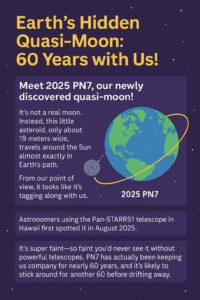
Asteroid 2025 PN7 is modest in size, measuring only about 19 meters across, roughly the length of a city bus. Because of its extreme faintness with a brightness of around magnitude 26, it cannot be seen without powerful telescopes. Its small scale and low visibility made it easy to overlook, which explains why it went unnoticed for decades. In comparison, asteroid 2025 FA22, another recently discovered near-Earth object, is significantly larger and easier to detect. The discovery of these asteroids underscores the need for continuous sky surveys and improved methods for rapid characterization of such celestial bodies.
Why It’s a Quasi-Moon
Unlike the Moon, which is bound tightly to Earth’s gravity, 2025 PN7 does not orbit our planet directly. Instead, it follows the Sun in an orbit strikingly similar to Earth’s. This unusual arrangement means it appears to travel alongside us, giving the impression of a second moon. In reality, it is locked in a gravitational dance, moving in resonance with Earth but never truly captured by it. This close encounter between Earth and the asteroid creates an astronomical spectacle that fascinates scientists and amateur astronomers alike, while also raising questions about potential space hazards.
Sixty Years Together and Sixty More to Go
Although discovered only recently by the Pan-STARRS1 telescope in Hawaii on August 29, 2025, researchers analyzing its orbit concluded that asteroid PN7 has likely been accompanying Earth for the past six decades. Even more intriguing, it is expected to remain in this quasi-satellite state for another 60 years before gravitational interactions eventually alter its trajectory and carry it away. This long-term companionship provides a unique opportunity for studying asteroid composition and behavior over an extended period.
The Discovery and Scientific Value
The discovery was validated by reviewing older observational data, which helped track its path backward in time. This process, known as precovery observations, is crucial for understanding the asteroid’s long-term behavior. Astronomers Carlos and Raúl de la Fuente Marcos reported the findings in the Research Notes of the American Astronomical Society, noting that PN7 is among the smallest and least stable quasi-moons ever recorded.
While the asteroid itself poses no danger and is considered a safe flyby object, its existence is scientifically important. Studying PN7 helps researchers understand how small asteroids enter and exit quasi-satellite orbits, improving models of orbital mechanics. It also contributes to planetary defense efforts, since learning to detect such faint objects sharpens our ability to identify potentially hazardous asteroids. This knowledge is crucial for impact prevention strategies and the development of emergency protocols in case of a collision course with Earth.
Because PN7 is so dim, it will remain a challenge to observe. However, next-generation observatories like the Vera C. Rubin Observatory are expected to reveal many more such hidden companions in the coming years. These small bodies may one day serve as convenient testbeds for robotic exploration or even asteroid resource missions, thanks to their proximity and relatively low energy costs to reach.
A Reminder of Cosmic Complexity
Though tiny and temporary, 2025 PN7 is a reminder that Earth’s neighborhood in space is more dynamic than we often imagine. Our planet may not be limited to one moon after all; from time to time, it picks up passing companions, each with its own story written in the language of gravity and motion.
Studying these quasi-moons can provide valuable insights into space weather and its effects on near-Earth objects. Future research may involve radar observations to better understand the asteroid’s composition and refine our planetary defense strategies. As we continue to explore these celestial bodies, we may uncover new mysteries and challenges related to orbital uncertainties and the complex gravitational interactions that govern our cosmic neighborhood.
The discovery of asteroid 2025 PN7 serves as a testament to the ever-evolving field of astronomy and the importance of continuous sky surveys. As technology advances, we may find that Earth has more temporary companions than we ever imagined, each offering a unique opportunity for scientific study and expanding our understanding of the solar system’s dynamics.
In contrast to 2025 PN7, some asteroids pose a greater potential threat. For instance, a skyscraper-size asteroid passing close to Earth would be considered a potentially hazardous asteroid, requiring careful monitoring and possibly triggering emergency protocols. The use of advanced radar telescopes, such as the Goldstone radar, plays a crucial role in the orbital improvement and characterization of these larger, more concerning space rocks.
As we continue to enhance our capabilities in asteroid detection and tracking, we’re better prepared to face the challenges posed by these celestial visitors. Whether it’s a tiny quasi-moon like 2025 PN7 or a larger near-Earth asteroid, each discovery contributes to our growing understanding of the cosmic dance occurring in our planet’s vicinity, helping us safeguard Earth from potential space hazards.




