 India's No.1 PU & Degree With Integrated IAS & IPS(UPSC/PSC) Training College.


WHY PM MODI’S CALL TO SAVE FOREX COULD SLOW DOWN INDIA’S GROWTH
WHY PM MODI’S CALL TO SAVE FOREX COULD SLOW DOWN INDIA’S GROWTH
Why in the News?
- Prime Minister Narendra Modi recently urged citizens to conserve foreign exchange reserves by reducing non-essential imports.
- He appealed to people to avoid purchasing gold for a year, as gold imports significantly increase India’s forex outflow.
- The Prime Minister also encouraged greater adoption of work-from-home practices to reduce consumption of imported crude oil, another major contributor to foreign exchange expenditure.
- However, critics argue that measures focused mainly on reducing consumption could slow economic growth, and emphasize the need to enhance domestic production and productivity as a more sustainable solution.
Link Between Forex and the Prime Minister’s Appeal
- Prime Minister Narendra Modi urged citizens to reduce consumption of edible oil, highlighting that it would lower import dependence while also improving public health.
- He appealed to farmers to reduce the use of chemical fertilisers by half and encouraged a transition towards natural farming practices.
- The Prime Minister also stressed the importance of purchasing “Made in India” products instead of imported goods for daily use.
- He called upon institutions such as courts, labour unions, and the media to collectively contribute towards reducing India’s import dependence and conserving foreign exchange reserves.
Why the Concern Over Forex?
- The appeal comes amid global disruptions caused by the Iran conflict, which triggered supply and price shocks in commodities such as fuel and fertilisers.
- When Indians purchase imported goods—such as gold, edible oil, fertilisers, or consumer products—India uses its foreign exchange reserves to pay in foreign currencies, mainly US dollars.
- Imports require converting Indian rupees into dollars, increasing demand for foreign currency and reducing India’s forex reserves held by the Reserve Bank of India.
- Forex reserves are replenished when foreign countries buy Indian goods and services, as they exchange dollars for rupees.
- Problems arise when imports exceed exports for a prolonged period, causing more dollars to flow out than come in.
- A sustained imbalance leads to:
○ depletion of forex reserves, and
○ depreciation of the rupee against the dollar and other foreign currencies.
Role of Investments in Forex Flows
- Foreign exchange also flows through investments:
○ Foreign Direct Investment (FDI), where global firms establish businesses in India.
○ Foreign Portfolio Investment (FPI), where foreign investors buy shares in Indian companies.
- Similarly, Indian firms and investors also invest abroad, leading to outward forex flows.
India’s Balance of Payments Situation
- Since the economic reforms of 1991, India has generally imported more than it exports, resulting in a Current Account Deficit (CAD).
- At the same time, foreign investments into India have usually exceeded Indian investments abroad, creating a Capital Account Surplus (CAS).
- Typically, the capital inflows are larger than the current account deficit, leading to an overall Balance of Payments (BoP) surplus, which helps India accumulate foreign exchange reserves.
Balance of Payments (BoP) and the Rupee’s Exchange Rate
- When India’s Balance of Payments (BoP) remains in surplus, the Reserve Bank of India has two options:
○ allow the rupee to appreciate against foreign currencies, or
○ accumulate additional foreign exchange reserves.
- The RBI often prefers accumulating forex reserves because:
○ an excessively strong rupee can hurt India’s export competitiveness, and
○ large reserves provide a financial cushion during external economic crises.
- When the BoP moves into deficit:
○ the rupee tends to depreciate against the US dollar, or
○ the RBI intervenes by selling dollars from its forex reserves to stabilise the exchange rate.
Recent Concerns in India’s External Sector
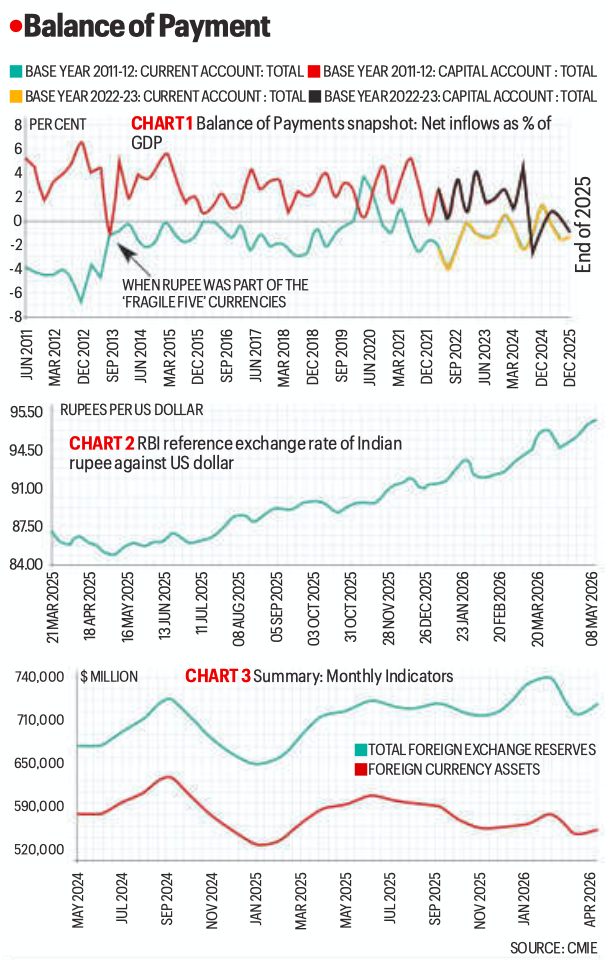
- Since mid-2024, India’s BoP surplus has weakened significantly.
- Although the Current Account Deficit (CAD) has not worsened sharply, the Capital Account Surplus (CAS) has narrowed and, at times, turned into a deficit.
- India’s current external sector position is being compared to the 2013 period, when Morgan Stanley classified India among the “Fragile Five” economies due to external sector vulnerabilities.
Consequences of a Weakening BoP
- The weakening BoP has resulted in:
○ depreciation of the rupee against the US dollar, and
○ depletion of forex reserves as the RBI intervenes to defend the rupee.
- A weaker rupee further increases the cost of imports, particularly crude oil, because India remains heavily dependent on imported energy.
- Rising import costs can fuel inflationary pressures and widen India’s trade imbalance further.
Will the Prime Minister’s Approach Help?
Two Ways to Address the Forex Challenge
- India can address foreign exchange pressures through two broad strategies:
- reducing demand for dollars by cutting domestic consumption of imports, or
- increasing forex earnings by boosting domestic production, exports, and productivity.
- Prime Minister Narendra Modi has largely focused on reducing consumption rather than expanding production capacity.
Impact of Consumption Reduction
- If Indians sharply reduce the use of imported goods such as gold and crude oil, imports would decline significantly, reducing demand for dollars and narrowing the Current Account Deficit (CAD).
- However, such a strategy may weaken economic growth because:
○ businesses linked to these sectors would experience lower sales,
○ reduced mobility and spending could lower economic activity, and
○ production inefficiencies may arise due to forced cutbacks.
- Weak consumer demand could also discourage private investment, as businesses are less likely to expand when consumption remains subdued.
- This may undermine the government’s broader objective of stimulating investment-led growth.
Possible Impact on Foreign Investment
- While lower imports may improve the current account position, weaker domestic demand could adversely affect the Capital Account by discouraging foreign investors.
- Investors may hesitate to invest in an economy where consumption and growth prospects appear weak.
The “Swadeshi” Alternative
- A possible medium-term outcome is that consumption shifts from imported goods to domestically produced “swadeshi” products rather than declining altogether.
- In such a scenario:
○ Indian firms could benefit from higher domestic demand, and
○ businesses may increase investment and production capacity.
- This could strengthen domestic industry and reduce dependence on imports over time.
Limits of Complete Self-Reliance
- Although self-reliance appears attractive, complete economic self-sufficiency is difficult in an interconnected global economy.
- For example, India may be self-sufficient in food production, but agriculture still depends heavily on imported fertilisers and fertiliser feedstock such as natural gas and naphtha.
- More than 80% of fertiliser production costs depend on imported inputs, limiting true self-reliance in agriculture.
- Similarly, India remains heavily dependent on imported crude oil, and replacing it with domestic alternatives in the short term is difficult and economically costly.
- Therefore, drastically reducing imports may slow economic growth instead of strengthening the economy.
- Fertiliser Use and Natural Farming
○ The issue with chemical fertilisers is not merely excessive usage, but rather their imbalanced application.
○ India’s subsidy structure heavily favours urea, encouraging its overuse by farmers.
○ While reducing chemical fertiliser use and promoting natural farming may provide environmental benefits, these measures alone cannot fully address India’s broader forex and productivity challenges.
Dealing with the Forex Issue: The Sustainable Approach
- Reducing consumption alone cannot serve as a long-term solution to India’s foreign exchange challenges.
- A sustainable strategy requires India to strengthen:
○ domestic production capacity, and
○ overall productivity and efficiency.
- India can improve its external sector position only by becoming a more competitive and efficient producer, irrespective of the machinery or inputs it imports.
- Higher productivity would enable Indian industries to expand their share in global export markets and earn greater foreign exchange.
- Structural reforms aimed at improving the ease of doing business are also essential to attract:
○ greater domestic investment, and
○ increased foreign investment inflows.
- Simplifying regulations, reducing compliance burdens, and improving the business environment can encourage entrepreneurship and industrial expansion.
- In the long run, sustained export growth and stronger investment inflows provide a more durable and growth-oriented solution to the forex issue than sharp reductions in consumption.
Source: https://indianexpress.com/article/explained/explained-economics/explainspeaking-india-forex-crisis-pm-modi-import-cuts-10684047/
Mains question
“Reducing import-dependent consumption alone cannot sustainably address India’s foreign exchange challenges.” Discuss the need for enhancing productivity and ease of doing business to strengthen India’s external sector stability.


