 India's No.1 PU & Degree With Integrated IAS & IPS(UPSC/PSC) Training College.


Uranium Mining and Tribal Consent in Meghalaya
Uranium Mining and Tribal Consent in Meghalaya
Syllabus:
GS Paper – 2 : Government Policies & Interventions, Issues Arising Out of Design & Implementation of Policies
GS Paper – 3 : Infrastructure
Why in the News ?
The Centre’s decision to mine uranium in Meghalaya, despite long-standing opposition from Khasi groups, has triggered intense debates on tribal rights, environmental safety, and democratic safeguards. The issue escalated after the Union Environment Ministry exempted atomic, critical, and strategic minerals from public consultation through an Office Memorandum (OM), raising concerns about erosion of community consent and constitutional protections. This decision has implications not only for Meghalaya but also for other resource-rich states like Arunachal Pradesh, where projects like the Tato-II hydro-electric project are being developed.
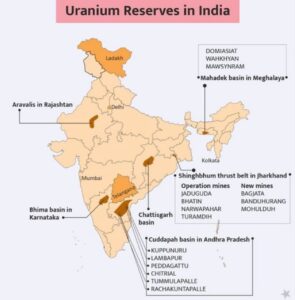
Historical Context of Uranium Mining in India
- Khasi resistance since 1980s: Communities in Domiasiat and Wahkaji have consistently opposed uranium exploration due to environmental and livelihood risks.
- Jharkhand precedent: The Uranium Corporation of India Limited (UCIL) has mined in Singhbhum district, facing decades of protests over radiation exposure and displacement.
- Past neglect: Public hearings often used unfamiliar languages, limiting tribal participation and violating principles of natural justice.
- Land as resource frontier: Tribals perceive mining decisions as an extension of exploitative policies where local needs are sidelined for national interests.
- Pattern of force: Uranium mining history reflects coercive strategies rather than consensual, participatory governance.
About Uranium Corporation of India Limited (UCIL):● Uranium Corporation of India Limited (UCIL): State-owned enterprise operating since 1967. ● Fifth Schedule (Article 244): Protects Scheduled Areas and empowers Tribes Advisory Councils. ● Sixth Schedule (Article 244): Grants autonomy to tribal councils in Northeast India. ● Niyamgiri case (2013): Supreme Court upheld gram sabha authority over land diversion. ● Environmental Impact Assessment (EIA) Notification, 2006: Mandates public consultations for major projects. ● Office Memorandum (OM): Executive order mechanism without parliamentary scrutiny. ● UNDRIP (2007): United Nations Declaration on the Rights of Indigenous Peoples—recognizes FPIC. ● Radiation risks: Long-term exposure causes cancers, genetic disorders, and ecological imbalance. ● India’s energy mix: Uranium powers nuclear energy (∼3% of total generation). ● Thorium reserves: India has large thorium deposits, offering alternative nuclear pathway. |
The Role and Impact of the OM (Office Memorandum) :
- Exemption granted: The Environment Ministry’s OM removes public consultation requirements for mining of atomic and critical minerals.
- Erosion of safeguards: OMs are executive instruments not subject to independent scrutiny, weakening democratic oversight.
- Communities sidelined: Tribals are reduced to bystanders in decisions with life-altering consequences.
- Dangerous precedent: Such executive shortcuts can reshape mining governance across India, bypassing Environmental Impact Assessment (EIA) norms.
- Condemnation: Civil society and even groups allied to ruling parties have rejected this top-down approach.
Environmental and Health Concerns of Uranium Mining :
- High pollution risk: Uranium mining causes radioactive contamination of soil, air, and water.
- Irreversible damage: Mining can permanently alter fragile landscapes of Meghalaya’s ecologically sensitive hills.
- Radiation hazards: Exposure leads to cancer, genetic mutations, and chronic diseases among workers and communities.
- Livelihood threat: Farming, forest produce, and local economy face irreparable damage.
- Global experiences: Countries like the US, Canada, and Australia have faced long-term ecological crises due to uranium extraction.
These concerns extend beyond uranium mining to other infrastructure projects. For instance, the Tato-II hydroelectric project on the Siyom river in Arunachal Pradesh’s Shi Yomi district also raises questions about river basin management and environmental impact.
Constitutional and Legal Safeguards for Tribals :
- Sixth Schedule: Empowers Khasi Hills Autonomous District Council to safeguard tribal land and resources.
- Fifth Schedule: Provides protections for Scheduled Areas with special governance mechanisms.
- Right to Consent: The principle of Free, Prior, and Informed Consent (FPIC) is embedded in international norms like UNDRIP.
- Judicial precedents: The Niyamgiri (2013) judgment upheld the role of gram sabhas in deciding forest land diversion.
- Violation risk: The OM undermines both constitutional and judicially upheld protections.
Democratic Deficit in Resource Governance :
- Dialogue breakdown: The Centre dismissed Khasi leaders’ refusal, signaling that “no” is no longer acceptable.
- Forced consent: Mining decisions often reflect coercion over consensus.
- Central vs local tension: National security arguments override local democratic rights.
- Erosion of trust: Communities lose faith in governance when objections are ignored.
- Legacy of resentment: Past experiences have already generated deep mistrust in state institutions.
Challenges in Balancing Uranium Mining and Rights :
- Environmental vulnerability: Meghalaya’s fragile ecology is at risk of permanent radiation damage.
- Health consequences: Long-term exposure to radioactive waste can devastate community health.
- Consent erosion: Ignoring tribal refusal violates democratic rights and global norms.
- Legal contradictions: OM bypasses Fifth and Sixth Schedule protections, inviting constitutional challenges.
- Security vs sustainability: Framing uranium solely as national security need overlooks alternative strategies.
- Protest potential: Intensified local resistance can destabilize the region socially and politically.
- Judicial overreach risk: Courts may need to intervene frequently, straining executive-legislative balance.
- Global reputation: Ignoring consent undermines India’s climate and human rights commitments.
- Resource misallocation: Heavy investment in uranium mining diverts funds from renewable energy alternatives.
- Tribal marginalization: Continuation of viewing tribal lands as “resource frontiers” entrenches historical injustices.
These challenges are not unique to uranium mining. Similar issues arise with other infrastructure development projects, such as the Tato-II hydro-electric project, where balancing national energy needs with local rights and environmental concerns is crucial.
Way Forward for Inclusive and Sustainable Policy :
- Respect community consent: Ensure mining projects follow Free, Prior, and Informed Consent (FPIC) norms.
- Withdraw OM: Restore mandatory public consultations for all mineral projects.
- Strengthen institutions: Empower autonomous councils under the Sixth Schedule to veto projects harmful to their people.
- Alternative strategies: Explore substitutes, other uranium deposits, or renewable power options instead of coercive mining. This could include expanding clean energy projects like the Tato-II hydroelectric project, while ensuring proper environmental safeguards.
- Transparent hearings: Conduct hearings in local languages with accessible documentation.
- Environmental safeguards: Enforce strict radiation safety and ecological monitoring frameworks.
- Judicial reliance: Communities can invoke Niyamgiri precedent to challenge OM in courts.
- Renewable focus: Invest in solar, wind, and thorium-based energy to reduce uranium dependence.
- Dialogue-based governance: Replace coercion with continuous state-community engagement.
- Balanced approach: Integrate development, security, and human rights in resource policy frameworks.
- Corporate social responsibility: Ensure mining companies contribute to local socio-economic development through skill development programmes and fair compensation packages.
- Aatmanirbhar Bharat Abhiyan: Align resource extraction with the goals of self-reliance while respecting tribal rights and environmental sustainability.
Conclusion :
Uranium mining in Meghalaya exposes the conflict between national security and tribal rights. Disregarding consent undermines democracy and risks ecological disaster. The government must prioritize inclusive dialogue, environmental protection, and constitutional safeguards, ensuring that resource governance strengthens trust instead of deepening alienation. This approach should extend to all infrastructure development projects, including hydro-electric initiatives like the Tato-II project, to ensure balanced growth that respects local communities and the environment while contributing to national grid stability and energy security.
Source : TH
Mains Practice Question :
“India’s uranium mining debate highlights the tension between energy security and tribal rights. Critically examine the role of constitutional safeguards, judicial precedents, and global norms in ensuring democratic consent for resource projects. Suggest policy measures to balance national development goals with environmental sustainability and indigenous rights.”

