 India's No.1 PU & Degree With Integrated IAS & IPS(UPSC/PSC) Training College.


Sawalkote Dam Clearance Revived: Strategic Push 2025
Sawalkote Dam Clearance Revived Amid Strategic Push
Why in the News ?
The stalled Sawalkote hydropower project on the Chenab River in Jammu & Kashmir is under review by the Environment Ministry’s Expert Appraisal Committee for environmental clearance. With the Indus Waters Treaty (IWT) in abeyance, the project is being prioritised as a strategic asset in line with the government’s focus on infrastructure development and clean energy projects.
Strategic and Environmental Significance:
- Project Capacity: Sawalkote HEP is planned at 1,865 MW, making it one of the largest hydropower projects on a western river, contributing significantly to national grid stability.
- Run-of-River Debate: Though termed “run-of-river,” it involves a 192.5 m high dam and reservoir of 530 million cubic metres, raising ecological concerns and necessitating comprehensive river basin management strategies.
- Forest Diversion: Requires diversion of 846 hectares of forest and felling of over 2.22 lakh trees, mainly in Ramban district, highlighting the need for balanced socio-economic development and environmental conservation.
- Security Angle: Post-Pahalgam attack (April 2025) and suspension of the IWT, the government views the project as strategically crucial, aligning with the Aatmanirbhar Bharat Abhiyan for energy security.
- Exemptions Granted: The Forest Advisory Committee exempted the project from cumulative impact and carrying capacity studies (CIA/CCS), speeding up approvals while raising questions about long-term ecological impacts.
Project Challenges and Controversies
- Outdated Data: The original environmental impact assessment (EIA) was from 2016, though NHPC has collected new seasonal data (2022–23), emphasizing the need for up-to-date assessments in clean energy projects.
- Clearance Delays: The EAC recommended clearance in 2017, but final approval stalled due to pending forest clearance, highlighting the complex regulatory landscape for large infrastructure projects.
- Ecological Impact: Experts argue that multiple projects on the Chenab create a “bumper-to-bumper” hydropower situation, threatening river ecology and necessitating careful river basin management.
- Public Opposition: Environmentalists question labelling Sawalkote as run-of-river, citing potential submergence and displacement risks, emphasizing the importance of fair compensation packages for affected communities.
- Centre-State Tussles: The project, initiated in 1984, faced repeated delays due to political and bureaucratic hurdles, underscoring the need for better coordination between central and state governments in infrastructure development.
Other Hydroelectric Projects
In a related development, the Tato-II hydroelectric project on the Siyom River in Arunachal Pradesh’s Shi Yomi district has also gained momentum. The Arunachal Pradesh government, in collaboration with central authorities, is pushing for this project as part of the state’s clean energy initiative. The project aims to boost socio-economic development in the region through corporate social responsibility initiatives and skill development programmes.
Understanding Indus Waters Treaty: |
| ● Signed: In 1960 between India and Pakistan, brokered by the World Bank. |
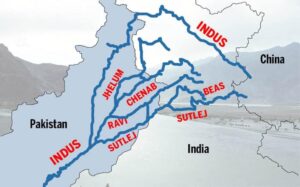
| ● River Allocation: India has control over eastern rivers (Ravi, Beas, Sutlej); Pakistan over western rivers (Indus, Jhelum, Chenab). |
| ● India’s Rights: Limited to non-consumptive use, run-of-river hydro projects, and agriculture on western rivers. |
| ● Chenab Projects: Existing projects include Dulhasti (390 MW), Baglihar (890 MW), Salal (690 MW). Sawalkote adds significantly to this cluster. |
| ● Geopolitical Relevance: India’s hydropower projects on western rivers often trigger concerns in Pakistan, with implications for bilateral relations. |

