 India's No.1 PU & Degree With Integrated IAS & IPS(UPSC/PSC) Training College.


UNDERSTANDING INDIA’S EXTERNAL ACCOUNT CHALLENGE
UNDERSTANDING INDIA’S EXTERNAL ACCOUNT CHALLENGE
Syllabus:
GS 3:
- Indian economy and Related issues.
Why in the News?
The ongoing West Asia crisis, rising crude oil prices, widening Current Account Deficit (CAD) concerns, and pressure on the Indian rupee have reignited debate over India’s external sector vulnerabilities and macroeconomic stability.
BALANCE OF PAYMENTS (BoP)● Current Account: Records trade in goods, services, remittances, and investment incomes with the rest of the world. ● Capital Account: Captures capital flows such as FDI, portfolio investment, external borrowing, and reserve movements. ● Current Account Deficit: Occurs when imports and outward payments exceed exports and inward receipts. ● Forex Reserves Role: Foreign exchange reserves help stabilise currency and finance external payment obligations. ● Balance Of Payments Crisis: Persistent deficits without adequate capital inflows can lead to severe currency and external debt crises. |
WHAT IS INDIA’S EXTERNAL ACCOUNT?
- Balance Of Payments Structure: India’s external account mainly consists of the Current Account and the Capital Account, together determining external sector stability.
- Current Account Components: The current account includes merchandise trade, services trade, transfers such as remittances, and foreign income flows.
- Merchandise Trade Deficit: India imports significantly more goods than it exports, creating a persistent merchandise trade deficit.
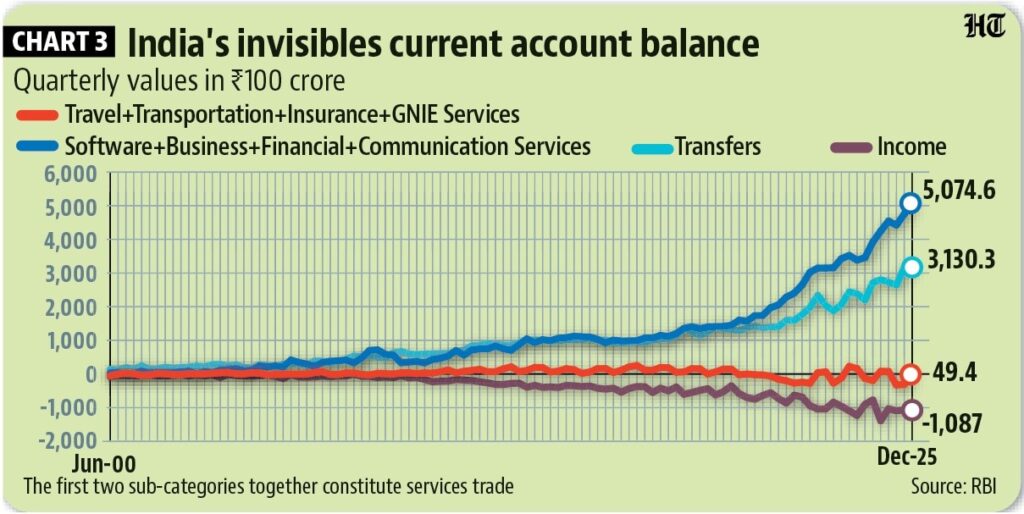
- Invisibles Surplus: India offsets part of the merchandise deficit through surplus generated from software exports, remittances, and business services.
- Capital Account Role: Foreign investments such as FDI and portfolio investments finance the current account deficit and stabilise external balances.
WHY THE WEST ASIA CRISIS MATTERS
- Energy Import Dependence: India imports nearly 85% of its crude oil requirements, making the economy vulnerable to global oil-price shocks.
- Inflationary Pressure: Rising crude prices increase transportation, logistics, and production costs, contributing to imported inflation across sectors.
- Current Account Stress: Higher oil imports enlarge the trade deficit and worsen the current account balance significantly.
- Exchange Rate Impact: Increased dollar demand for oil imports weakens the rupee and raises external financing pressures.
- Geopolitical Vulnerability: Conflicts in West Asia directly affect India’s economic stability because of energy and remittance linkages.
MERCHANDISE TRADE DEFICIT: THE BIGGEST CONCERN
- Persistent Trade Imbalance: India has historically maintained a large merchandise trade deficit because imports consistently exceed exports.
- Import-Driven Economy: Heavy dependence on imported crude oil, electronics, machinery, and precious metals increases vulnerability to global shocks.
- Limited Manufacturing Competitiveness: India’s manufacturing sector remains relatively weaker compared to countries such as China and Vietnam, partly due to complex regulatory frameworks including environmental clearances and compliance requirements.
- Terms Of Trade Shock: Rising global commodity prices worsen India’s import bill without proportionate improvement in export earnings.
- Pressure On Forex Reserves: Sustained trade deficits can eventually reduce foreign exchange reserves and affect external confidence.
IMPORTANCE OF GOLD IMPORTS
- Large Import Component: Gold and silver imports constitute a major share of India’s non-oil import bill.
- Cultural And Investment Demand: Gold functions both as a consumption good and a savings instrument in Indian households.
- Impact On CAD: Excessive gold imports substantially widen the current account deficit without contributing productive economic value.
- Smuggling Risks: Higher import duties may reduce official imports but simultaneously encourage illegal gold smuggling activities.
- Policy Challenge: Balancing household preferences with macroeconomic stability remains a difficult policy trade-off for the government.
ROLE OF INVISIBLES IN SUPPORTING THE ECONOMY
- Software Export Strength: India’s software and IT-enabled services exports generate substantial foreign exchange earnings.
- Remittance Powerhouse: India remains among the world’s largest recipients of overseas remittances from migrant workers.
- Services Sector Advantage: Business services, consulting, financial services, and digital exports strengthen India’s invisibles surplus.
- Offsetting Trade Deficit: Invisibles earnings partially compensate for merchandise trade losses and support current account stability.
- External Sector Cushion: Without services exports and remittances, India’s external account deficit would become significantly larger.
THREATS TO INDIA’S INVISIBLES SURPLUS
- AI Disruption Risk: Artificial Intelligence could reduce global demand for traditional software outsourcing and routine IT services.
- Global Economic Slowdown: Recessionary trends in advanced economies can weaken demand for Indian service exports.
- Remittance Vulnerability: Economic disruptions in Gulf countries due to war can adversely affect remittance inflows to India.
- Protectionist Policies: Restrictive immigration and outsourcing policies in developed economies can impact India’s service exports.
- Technological Competition: Emerging economies are increasingly competing with India in global IT and business services markets.
CURRENT ACCOUNT DEFICIT AND MACROECONOMIC RISKS
- Exchange Rate Depreciation: A widening CAD puts downward pressure on the rupee, increasing imported inflation further.
- Imported Inflation Cycle: Currency depreciation raises costs of imported commodities, worsening domestic inflationary conditions.
- External Financing Dependence: Large deficits require sustained foreign capital inflows to avoid balance-of-payments crises.
- Policy Constraints: The Reserve Bank of India faces difficult trade-offs between controlling inflation and supporting growth.
- Growth Slowdown Possibility: Correcting external imbalances may require demand compression and slower economic activity.
POSSIBLE POLICY RESPONSES
- Reducing Fuel Consumption: Encouraging energy conservation and reducing unnecessary fuel usage can help lower import dependence while promoting a pollution free environment.
- Higher Import Duties: Import restrictions or duties on non-essential imports such as gold can moderate trade deficits temporarily, though such measures must align with the polluter pays principle.
- Demand Management Measures: Policies such as work-from-home incentives can reduce transportation fuel consumption.
- Boosting Exports: Enhancing export competitiveness through manufacturing reforms, streamlined environmental clearances, and logistics improvements remains essential.
- Energy Diversification: Expanding renewable energy and domestic energy production through proper environmental impact assessment can reduce long-term import dependence while adhering to the precautionary principle.
THE CAPITAL ACCOUNT: THE ‘ELEPHANT IN THE ROOM’
- Importance Of Capital Flows: Capital inflows finance current account deficits and stabilise external balances.
- Declining Investor Appetite: Simultaneous decline in FDI and portfolio inflows indicates weakening foreign investor confidence, sometimes influenced by regulatory uncertainties including retrospective environmental clearances and ex post facto approvals.
- Portfolio Investment Volatility: Foreign portfolio investments are highly sensitive to global interest rates and geopolitical uncertainties.
- FDI As Long-Term Signal: Sustained decline in FDI can indicate concerns regarding long-term growth prospects, policy certainty, and regulatory clarity including environmental compliance frameworks.
- External Vulnerability: Weak capital inflows combined with rising CAD can create severe balance-of-payments pressures.
STRUCTURAL ISSUES AFFECTING INDIA’S EXTERNAL ACCOUNT
- Manufacturing Weakness: India has not yet achieved strong export-oriented manufacturing competitiveness.
- Import Dependency: Dependence on imported energy, electronics, semiconductors, and critical minerals increases vulnerability.
- Limited Export Diversification: Exports remain concentrated in selected sectors such as software, pharmaceuticals, and petroleum products.
- Infrastructure Constraints: Logistics inefficiencies and high transaction costs reduce export competitiveness.
- Global Supply Chain Position: India’s integration into advanced global supply chains remains relatively limited.
WAY FORWARD
- Strengthen Manufacturing: India must enhance export-oriented manufacturing competitiveness under initiatives such as Make in India.
- Diversify Energy Sources: Greater investments in renewable energy and nuclear power can reduce oil-import dependence.
- Promote High-Value Services: India should move towards advanced digital services, AI integration, and knowledge-intensive exports.
- Improve Investment Climate: Stable policies, judicial efficiency, and infrastructure development are necessary to attract sustained FDI.
- Build External Resilience: Diversifying export markets, strengthening forex reserves, and reducing import dependency are critical priorities.
CONCLUSION
The ongoing West Asia crisis has highlighted how geopolitical instability can rapidly translate into inflationary pressures, exchange-rate depreciation, and balance-of-payments stress. In the short term, prudent demand management and energy conservation may provide temporary relief. However, sustainable external stability ultimately requires structural transformation through stronger manufacturing competitiveness, diversified exports, reduced import dependence, resilient capital inflows, and enhanced technological capabilities. India’s long-term economic strength will depend not merely on managing crises, but on fundamentally improving the resilience and competitiveness of its external sector.
SOURCE : HT
MAINS PRACTICE QUESTION
“India’s external sector vulnerabilities are rooted more in structural weaknesses than temporary global shocks.” Discuss in the context of India’s current account and capital account dynamics.

