 India's No.1 PU & Degree With Integrated IAS & IPS(UPSC/PSC) Training College.


AT INDIA-NORDIC SUMMIT, TURN HISTORICAL SAMBANDH INTO FUTURE PARTNERSHIP
AT INDIA-NORDIC SUMMIT, TURN HISTORICAL SAMBANDH INTO FUTURE PARTNERSHIP
Syllabus:
GS 2:
- Indian and international relations.
- Global grouping.
Why in the News?
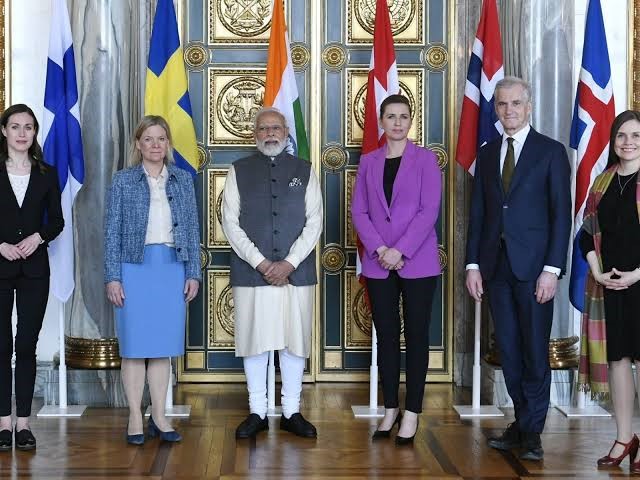
Prime Minister Narendra Modi’s visit to Oslo for the India-Nordic Summit marks the first visit by an Indian Prime Minister to Norway since Indira Gandhi’s 1983 visit, signalling renewed strategic engagement with the Nordic region.
INDIA AND MULTILATERALISM● Commitment To Global Governance: India consistently advocates reforms in global institutions to make them more representative and democratic. ● Support For Rule-Based Order: India emphasises peaceful coexistence, sovereignty, and adherence to international law. ● Strategic Autonomy Principle: India seeks diversified partnerships while preserving independent foreign-policy decision-making. ● Climate Diplomacy Leadership: India actively promotes sustainable development through initiatives like the International Solar Alliance (ISA). ● Middle-Power Cooperation: Partnerships with Nordic countries strengthen India’s role in shaping a balanced multipolar international order. |
HISTORICAL FOUNDATIONS OF INDIA-NORDIC RELATIONS
- Early Diplomatic Recognition: Norway was among the first nations to recognise an independent India in 1947, laying foundations for enduring bilateral ties.
- Kerala Fisheries Project: Norway’s developmental assistance in the 1950s modernised Kerala’s fisheries sector through motorised boats and technological cooperation.
- Institutional Legacy: The establishment of the National Institute of Fisheries Post Harvest Technology and Training (NIFPHATT) reflects sustained Indo-Norwegian cooperation.
- Cultural Resonance: Linguistic similarities such as sambandh in Hindi and samband in Norwegian symbolise deep civilisational connections.
- Stable Bilateral Relations: India and Nordic countries have largely maintained cordial ties without major geopolitical conflicts or strategic hostility.
SIGNIFICANCE OF THE INDIA-NORDIC SUMMIT
- Strategic Recalibration: The summit signifies a shift from symbolic diplomacy towards a future-oriented Green Strategic Partnership.
- Emerging Nordic Relevance: Nordic countries have become leaders in renewable energy, deep technology, innovation, and sustainable development models.
- Multipolar Cooperation: The summit reflects India’s effort to diversify strategic partnerships in an evolving multipolar world order.
- Shared Democratic Values: India and Nordic nations support multilateralism, democracy, rule-based governance, and international institutional stability.
- Economic Opportunities: The summit provides opportunities for enhanced investments, technology transfers, and sustainable industrial cooperation.
THE EFTA-INDIA TRADE AND ECONOMIC PARTNERSHIP AGREEMENT (TEPA)
- Landmark Economic Agreement: The EFTA-India TEPA represents a transformative trade arrangement involving Norway, Switzerland, Iceland, and Liechtenstein.
- Investment Commitments: EFTA countries have committed nearly $100 billion investments in India over the next 15 years.
- Boost To Manufacturing: The agreement can accelerate India’s manufacturing growth, infrastructure expansion, and green industrial transition.
- Long-Term Capital Flow: Norway’s Government Pension Fund Global, among the world’s largest sovereign wealth funds, can provide patient developmental capital.
- Strategic Economic Confidence: Increased Nordic investments would reinforce global confidence in India’s long-term economic trajectory.
GREEN ENERGY AND CLIMATE COOPERATION
- Offshore Wind Potential: Norway possesses advanced expertise in offshore wind technology, aligning with India’s renewable energy ambitions that require streamlined environmental clearances and adherence to EIA notification procedures.
- Carbon Capture Technologies: Cooperation in Carbon Capture and Storage (CCS) can support India’s decarbonisation objectives for heavy industries while ensuring compliance with environmental impact assessment frameworks and the precautionary principle.
- Green Shipping Corridors: Sustainable maritime transport initiatives can strengthen India’s blue economy and reduce shipping emissions, contributing to a pollution free environment.
- Hydrogen Mission Support: Nordic technological capabilities can assist India’s National Green Hydrogen Mission and clean-energy transition through knowledge sharing on regulatory best practices including environmental clearance mechanisms.
- Circular Economy Expertise: Scandinavian models of waste management, recycling, and sustainable production that incorporate the polluter pays principle offer valuable lessons for India.
BLUE ECONOMY AND MARITIME PARTNERSHIP
- Strategic Maritime Interests: India and Nordic countries share interests in maritime sustainability, fisheries management, and ocean governance aligned with coastal regulation zone norms.
- Coastal Development Cooperation: States like Kerala, Tamil Nadu, and Gujarat can benefit from specialised Norwegian maritime expertise while ensuring proper environmental impact assessment for coastal projects.
- Sustainable Fisheries: Norway’s experience in scientific fisheries management can strengthen India’s coastal economy and food security.
- Marine Technology Transfer: Nordic countries possess advanced technologies in shipping, marine engineering, and ocean resource management.
- Climate-Resilient Oceans: Cooperation can help address marine pollution, rising sea levels, and climate-related oceanic disruptions.
ARCTIC-INDIAN OCEAN LINKAGES
- Climate Interdependence: Changes in the Arctic region significantly influence the Indian monsoon system and food security patterns.
- Scientific Collaboration: Norway’s role in the Arctic Council provides opportunities for India’s polar research expansion.
- Climate Monitoring: Joint research can strengthen global climate observation and environmental monitoring systems.
- Geostrategic Importance: The Arctic is emerging as a critical region for shipping routes, energy resources, and geopolitical competition.
- Environmental Diplomacy: India’s engagement with Arctic nations strengthens its climate diplomacy and environmental governance credentials.
GEOPOLITICAL SIGNIFICANCE OF INDIA-NORDIC COOPERATION
- Rules-Based Order: India and Nordic countries support international law, peaceful dispute resolution, and institutional multilateralism.
- Trump Era Uncertainty: Growing unpredictability in global politics has increased the importance of stable middle-power partnerships.
- Strategic Diversification: Stronger Nordic engagement helps India reduce overdependence on major powers like the U.S. and China.
- Technological Partnerships: Nordic countries provide alternatives in critical technologies, innovation ecosystems, and sustainable infrastructure.
- Global Governance Reform: Joint cooperation can strengthen India’s voice in shaping equitable global governance structures.
CHALLENGES IN INDIA-NORDIC RELATIONS
- Limited Political Engagement: High-level diplomatic interactions remained infrequent for several decades, limiting strategic momentum.
- Small Trade Volumes: Despite strong complementarities, bilateral trade between India and Nordic countries remains relatively modest.
- Past Diplomatic Irritants: Issues such as extradition disputes and child custody controversies occasionally created diplomatic tensions.
- Geographical Distance: Physical distance and limited public awareness constrain people-to-people and business engagement.
- Underutilised Potential: India’s engagement with Nordic countries remains significantly below its potential in technology and climate cooperation, including areas of environmental jurisprudence and regulatory harmonisation.
WAY FORWARD FOR INDIA-NORDIC PARTNERSHIP
- Expand Sectoral Cooperation: Collaboration should deepen in renewable energy, AI, semiconductors, maritime technology, and climate resilience while harmonising environmental clearances and regulatory frameworks.
- State-Level Partnerships: Coastal and industrial Indian States should directly engage Nordic partners for targeted developmental cooperation, ensuring compliance with the Forest Conservation Act and sustainable land-use practices.
- Increase Research Collaboration: Joint research institutions and academic partnerships should be encouraged in climate science and technology, avoiding ex post facto regulatory challenges through proactive planning.
- Strengthen Investment Flows: India should create favourable regulatory conditions to attract long-term Nordic institutional investments while promoting environmental democracy and transparent governance.
- Enhance People-To-People Links: Educational exchanges, tourism, cultural diplomacy, and innovation partnerships should be expanded to build lasting institutional connections.
CONCLUSION
The India-Nordic Summit represents a crucial opportunity to transform historically cordial relations into a robust strategic partnership for the twenty-first century. Nordic countries possess advanced technological capabilities, sustainable development expertise, and institutional strengths that align closely with India’s developmental priorities. Simultaneously, India offers scale, markets, skilled manpower, and geopolitical relevance. In an increasingly uncertain global environment marked by geopolitical fragmentation, climate challenges, and technological competition, India and the Nordic nations share common interests in defending a rules-based international order, promoting green growth, and advancing democratic resilience. The summit therefore marks not merely a diplomatic engagement but a strategic convergence capable of shaping future global governance, sustainability transitions, and economic cooperation. Converting this historical sambandh into a transformative partnership will require sustained political attention, institutional innovation, and long-term strategic vision.
SOURCE:
IE
MAINS PRACTICE QUESTION
“India’s engagement with Nordic countries can significantly strengthen its green growth and strategic autonomy objectives.” Discuss in the context of the India-Nordic Summit.

