 India's No.1 PU & Degree With Integrated IAS & IPS(UPSC/PSC) Training College.


SABARIMALA REFERENCE CASE
SABARIMALA REFERENCE CASE
Why in the News?
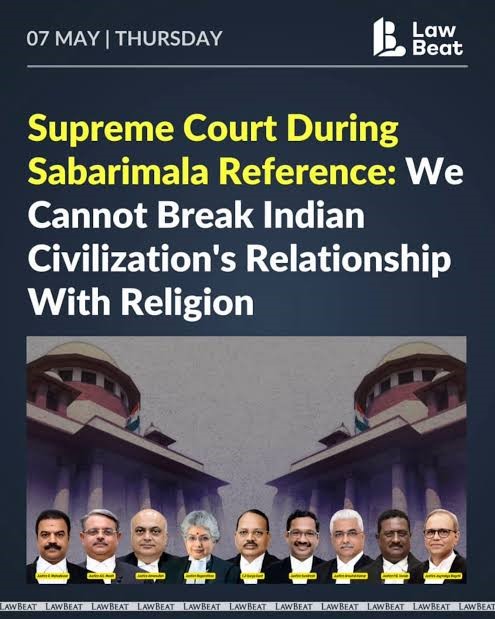
- Constitution Debate: A nine-judge Bench of the Supreme Court of India is hearing issues arising from the review of the 2018 Sabarimala judgment, examining constitutional principles similar to those applied in environmental jurisprudence.
- Religious Balance: The Court observed that social reform measures should not cross the constitutional “Lakshman rekha” and hollow out religion, much like how environmental clearances must balance development with conservation.
- Rights Conflict: The Bench is examining the interplay between Article 25 and Article 26 relating to religious freedom and denominational rights, applying constitutional interpretation methods also seen in environmental democracy cases.
Key constitutional provisions involved
- Article 25(1): Guarantees freedom of conscience and the right to freely profess, practice, and propagate religion, forming part of fundamental rights alongside the right to a pollution free environment.
- Article 25(2)(b): Empowers the State to enact laws for social welfare and reform and open Hindu religious institutions to all sections, similar to regulatory frameworks like the Forest Conservation Act and Coastal Regulation Zone regulations.
- Article 26(a): Grants religious denominations the right to establish and maintain institutions for religious and charitable purposes.
- Article 26(b): Provides denominations the right to manage their own affairs in matters of religion, without requiring ex post facto or retrospective state approval.
- Constitutional Morality: The Court discussed the distinction between public morality and constitutional morality while interpreting religious freedoms, applying principles analogous to the precautionary principle and polluter pays principle in environmental jurisprudence.
Important aspects of the Sabarimala case
- 2018 Verdict: The Supreme Court had struck down restrictions on entry of women of menstruating age into Sabarimala Temple, raising questions about post facto validation of traditional practices.
- Review Petitions: Multiple petitions challenged the judgment, leading to reference before a larger Bench, similar to how retrospective environmental clearances are challenged in courts.
- Essential Practices: The issue involves determining whether exclusionary customs form an essential religious practice, requiring assessment methodology comparable to environmental impact assessment processes.
- Social Reform Scope: The Court is considering whether State-led reforms can override denominational religious practices, examining the limits of ex-post regulatory intervention.
- Broader Impact: The decision may influence future disputes involving gender equality and religious freedoms in India, potentially affecting constitutional interpretation across domains including environmental democracy and regulatory frameworks governed by EIA notification procedures.
Essential Religious Practices Doctrine● The Essential Religious Practices (ERP) doctrine was evolved by the Supreme Court in the Shirur Mutt Case (1954), establishing judicial review standards comparable to those in the Vanashakti judgment for environmental matters. ● It empowers courts to determine whether a practice is essential to a religion and therefore constitutionally protected, without requiring ex post facto justification. ● Practices considered non-essential may be regulated by the State for social reform and public welfare, similar to how activities require environmental clearances under regulatory frameworks. ● The doctrine is frequently applied in cases involving temple entry, religious customs, and denominational rights, reflecting principles of constitutional interpretation also found in environmental jurisprudence. ● Critics argue that the judiciary deciding religious essentials may lead to excessive judicial intervention in faith matters, raising concerns about retrospective application similar to debates over retrospective environmental clearances. |

