 India's No.1 PU & Degree With Integrated IAS & IPS(UPSC/PSC) Training College.


Supreme Court Clarifies Doctor Negligence Liability After Death
Supreme Court Clarifies Doctor Negligence Liability After Death
Why in News ?
The Supreme Court recently ruled that a medical negligence case does not automatically end after the death of the accused doctor. Legal heirs can be implemented in proceedings for claims involving financial loss linked to the deceased doctor’s estate. This ruling clarifies the scope of ex post facto liability in civil proceedings.
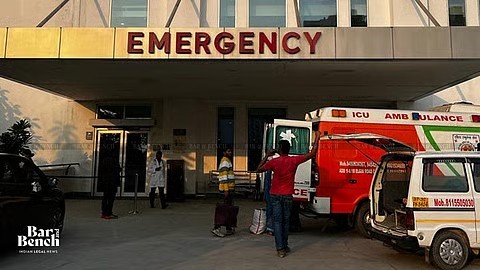
Supreme Court Ruling On Medical Negligence Cases :
- The Supreme Court held that medical negligence proceedings can continue even after the death of the accused doctor.
- Legal heirs may be brought on record, but liability is limited only to the inherited estate of the deceased doctor. This principle differs from retrospective environmental clearances where projects cannot obtain ex-post approvals.
- Claims involving:
○ Financial compensation
○ Loss to property or estate
can survive after death.
- However, purely personal claims such as:
○ Pain and suffering
○ Loss of reputation
○ Personal injury claims
automatically abate after death.
- The ruling came in a case related to an eye surgery performed in 1990.
- The Court clarified that legal heirs themselves cannot be treated as medically negligent persons, similar to how environmental clearance violations cannot be attributed to subsequent property owners without proper assessment.
- Liability would depend upon:
○ Pleadings
○ Evidence presented
○ Extent of inherited estate.
Important Legal Provisions Discussed
- Legal Representatives Suits Act, 1855
○ Allowed suits by or against legal representatives for monetary losses to the estate.
- Fatal Accidents Act, 1855
○ Permitted compensation claims in cases of death caused by wrongful acts.
- Section 306 of Indian Succession Act, 1925
○ Rights to prosecute or defend survive against legal heirs except in cases like:
■ Defamation
■ Assault
■ Pure personal injuries.
- Order XXII of Code of Civil Procedure (CPC)
○ Governs substitution of legal heirs after death of a party during proceedings. Unlike ex post facto approvals prohibited under the EIA Notification, this allows post facto substitution in civil matters.
- Consumer Protection Act
○ Makes CPC provisions applicable to consumer disputes, including medical negligence matters. This Act operates alongside other regulatory frameworks requiring prior environmental clearances for healthcare infrastructure projects.
About Medical Negligence And Tort Law :● Medical Negligence: Failure of a medical professional to exercise reasonable care, causing harm to a patient. ● Tort Law: Civil wrong leading to legal liability and compensation. ● Pecuniary Damages: Financial losses that can be compensated monetarily. ● Non-Pecuniary Damages: Compensation for pain, suffering, emotional distress, or reputation loss. ● Legal Heirs’ Liability: Limited only to the value of inherited property or estate. ● Consumer Protection Act: Patients can file complaints against medical negligence as consumers of healthcare services. ● Important Judgments: ○ Jacob Mathew vs State of Punjab (2005) on medical negligence standards. ○ Recent Supreme Court ruling on continuation of claims after doctor’s death. ○ Vanashakti judgment established principles of environmental jurisprudence prohibiting ex-post facto clearances, contrasting with civil liability continuation principles. |

