 India's No.1 PU & Degree With Integrated IAS & IPS(UPSC/PSC) Training College.


Strategic Missile Tests: Prithvi-II & Agni-I
Strategic Missile Tests: Prithvi-II & Agni-I
India recently conducted successful test flights of two nuclear-capable ballistic missiles, reinforcing its strategic strike capability and deterrence posture. These routine trials, carried out at the integrated test range in Chandipur, demonstrate the nation’s commitment to maintaining a robust strategic arsenal and ensuring national security.
Prithvi-II Missile
Type: Surface-to-surface missile, short-range ballistic missile (SRBM) Range: ~350 km Payload Capacity: Up to 500 kg (can carry both conventional and nuclear warheads)
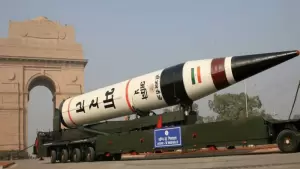
Features:
- Uses liquid propulsion
- High accuracy due to advanced inertial guidance system
- Developed under India’s Integrated Guided Missile Development Program (IGMDP)
Strategic Role: Acts as a tactical nuclear strike weapon for close targets and battlefield deterrence, enhancing India’s strike envelope in regional conflicts.
Agni-I Missile
Type: Surface-to-surface missile, short-to-medium range nuclear ballistic missile Range: ~700–900 km Payload Capacity: ~1,000 kg (nuclear-capable)
Features:
- Solid propellant, quick launch, low maintenance
- Precision targeting using a modern navigation system
Strategic Role: Serves as a credible nuclear deterrent against short and medium-range adversaries, especially Pakistan and parts of China, bolstering India’s strategic self-reliance.
Test Conducted by:
Strategic Forces Command (SFC) – a specialized wing of India’s nuclear command responsible for operational control of nuclear assets.
Significance:
- Validates India’s nuclear triad and second-strike capability
- Confirms India’s posture of credible minimum deterrence
- Ensures the missiles are ready under real-time wartime scenarios
- Comes amidst increasing regional tensions and need for strategic preparedness
- Demonstrates technological robustness of India’s nuclear-capable ballistic missiles
Air Defence Success: Akash Prime in Ladakh
Akash Prime Missile
Type: Upgraded variant of Akash SAM (Surface-to-Air Missile) Range: ~25–30 km Altitude: Tested above 4,500 metres, specifically tuned for high-altitude warfare Payload: ~60 kg Guidance: Enhanced with indigenously developed Radio Frequency (RF) Seeker
Significance of Test in Ladakh:
- Tested near the Line of Actual Control (LAC) – the sensitive Indo-China border
- Demonstrates India’s capability to deploy air defence systems in high-altitude, harsh terrains like the Himalayas
- Reflects India’s operational readiness against aerial threats including drones, helicopters, and enemy aircraft in forward areas
Upgrades & Feedback Loop:
Based on user feedback from field operations, especially Operation Sindoor, Akash Prime received:
- Improved mobility for better operational flexibility
- Enhanced target-tracking in mountainous terrain
- Upgraded electronics for faster response and precision, increasing operational effectiveness
Indigenous Push:
- Developed by DRDO with Indian industry partners
- Showcases strength of India’s Atmanirbhar Bharat (self-reliant defence) mission
- Reduces dependency on foreign air defence systems (e.g., S-400s)
Political & Strategic Context
The Defence Ministry hailed this as a triple success showcasing India’s indigenous capability across both ballistic and air defence domains. These tests come at a critical time when:
- China is ramping up missile deployment along borders
- Pakistan is investing in tactical nuclear weapons and long-range missiles
- India is reinforcing deterrence across the two-front war doctrine
The successful trials underscore India’s commitment to meeting its operational requirements and maintaining a strong deterrence posture in the region.
Summary: Why It Matters
| Test | Weapon System | Strategic Role | Location | Significance |
| Prithvi-II | SRBM, nuclear-capable | Tactical deterrent | Chandipur | Battlefield nuclear strike capability |
| Agni-I | MRBM, nuclear-capable | Regional deterrent | Chandipur | First-line strategic deterrence |
| Akash Prime | Air Defence, SAM | Anti-aircraft/missile | Ladakh | High-altitude air defence and force protection |
These successful test flights of nuclear-capable ballistic missiles and air defence systems demonstrate India’s commitment to maintaining a credible strategic arsenal. By conducting routine trials and continuously improving its nuclear assets, India ensures the operational effectiveness of its deterrence posture while promoting strategic self-reliance in defence technology.




