India's No.1 PU & Degree With Integrated IAS & IPS(UPSC/PSC) Training College.


India’s ULRA Stealth Bomber: A Strategic Leap Toward Global Power Projection
India’s ULRA Stealth Bomber: A Strategic Leap Toward Global Power Projection
India is entering a new era of strategic deterrence and military modernization with the conceptualization of its most ambitious aerospace defense project to date—the Ultra-Long Range Strike Aircraft (ULRA). This advanced strategic bomber, designed to fly over 12,000 kilometers without refueling, will enable India to project air power across continents, potentially reaching cities like New York from domestic bases. Once operational, this stealth aircraft will mark a historic transition in India’s defense posture—from regional security to global strike capability.
The Vision: A True Intercontinental Bomber
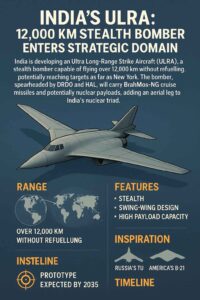
India’s ULRA project envisions an indigenously developed, stealth-enabled, strategic bomber capable of delivering high-precision strikes deep inside adversary territory. It is being jointly developed by DRDO and HAL as part of a special access program, drawing inspiration from elite global systems such as Russia’s Tu-160 “Blackjack”, the U.S. Air Force’s B-2 Spirit, and the next-generation B-21 Raider.
The ULRA aims to join the ranks of elite platforms by delivering:
- Intercontinental range (~12,000 km) with unrefueled range capabilities, with potential for aerial refueling to extend its reach even further, • Heavy payload capacity (~12 tonnes) in an advanced weapons bay, • Stealth technology to minimize radar cross section and avoid detection, • Swing-wing design for aerodynamic efficiency and operational flexibility.
Design Philosophy: Blending Stealth, Speed & Payload
Global Inspiration:
- Russia’s TU-160: A proven long-range bomber with swing wings and Mach 2+ speed. • America’s B-2 Spirit and B-21 Raider: Designed for deep-strike missions with top-tier stealth characteristics, including minimized radar cross section.
Proposed ULRA Features:
- Swing-Wing Configuration: For balance between speed and maneuverability. • Broadband Stealth Capabilities: To reduce radar signature and evade enemy detection. • Heavy Weapons Payload: Including supersonic cruise missiles, guided bombs, and short-range nuclear assets. • Composite Materials and Titanium Alloy: Utilization of advanced technology in airframe construction for strength and stealth. • Electronic Countermeasures: Enhanced survivability against modern air defenses. • Stealth Coating: Advanced materials to further reduce radar cross section.
The ULRA’s design philosophy draws heavily from the B2 Spirit’s success in minimizing its radar signature, aiming to achieve similar levels of stealth performance.
Weapons Loadout: Firepower Across the Spectrum
The ULRA is designed to carry an advanced and flexible armament suite in its sophisticated internal weapons bay:
Primary Weapon:
- BrahMos-NG (Next Generation): A lighter, faster variant of India’s supersonic cruise missile, ideal for internal carriage in stealth configuration.
Secondary Payload Options:
- Agni-1P: Short-range ballistic missiles with nuclear delivery potential. • Laser-Guided Bombs: For surgical strikes. • Anti-Radiation Missiles (ARM): For targeting enemy radar and air defense systems.
This flexible payload configuration enhances both conventional and strategic deterrence, making the ULRA a true force multiplier in India’s arsenal.
Strategic Significance: Strengthening the Triad
ULRA will form the air-based leg of India’s nuclear triad, complementing submarine-launched and land-based systems. Its long reach ensures second-strike capability, even if India’s land and sea-based assets are compromised in a first strike. This capability is crucial for India’s evolving nuclear doctrine and overall strategic posture.
Additionally, the bomber allows India to:
- Conduct deep penetration missions across multiple theaters, • Establish global air presence in distant regions like Africa, the Pacific, or Eastern Europe, • Deter multiple adversaries with flexible, credible force projection. • Enhance mission planning capabilities for complex, long-range operations.
The ULRA’s strategic significance is comparable to that of the B21 Raider for the United States, representing a leap in long-range strike capabilities and global power projection.
Development & Timelines: The Road Ahead
- 2024–2026: Feasibility studies, design trials, and system integrations. • 2027 onward: Technology partnerships and prototype fabrication. • By 2035: First prototype flight expected, initiating flight testing phase. • Mid-2030s: Entry into operational service, achieving full operational capability.
Russia and France are reported to be potential partners in providing engine technology (possibly afterburning turbofan), stealth coatings, and avionics systems, building on past Indo-Russian collaborations and the recent India-France jet engine pact. This international collaboration is crucial for overcoming technical challenges and meeting the ambitious development timeline.
International Watchlist: A Global Game-Changer
The ULRA’s announcement has captured global attention as a potential black project. Observers from China, Pakistan, the U.S., and Australia are closely tracking developments, given the potential shift in air-power dynamics.
Its emergence suggests a major policy evolution in Indian defense—from reactive territorial defense to offensive long-range readiness, aligning India’s military aircraft capabilities with superpower standards set by the B-2 and B-21 programs.
Current Status: Vision vs. Reality
The ULRA remains in its conceptual phase. No physical prototype has been unveiled yet, and the program costs are still being evaluated.
While the project has high strategic potential, challenges lie ahead:
- Engine development capable of sustained high-speed intercontinental flight, • Stealth integration with heavy weapons carriage in the internal weapons bay, • Command-and-control compatibility for nuclear deterrent missions, • Optimizing the flying wing design for maximum stealth and performance. • Perfecting stealth configuration to minimize radar cross section across various frequencies.
Experts caution that while the concept is transformative, successful realization depends on consistent funding through the defense budget, global tech partnerships, and clear strategic prioritization. The cost per aircraft and maintenance requirements, including specialized stealth coating upkeep, will be significant factors in the program’s long-term viability.
Conclusion: India’s Strategic Skyward Shift
If realized as planned, the ULRA will not just be a weapon—it will be a symbol of India’s arrival as a global aerospace and strategic power. With its unmatched range, stealth technology, and nuclear capability, the aircraft will reconfigure the strategic balance in Asia and beyond.
The ULRA’s mission profile, combining advanced stealth configuration, threat warning systems, and a reduced infrared signature, positions it as a formidable asset in India’s military arsenal. As the project moves from concept to reality, its impact on global security dynamics and India’s position as a world power will be profound and far-reaching.