 India's No.1 PU & Degree With Integrated IAS & IPS(UPSC/PSC) Training College.


Voting Is More Than a Statutory Right
In India, voting cannot remain merely a statutory right
Syllabus
GS 2: Government Interventions
Introduction
- Citizenship defines the legal relationship between an individual and the State, establishing voting qualifications and voter eligibility standards that prevent disenfranchisement.
Why in the News?
- Recent debate: A Congress leader reignited the constitutional debate by demanding that the right to vote be recognised as a Fundamental Right, similar to how constitutional amendments in other democracies have protected voting rights against discriminatory practices.
- Present legal position: The Supreme Court of India (SC) has consistently held for over seven decades that the right to vote is a statutory right, not a Fundamental Right, applying rational basis scrutiny rather than strict scrutiny to election laws.
- Emerging constitutional paradox: Although voting itself remains statutory, several essential aspects of voting have gradually received constitutional protection through judicial interpretation, moving toward heightened scrutiny in electoral matters.
- Judicial evolution: The SC has progressively transformed the voter from a passive statutory beneficiary into an active constitutional participant in the democratic process, addressing concerns about voter fraud and ensuring fair voting practices.
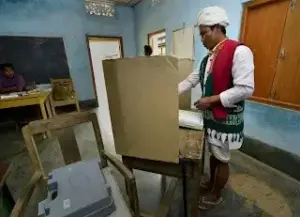
Judicial Position on the Right to Vote
- N.P. Ponnuswami v. Returning Officer (1952):
- Held that the right to vote and the right to contest elections are statutory rights, not common law rights, establishing the framework for state elections and federal elections alike.
- Jyoti Basu & Others v. Debi Ghosal & Others (1982):
- Justice O. Chinnappa Reddy observed that although the right to elect is fundamental to democracy, it is neither a Fundamental Right nor a common law right, but a purely statutory right, distinguishing it from the equal protection clause standards applied in other jurisdictions.
- Kuldip Nayar v. Union of India (2006):
- Reaffirmed that while democracy forms part of the Constitution’s Basic Structure, the individual right to vote flows from legislation, primarily the Representation of the People Acts, which regulate primary elections, congressional elections, and presidential election procedures.
Constitutional Basis for the Existing Position
- The Constitution does not expressly include the right to vote among the Fundamental Rights under Part III, unlike constitutional amendments such as the Fifteenth Amendment, Nineteenth Amendment, and Twenty-Fourth Amendment in other democracies.
- Consequently, Parliament has the authority to prescribe:
- Qualifications and disqualifications of voters, including residency restrictions and provisions regarding convicted felons.
- Electoral procedures and regulations to prevent gerrymandering and malapportionment.
- Other conditions governing elections through statutory law, addressing voter registration and voter id laws.
Global Context: Lessons from Constitutional Evolution
- Historical struggles against disenfranchisement: The evolution of voting rights globally demonstrates how discriminatory practices based on ethnicity and racial discrimination were challenged through constitutional amendments and civil rights movements.
- Post-Civil War reforms: The Reconstruction Amendments, including Amendment XV (the Fifteenth Amendment), sought to eliminate barriers that prevented the African American population from exercising electoral power, though grandfather clauses and poll taxes continued discriminatory practices.
- Enforcement mechanisms: The Enforcement Act and later the Civil Rights Act and Voting Rights Act were necessary to combat organizations like the Ku Klux Klan and eliminate barriers to voter registration.
- Landmark judicial decisions: Cases like Harper v Virginia eliminated poll taxes, Reynolds v Sims addressed malapportionment in legislative districts based on population basis, and Bush v Gore dealt with recount procedures involving hanging chads and dimpled chads during a presidential election.
- Expanding suffrage: The Seventeenth Amendment enabled direct election of senators, while the Nineteenth Amendment extended voting rights beyond white male voters, and the Fourteenth Amendment’s equal protection clause became crucial in challenging voting strength dilution in electoral districts.
Transition
- Despite its statutory status, subsequent judicial developments have increasingly constitutionalised various facets of the voting process, creating a significant constitutional debate over whether the right to vote should continue to remain merely statutory, particularly in light of the civil rights movement’s legacy and ongoing concerns about discriminatory practices in election day procedures.
Constitutionalising the Poll Process
- Shift towards constitutionalisation: From the early 2000s, the Supreme Court began expanding constitutional protection to various aspects of the electoral process, moving beyond rational basis scrutiny toward stricter standards in reviewing election laws.
Right to Know (2002):
- In Union of India v. Association for Democratic Reforms (2002), the Court recognised voters’ right to know the criminal background, educational qualifications, and financial assets of candidates.
- This right was derived from Article 19(1)(a) (Freedom of Speech and Expression), ensuring transparency in voting practices.
- The Court held that informed voting is essential for meaningful democratic participation, preventing voter fraud and ensuring electoral integrity.
Freedom of Voting (2003):
- In People’s Union of Civil Liberties v. Union of India (2003), the Court reaffirmed that the right to vote is a statutory right.
- However, it distinguished the freedom of voting—the right to make an informed and independent choice—as a fundamental right protected under Article 19(1)(a), applying heightened scrutiny to restrictions on this freedom.
Recognition of NOTA (2013):
- The Supreme Court recognised the ‘None of the Above’ (NOTA) option, enhancing voter eligibility to express dissent.
- It held that rejecting all candidates is a form of political expression, protected under Article 19(1)(a).
- The Court also ruled that the secrecy of the ballot applies equally to voters choosing NOTA, protecting voting practices from external pressure.
Constitutional Paradox:
- The Court has granted constitutional protection to:
- The right to know about candidates.
- The freedom to make an informed choice.
- The secrecy of the ballot.
- The right to reject all candidates (NOTA).
- However, the act of casting a vote itself continues to be treated as only a statutory right, creating a constitutional anomaly similar to historical contradictions where voting qualifications were subject only to rational basis scrutiny despite their fundamental importance.
Key Observation: “The right not to vote enjoys constitutional protection; paradoxically, the right to vote does not.”
Judicial Shift Towards Constitutional Recognition of Voting
- Key Constitutional Question:
- If the Constitution protects the right to reject all candidates (NOTA), should it not also protect the right to choose a candidate, ensuring equal protection in electoral power?
- Anoop Baranwal v. Union of India (2023):
- In his separate opinion, Justice Ajay Rastogi advocated recognising the right to vote as a fundamental right, applying strict scrutiny to laws affecting voting strength.
- Although this view did not receive majority support, the Constitution Bench repeatedly described voting as a constitutional right, indicating a shift from the traditional view of it being merely statutory.
- Evolving Judicial Approach:
- The Supreme Court has not formally declared voting to be a fundamental right.
- However, its jurisprudence reflects a movement beyond the narrow statutory conception towards greater constitutional recognition of voting rights, addressing concerns about disenfranchisement and discriminatory practices in voter registration.
Voting and the Basic Structure Doctrine
- Democracy as Basic Structure:
- In Kesavananda Bharati v. State of Kerala (1973), the Supreme Court held that democracy forms part of the Constitution’s Basic Structure, which cannot be altered even by constitutional amendment.
- Free and Fair Elections:
- In Indira Nehru Gandhi v. Shri Raj Narain (1975), the Court affirmed that free and fair elections are an essential feature of democracy and therefore integral to the Basic Structure, requiring protection against gerrymandering and malapportionment in electoral districts.
- Consistent Judicial Position:
- Subsequent Supreme Court judgments have consistently reaffirmed that democracy and free and fair elections are indispensable constitutional values, strengthening the case for according greater constitutional protection to the right to vote, similar to how the Voting Rights Act protected against discriminatory practices.
- The Supreme Court’s evolving jurisprudence increasingly treats voting as a constitutional value rooted in democracy and the Basic Structure doctrine, even though it has not yet formally recognised it as a fundamental right, maintaining a distinction from jurisdictions where constitutional amendments explicitly protect voting rights.
Democracy Begins with Votes
Voting is the foundation of democracy:
- Democracy functions through elections, and elections derive their legitimacy from the participation of citizens on election day.
- The vote is the primary instrument through which popular sovereignty is exercised, whether in state elections, federal elections, or primary elections.
- By voting, “We, the People” periodically renew the legitimacy of the government and ensure its accountability, preventing the concentration of electoral power.
Need for Constitutional Recognition:
- Since democracy is part of the Constitution’s Basic Structure and free and fair elections are essential to democracy, the right to vote should form part of the constitutional core, rather than remain merely a statutory right subject to rational basis scrutiny.
- Treating democracy as a constitutional principle while considering voting only a statutory right creates a constitutional inconsistency, particularly when considering how the civil rights movement fought against disenfranchisement based on ethnicity and racial discrimination.
Voting Need Not Be an Absolute Fundamental Right:
- Constitutional recognition of voting does not imply that it should be free from reasonable regulation.
- Parliament must retain the power to prescribe:
- Qualifications and disqualifications of voters, including provisions for convicted felons.
- Electoral procedures and rolls to maintain accurate voter registration.
- Residency restrictions to ensure proper representation in legislative districts.
- Measures to prevent corrupt electoral practices, voter fraud, and discriminatory practices.
- Such regulations are necessary to ensure free, fair, and orderly elections, preventing gerrymandering and ensuring proper population basis for electoral districts.
Core Right vs. Procedural Regulations:
- What deserves constitutional protection is the core right of every eligible citizen to participate in the democratic process, not every procedural aspect of elections.
Constitutional Basis: Article 326
- Universal Adult Suffrage:
- Article 326 mandates that elections to the Lok Sabha and State Legislative Assemblies shall be based on universal adult suffrage.
- Constitutional Entitlement to Vote:
- Every citizen 18 years and above has a constitutional entitlement to be registered as an elector, subject only to constitutionally permitted disqualifications.
- This entitlement flows directly from the Constitution, not from ordinary legislation.
- Role of the Representation of the People Acts:
- The Representation of the People Acts do not create the right to be an elector; they merely operationalise the constitutional mandate contained in Article 326.
- Constitutional Guarantee:
- While the mechanics and procedures of voting may be governed by statute, the citizen’s entitlement to be a voter is constitutionally guaranteed.
- Therefore, exclusion from the electoral roll, except on constitutionally valid grounds, amounts to a violation of a constitutional guarantee.
- The Constitution itself guarantees the right of every eligible citizen to participate in elections, while statutory laws regulate only the procedure. This strengthens the argument that the core right to vote deserves constitutional recognition beyond its present statutory status.
A Matter for the Court to Revisit
- Changing Constitutional Landscape:
- The distinction between statutory rights and constitutional rights may have been appropriate in the early years of the Republic when electoral jurisprudence was still evolving.
- However, through successive judgments, the Supreme Court has progressively constitutionalised several facets of the voting process, making this distinction increasingly blurred.
- Need to Reconsider the Existing Doctrine:
- The author argues that the Supreme Court should revisit its traditional position that voting is merely a statutory right.
- In a constitutional framework where democracy and free and fair elections form part of the Basic Structure, the right to vote deserves stronger constitutional recognition.
- Voting as an Expression of Popular Sovereignty:
- The ballot is not merely a statutory privilege granted by Parliament.
- It is the primary instrument through which popular sovereignty is exercised.
- Voting enables citizens to periodically renew the democratic legitimacy of the State and hold governments accountable.
- Resolving the Constitutional Inconsistency:
- The Constitution already protects the right to reject all candidates (NOTA) as a form of political expression.
- Therefore, it is logically inconsistent to deny similar constitutional protection to the right to choose a candidate.
- The Supreme Court should reconsider its long-standing doctrine and recognise that the core right to vote is a constitutional right, as it is indispensable to democracy, popular sovereignty, and the Constitution’s Basic Structure.
Way Forward
- Revisit Judicial Doctrine: The Supreme Court should reconsider its long-standing position that the right to vote is merely a statutory right in light of evolving constitutional jurisprudence.
- Recognise Voting as a Fundamental Right: The core right of every eligible citizen to vote should be recognised as a Fundamental Right under Article 19(1)(a) and read harmoniously with Article 326.
- Strengthen Electoral Democracy: Ensure that the right to vote is protected as an essential component of popular sovereignty, free and fair elections, and the Basic Structure of the Constitution.
- Retain Reasonable Regulation: Continue allowing Parliament to regulate electoral procedures, qualifications, disqualifications, and electoral rolls to maintain the integrity of elections.
- Guarantee Universal Enfranchisement: Prevent arbitrary exclusion from electoral rolls and ensure that every eligible citizen can effectively exercise the right to vote.
- Deepen Voter Empowerment: Strengthen voter awareness, access to candidate information, electoral transparency, and the secrecy of the ballot to make democratic participation more meaningful.
- Legislative and Constitutional Reforms: Consider appropriate constitutional or legislative measures to remove the anomaly between the constitutional protection of voting-related rights (e.g., NOTA, informed choice) and the absence of similar protection for the act of voting itself.
Source: The Hindu
Mains Practice Question
Should the right to vote be recognised as a Fundamental Right in India? Critically examine in the light of constitutional provisions and Supreme Court judgments. (15 Marks, 250 words)

