India's No.1 PU & Degree With Integrated IAS & IPS(UPSC/PSC) Training College.


Saudi–Pakistan Pact Reshapes India’s Strategic Landscape
Saudi–Pakistan Pact Reshapes India’s Strategic Landscape
Syllabus:
GS Paper – 2 Bilateral Groupings & Agreements, Groupings & Agreements Involving India and/or Affecting India’s Interests, Effect of Policies & Politics of Countries on India’s Interests
Why in the News?
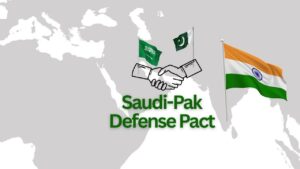
The recently concluded Strategic Mutual Defence Agreement between Saudi Arabia and Pakistan has triggered concerns in New Delhi. The clause declaring that “any aggression against either country will be treated as aggression against both” indicates a deepening security partnership that could alter India’s strategic calculations in West Asia and South Asia, potentially impacting India-Israel relations and India’s de-hyphenation policy in the region.
Background of the Saudi–Pakistan Defence Pact
- Historic agreement: Pakistan and Saudi Arabia signed a Strategic Mutual Defence Agreement (SMDA) in September 2025, reaffirming military and security cooperation.
- Security clause: The pact includes a collective defence clause, indicating that an attack on one will be considered an attack on the other.
- Post-terror dynamics: It followed the April 2025 Pahalgam terror attack, which caused the largest India–Pakistan military exchange since 1971.
- India’s diplomatic push: India had mobilised a global campaign to isolate Pakistan, but the Saudi pact weakened those efforts, challenging India’s multilateral diplomacy.
- Regional impact: The agreement reinforces Pakistan’s strategic leverage and complicates India’s outreach to key Gulf states under its Look West Policy, potentially affecting India’s engagement with the Palestine Liberation Organization.
| Key Facts and policies: |
| ● Strategic Mutual Defence Agreement (2025): Pact between Saudi Arabia and Pakistan ensuring collective defence. |
| ● Look West Policy: India’s outreach to Gulf nations for energy security and trade diversification. |
| ● Operation Sindoor (2025): Indian military operation post-Pahalgam terror attack targeting Pakistan-based terror camps. |
| ● Non-Alignment 2.0 Doctrine: India’s modern adaptation emphasising strategic autonomy and multipolar engagement. |
| ● Balance of Power Theory: Explains how alliances form to prevent dominance by one state or bloc. |
| ● Islamic Bomb Concept (1980s): Refers to Pakistan’s nuclear capability viewed as a deterrent for the Islamic world. |
| ● India’s energy imports: ~63% of crude oil sourced from West Asia. |
| ● Indian diaspora: Over 9 million Indians reside in Gulf countries, contributing significant remittances. |
| ● UN Charter Article 51: Basis for collective defence pacts like the Saudi–Pakistan agreement. |
| ● Strategic Autonomy in Indian Policy: Aims for independence in decision-making while engaging multiple power centres. |
India’s Diplomatic Context and Immediate Concerns
- Operation Sindoor: India’s cross-border operation targeting terror camps in Pakistan heightened tensions during the Saudi FM’s visit to New Delhi, raising questions about international humanitarian law.
- Diplomatic unease: Despite India’s efforts, Riyadh maintained dialogue with Islamabad, reflecting its balancing approach.
- Leadership optics: Prime Minister Modi’s visit to Riyadh during this crisis underscored India’s attempt to consolidate West Asia ties, but the pact diluted those gains, challenging India’s diplomatic balancing act.
- Symbolic setback: The Saudi decision reflects strategic autonomy rather than anti-India intent, but it challenges India’s Middle East diplomacy credibility.
- Shift in alliances: India’s assumption that Gulf states would remain neutral in South Asian conflicts is no longer guaranteed, potentially impacting India’s role in the UN Security Council.
Geopolitical Linkages: Beyond South Asia
- West Asia turbulence: The pact is part of wider reorientations in West Asia since the Hamas–Israel conflict of 2023, reshaping alliances and affecting India-Israel relations.
- Iran–Saudi thaw: Riyadh’s rapprochement with Tehran (mediated by China) has diversified its foreign policy tools, eroding U.S. dominance.
- Riyadh’s balancing act: Saudi Arabia now balances ties between rivals—Iran, Pakistan, Israel, and India—to sustain regional influence.
- Multipolar impulses: The pact highlights multipolar realignment, where states pursue strategic autonomy over ideological loyalty.
- India’s challenge: New Delhi’s energy and diaspora dependence on the Gulf demands pragmatic engagement despite such setbacks, necessitating a diplomatic balancing act.
Evolution of the Saudi–Pakistan Relationship
- Historic military ties: Since the 1960s, Pakistani military advisers have trained Saudi forces and guarded royal assets.
- Nuclear undertones: Pakistan, the only Islamic nuclear power, remains a potential supplier of nuclear deterrence guarantees for Riyadh.
- Strained period: Relations soured in 2015 when Pakistan refused to join the Saudi-led Yemen campaign against Iran-backed Houthis.
- Strategic restoration: The 2025 pact restores the lost trust, reviving Pakistan’s centrality in Saudi security planning.
- Mutual gains: While Riyadh secures a military partner outside the U.S. orbit, Islamabad regains economic and political patronage from the Kingdom.
India’s Strategic Misreading and Policy Lessons
- False assumptions: India’s belief that its expanding West Asia engagement could wedge Arab states from Pakistan has proved over-optimistic.
- Religious and ideological ties: The Sunni Islamic connect between Riyadh and Islamabad remains an enduring foundation beyond realpolitik.
- Strategic autonomy paradox: Saudi Arabia’s pursuit of multi-alignment mirrors India’s own doctrine but works against Indian interests here.
- Dependence dilemma: India’s energy imports (over 60%) and diaspora remittances from Gulf countries limit its strategic flexibility.
- Need for recalibration: India must adapt from symbolic diplomacy to sustained institutional partnerships focusing on defence, technology, and economy, while considering domestic political considerations.
The Broader Global Reordering
- Declining U.S. reliability: Riyadh’s scepticism of U.S. security guarantees drives it toward regional diversification, including China and Pakistan.
- Pakistan’s advantage: The Pakistan Army, with decades of combat experience, offers Riyadh reliable military manpower.
- Emerging blocs: The pact fits into a post-Western realignment, where China, Russia, Iran, and Pakistan increasingly cooperate in parallel networks.
- India’s position: India’s non-aligned strategic autonomy now appears cautious amid a risk-taking regional order.
- Opportunity in crisis: If India enhances defence cooperation with Gulf monarchies and leverages soft power diplomacy, it can retain influence and strengthen its global South leadership.
The Message for India’s Strategic Thought
- Risk-aversion problem: India’s cautious diplomacy often undercuts its capacity for decisive leadership in turbulent times.
- Chief pacifist image: India’s overemphasis on moral neutrality risks strategic irrelevance in a realist, multipolar world.
- Geopolitical assertiveness: India must embrace calculated risks—whether in deterrence, diplomacy, or defence outreach.
- Strategic realism: Aligning principled neutrality with power projection is key to maintaining regional authority.
- Urgency of action: The Saudi–Pakistan pact signals that the world won’t wait for India’s turn—it must act with resolve and foresight.
Challenges:
- Erosion of regional leverage: India’s ability to act as a balancer in West Asia is undermined by the Riyadh–Islamabad defence alignment.
- Security vulnerability: Increased Saudi–Pakistani defence cooperation may indirectly aid Pakistan’s military capabilities, affecting India’s western front.
- Diplomatic credibility: The deal questions India’s success in isolating Pakistan internationally, especially after the Pahalgam terror attack.
- Energy dependency: With Saudi Arabia and UAE as major energy suppliers, India’s reaction space is strategically constrained.
- Perception management: India risks being viewed as passive or hesitant amid shifting alliances if it avoids proactive engagement.
- Religious geopolitics: The Sunni-centric bloc led by Riyadh and Islamabad may marginalise India within Islamic multilateral forums like the OIC.
- Strategic overstretch: Balancing ties with Iran, Israel, and the Arab world simultaneously becomes increasingly complex.
- Lack of institutional mechanisms: India’s foreign policy in West Asia remains leader-centric, lacking sustained bureaucratic depth.
- Risk of polarisation: The revival of the ‘Islamic bomb’ narrative could reintroduce nuclear anxieties in South Asia.
- Domestic opinion: India’s muted response may face domestic criticism for appearing diplomatically reactive, potentially leading to civil society protests.
Way Forward:
- Deepen Look West Policy: Strengthen ties with Saudi Arabia, UAE, Oman, and Qatar through economic, technological, and counter-terror partnerships.
- Enhance defence cooperation: Expand joint military training, intelligence sharing, and defence industrial collaboration with Gulf states.
- Diversify energy sources: Reduce overdependence on Gulf oil through renewables, strategic reserves, and African partnerships.
- Reassert strategic autonomy: Maintain balanced relations with Iran and Israel while avoiding alignment with any single bloc.
- Institutionalise diplomacy: Establish a West Asia Strategic Dialogue (WASD) led by the MEA for long-term coordination.
- Invest in soft power: Leverage India’s diaspora, education, and healthcare to build influence beyond military channels.
- Realpolitik approach: Recognise that morality and strategy must coexist — foreign policy cannot rely solely on idealism.
- Boost multilateral engagement: Reinvigorate participation in the IORA, SCO, and BRICS+ to counter emerging Islamic power centres.
- Strengthen deterrence: Modernise India’s nuclear and conventional posture to address indirect threats from Pakistan’s renewed confidence.
- Strategic patience: Pursue long-term regional credibility through consistency, not episodic responses.
Conclusion:
The Saudi–Pakistan defence pact reflects the fluidity of global alignments in a multipolar world. For India, it’s a strategic wake-up call demanding sharper realism, faster policy response, and stronger regional partnerships. India must combine moral leadership with strategic assertiveness to remain an influential power in West Asia and beyond. This requires a delicate diplomatic balancing act, considering both international dynamics and domestic political considerations, while asserting India’s role as a leader in the Global South.
Source: TH
Mains Practice Question:
“Examine how the 2025 Saudi–Pakistan defence pact reflects the changing nature of alliances in West Asia. Discuss its implications for India’s Look West Policy and strategic autonomy. Suggest policy measures India should adopt to preserve its influence in an evolving multipolar regional order.”