 India's No.1 PU & Degree With Integrated IAS & IPS(UPSC/PSC) Training College.


New Ramsar Sites in India: Silisari Lake & Kopra Jalashaya
New Ramsar Sites in India: Silisari Lake & Kopra Jalashaya
(Relevant for UPSC & State PSC Examinations)
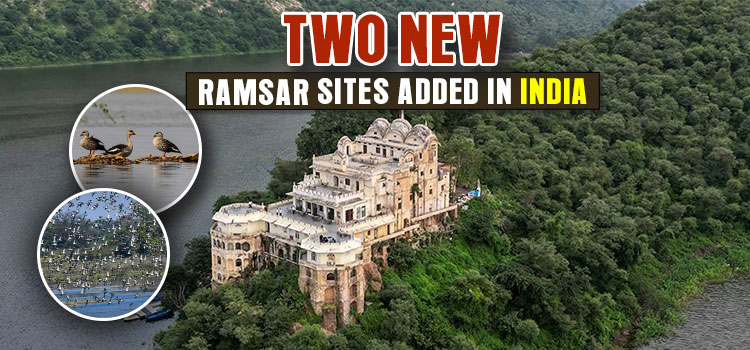
India has recently added two new wetlands to its list of Ramsar sites, reinforcing its commitment to environmental conservation. The first Ramsar site from Chhattisgarh, Kopra Jalashaya, has been included, while Silisari Lake has been designated from Rajasthan. These additions are significant from both ecological and examination perspectives.
It is important to note that Silisari Lake is not the first Ramsar site of Rajasthan. The state already has several Ramsar sites, including Khichan Bird Sanctuary, which was added recently. Apart from these, Rajasthan also has two well-known Ramsar sites that are frequently asked in competitive examinations and should be revised by aspirants.
With these recent inclusions, the total number of Ramsar sites in India has reached 96. India now ranks first in Asia and third globally, after the United Kingdom and Mexico, highlighting its leading role in wetland conservation.
What is a Ramsar Site?
Ramsar sites are wetlands of international importance. Wetlands are ecosystems where land remains permanently or seasonally saturated with water. These ecosystems play a vital role in maintaining the hydrological cycle by supporting evaporation, cloud formation, and precipitation.
Wetlands also act as natural filters, absorbing pollutants and heavy metals, similar to how kidneys filter toxins in the human body. Due to these ecological functions, wetlands are essential for biodiversity conservation, climate regulation, and sustaining local livelihoods.
The concept of Ramsar sites originates from the Ramsar Convention, held in 1971 in Ramsar, Iran, which came into force in 1975. Once a wetland is designated as a Ramsar site, it comes under international monitoring, and the concerned country is responsible for its protection and sustainable management.
Silisari Lake (Rajasthan)
Silisari Lake is a human-made artificial lake, constructed in 1845 by Maharaja Vinay Singh. The Alwar region faced severe water scarcity, leading to the construction of aqueducts and artificial channels to divert water from the Ruparel River. Initially developed to meet drinking water needs, the lake gradually evolved into an important wetland ecosystem.
Silisari Lake supports diverse flora and fauna and is an important habitat for the River Tern, which is classified as Vulnerable on the IUCN Red List. Another notable species found here is the Black Stork, whose global population is very limited. This makes the lake ecologically significant and important for bird conservation.
However, agricultural activities in surrounding areas have led to polluted runoff entering the lake, increasing environmental stress. As a Ramsar site, Silisari Lake will now be under international scrutiny, necessitating stronger conservation measures.
Kopra Jalashaya (Chhattisgarh)
Kopra Jalashaya is the first Ramsar site from Chhattisgarh. It is a reservoir-type wetland that receives water from the Mahanadi River system. Originally constructed for irrigation, it helped address agricultural water scarcity in the region.
Over time, Kopra Jalashaya has developed into an ecologically important wetland, supporting the hydrological balance and local livelihoods, including fishing and agriculture. The site is also home to threatened species such as the Greater Spotted Eagle and the Egyptian Vulture, both listed as Vulnerable by the IUCN.
Conclusion
The addition of Silisari Lake and Kopra Jalashaya strengthens India’s wetland conservation framework. For competitive exam aspirants, Ramsar sites remain a high-yield topic, requiring clarity on location, ecological significance, and associated species.




