India's No.1 PU & Degree With Integrated IAS & IPS(UPSC/PSC) Training College.


Nepal and India Tread Carefully Back to Normalcy
Nepal and India Tread Carefully Back to Normalcy
Syllabus:
- GS – 2 – Neighbourhood first policy and India’s Foreign Policy
Focus :
India–Nepal Relations – Recent diplomatic developments, political transitions in Nepal, border disputes, defence cooperation, energy partnerships, infrastructure connectivity, India–China competition and the significance of neighbourhood-first diplomacy for regional stability.
Introduction: India–Nepal Relations and the Need for Diplomatic Reset
- India and Nepal share a unique bilateral relationship based on geographical proximity, historical connections, cultural similarities, religious ties, economic interdependence and people-to-people relations.
- The two countries share an open border, extensive trade relations and close cooperation in areas such as defence, energy, infrastructure, education and disaster management.
- However, bilateral relations have periodically experienced tensions due to political disagreements, territorial disputes, domestic political developments in Nepal and the growing geopolitical competition between India and China.
- The political transition in Nepal following a major youth-led uprising and the subsequent rise of Balendra (Balen) Shah as Prime Minister introduced a new dimension to bilateral relations.
- Shah’s initial reluctance to engage with senior Indian diplomatic representatives created uncertainty regarding Nepal’s approach towards India.
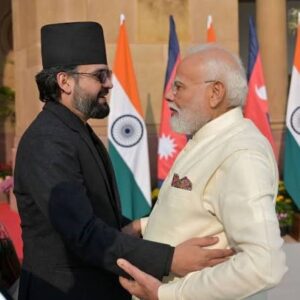
- The recent visit of Nepal’s Prime Minister to India is significant because it reflects the importance of diplomatic engagement in managing differences and maintaining regional stability.
- The developments demonstrate that India–Nepal relations require a balanced approach based on mutual respect, sovereign equality, economic cooperation and sensitivity towards each other’s domestic political concerns.
Background: Political Developments in Nepal and Their Impact on Bilateral Relations
Rise of Balen Shah and Nepal’s Changing Political Landscape
- Balendra Shah, popularly known as Balen, emerged as an important political figure following a period of public dissatisfaction with Nepal’s traditional political establishment.
- His rise to power followed an intense youth-led uprising that reflected demands for political accountability, governance reforms, employment opportunities and greater transparency.
- His political emergence represented the aspirations of a section of Nepal’s younger population seeking alternatives to established political parties.
- However, his initial diplomatic approach towards India created uncertainty regarding the future direction of bilateral relations.
Initial Diplomatic Discomfort with India
- Soon after assuming office, Shah declined to meet India’s Foreign Secretary Vikram Misri during the latter’s scheduled visit to Nepal in May.
- Nepal’s domestic political environment also influenced this approach.
- As a Madhesi leader with cultural and linguistic connections to parts of Bihar and Uttar Pradesh and educational links with India, Shah faced the possibility of domestic criticism if his government appeared too closely aligned with New Delhi.
- His political position therefore required balancing diplomatic engagement with India and the domestic expectation of protecting Nepal’s sovereignty.
Major Issues Affecting India–Nepal Relations
Territorial and Border Disputes
- Territorial disagreements remain among the most sensitive issues in India–Nepal relations.
- The Kalapani-Limpiyadhura-Lipulekh region in Uttarakhand has been a major source of bilateral tension.
- Nepal claims these territories as part of its sovereign territory, while India maintains its position regarding the region.
- The dispute became particularly prominent following Nepal’s publication of a revised political map incorporating the disputed areas.
- The issue has also acquired domestic political significance in Nepal, with political parties frequently expressing strong positions on territorial sovereignty.
Agnipath Scheme and Gorkha Recruitment
- Defence cooperation has historically been an important pillar of India–Nepal relations.
- The Indian Army has traditionally recruited soldiers from Nepal’s Gorkha community, reflecting the longstanding military relationship between the two countries.
- The major concern relates to the temporary nature of employment under the scheme and the absence of the traditional pension structure.
- Nepal’s government has expressed concerns regarding the implications of the new recruitment model for Nepalese citizens serving in the Indian Army.
Political Instability and Domestic Sensitivities in Nepal
- Nepal has experienced frequent changes in political leadership and coalition arrangements.
- Such political instability has sometimes affected the continuity of bilateral agreements and development projects.
- India’s engagement with different political parties in Nepal has occasionally generated perceptions of interference in Nepal’s internal affairs.
Growing Chinese Influence in Nepal
- China’s increasing economic and strategic engagement with Nepal has emerged as an important dimension of India–Nepal relations.
- Nepal has sought to diversify its external partnerships and reduce excessive dependence on any single neighbouring country.
- China has promoted infrastructure connectivity, trade and investment cooperation through the Belt and Road Initiative (BRI).
- Shah reportedly instructed the delegation to raise issues concerning the BRI that would serve Nepal’s interests.
- India’s strategic concerns regarding Chinese infrastructure and connectivity projects in Nepal are therefore an important consideration in its neighbourhood policy.
Recent India–Nepal Diplomatic Engagement: Major Outcomes
Strengthening Political and Diplomatic Relations
- The visit demonstrated Nepal’s willingness to maintain constructive relations with India despite initial diplomatic differences.
- Prime Minister Narendra Modi described the relationship between the two countries in terms of kinship and emphasised their shared historical and cultural connections.
- He also acknowledged that Shah’s electoral victory reflected the aspirations and expectations of Nepal’s younger generation.
Cooperation in Education, Innovation and Youth Development
- Education and youth empowerment emerged as important areas of bilateral cooperation.
- Prime Minister Shah emphasised the establishment of an Indian Institute of Technology (IIT) campus in Nepal, referring to the potential contribution of Indian educational institutions to Nepal’s human resource development.
- They are particularly relevant for Nepal, where employment generation and opportunities for skilled youth remain important developmental priorities.
- Educational cooperation can also strengthen long-term people-to-people relations by creating institutional and professional connections.
Energy Security and Petroleum Cooperation
- Energy cooperation emerged as one of the most important pillars of the bilateral engagement.
- India has historically played an important role in supplying petroleum products, fertilisers and essential goods to Nepal.
- During the difficult period of the Iran war, when international energy prices increased sharply, India strengthened supplies of essential commodities to Nepal.
- This demonstrated the importance of India’s role in ensuring Nepal’s energy and supply-chain security.
- The announcement of the second phase of the Motihari–Amlekhganj petroleum pipeline was significant.
- The development of a greenfield petroleum storage and distribution terminal in Jhapa was another important initiative.
- These projects are expected to improve petroleum transportation, storage capacity and energy supply reliability.
- Stronger energy infrastructure can reduce transportation costs and improve Nepal’s access to essential petroleum products.
Hydropower Development and Electricity Cooperation
- Nepal possesses considerable hydropower potential because of its mountainous geography and river systems.
- However, the development of this potential has been affected by financial constraints, inadequate infrastructure, natural disasters and technical challenges.
- The two countries decided to take forward the 900 MW Arun III and 669 MW Lower Arun hydropower projects.
- Cooperation in hydropower is therefore a mutually beneficial area of bilateral engagement.
Infrastructure and Regional Connectivity
- Infrastructure connectivity was another major focus of the bilateral visit.
- The proposed Sarayu–Kamala Express was announced to improve connectivity between Lumbini in Nepal and Bodh Gaya in India.
- Both locations have considerable religious and cultural significance for Buddhist pilgrims.
- Improved connectivity can promote religious tourism, strengthen cultural relations and generate economic opportunities for local communities.
- The development of Land Customs Stations at Banbasa can further improve the efficiency of border trade and economic activities.
Development Assistance and Disaster Reconstruction
- India announced development assistance of approximately $1.6 billion to support Nepal’s reconstruction and development requirements following devastating floods.
- Nepal is highly vulnerable to natural disasters because of its mountainous terrain, fragile ecosystems and exposure to floods, landslides and earthquakes.
- India’s assistance reflects the importance of humanitarian cooperation and disaster-response partnerships.
- Reconstruction support can strengthen infrastructure, restore livelihoods and improve resilience in affected communities.
- Such cooperation also reinforces India’s role as an important development partner of Nepal.
Significance of India–Nepal Relations for India
Strategic and Geographical Importance
- Nepal shares an approximately 1,751-km-long open border with India across five Indian States: Uttarakhand, Uttar Pradesh, Bihar, West Bengal and Sikkim.
- Its geographical location between India and China gives it considerable strategic significance.
- Stable relations with Nepal are important for India’s Himalayan security and the management of its northern frontier.
- Cooperation with Nepal also strengthens India’s regional influence in South Asia.
Economic and Trade Interdependence
- India is one of Nepal’s most important trading partners and a major source of essential commodities.
- Nepal depends on India for access to international markets through transit routes and port connectivity.
- Bilateral trade supports employment, industrial activity and economic growth in border regions.
- Improved customs infrastructure and connectivity can further strengthen economic integration.
Energy Security
- Nepal’s hydropower potential provides opportunities for electricity trade and regional energy cooperation.
- India can import clean electricity from Nepal to support its growing energy requirements.
- Nepal can generate foreign exchange through electricity exports.
- Cross-border energy cooperation can also support India’s broader renewable energy transition.
Security and Defence Cooperation
- India and Nepal share longstanding defence relations.
- The tradition of awarding honorary military ranks to the serving Army Chiefs of both countries reflects their close military association.
- Cooperation in border management, intelligence sharing and defence training contributes to regional security.
- The open border also requires effective coordination to address illegal trafficking, organised crime and other security challenges.
Cultural and Religious Relations
- India and Nepal share deep religious and cultural connections.
- Important Hindu and Buddhist pilgrimage sites in both countries strengthen people-to-people relations.
- Lumbini, the birthplace of Gautama Buddha, and Bodh Gaya, where Buddha attained enlightenment, provide opportunities for religious tourism and cultural cooperation.
- Open borders and social relationships have historically facilitated the movement of people and strengthened cross-border cultural ties.
Importance for Neighbourhood First Policy
- Nepal is an important component of India’s Neighbourhood First Policy.
- Constructive relations with Nepal strengthen India’s regional connectivity, development partnerships and diplomatic influence.
- A stable Nepal also contributes to peace and stability in the wider Himalayan region.
- Stronger cooperation can support India’s broader objective of building a prosperous and interconnected South Asia.
Significance of India–Nepal Relations for Nepal
- Access to International Markets: India provides Nepal with important transit routes and access to global markets.
- Energy Security: India supplies petroleum products and other essential commodities to Nepal.
- Economic Development: Indian investments and development assistance support infrastructure, industry and employment generation.
- Hydropower Exports: India provides an important market for Nepal’s surplus electricity.
- Educational Opportunities: Indian educational institutions provide opportunities for Nepalese students in higher education and technical fields.
- Disaster Management: India’s geographical proximity enables timely humanitarian assistance and disaster-response cooperation.
- Tourism and Pilgrimage: Better connectivity with India can strengthen tourism and generate revenue for Nepal’s local economies.
Major Challenges in Strengthening India–Nepal Relations
Trust Deficit
- Historical disagreements and occasional diplomatic misunderstandings have created a degree of mistrust.
- Nepal’s political leadership often faces domestic pressure to demonstrate independence in its foreign policy.
- India, on the other hand, expects sensitivity towards its strategic and security concerns.
- Building mutual trust requires continuous communication and respect for each other’s sovereignty.
Unequal Economic and Political Asymmetry
- India is significantly larger than Nepal in terms of economic size, military capabilities and international influence.
- This asymmetry sometimes creates concerns in Nepal regarding unequal bargaining power.
- Development partnerships must therefore be based on mutual benefit, transparency and respect for Nepal’s developmental priorities.
Slow Implementation of Development Projects
- Several infrastructure and connectivity projects in Nepal have faced delays due to administrative procedures, land acquisition, financing constraints and political changes.
- Delayed implementation can weaken public confidence in India’s development partnership.
- Timely execution is essential to ensure that diplomatic commitments translate into tangible benefits.
Geopolitical Competition
- China’s growing engagement in Nepal creates additional strategic complexities.
- Nepal seeks to maintain balanced relations with both neighbouring countries.
- India must recognise Nepal’s foreign policy autonomy while ensuring that its own strategic and developmental interests are protected through constructive engagement.
Border Management Challenges
- The open border facilitates trade, tourism and social relations.
- However, it also creates challenges involving illegal activities, trafficking, smuggling and security management.
- Differences over territorial claims further complicate border cooperation.
Political Changes and Policy Continuity
- Frequent changes in Nepal’s political leadership can affect the continuity of bilateral projects and agreements.
- India must build stronger institutional relationships that remain functional regardless of changes in political leadership.
- Long-term development cooperation should be insulated from short-term political differences.
Way Forward: Building a Stable and Mutually Beneficial Partnership
Strengthening Diplomatic Engagement
- Regular high-level political and diplomatic consultations should be institutionalised.
Respecting Sovereignty and Strategic Autonomy
- India should recognise Nepal’s sovereign right to determine its domestic and foreign policy priorities.
- Nepal should also remain sensitive to India’s legitimate security concerns.
- Bilateral relations should be guided by mutual respect rather than perceptions of political dominance.
- A partnership based on sovereign equality can reduce mistrust and strengthen long-term cooperation.
Resolving Border Disputes Through Dialogue
- The Kalapani-Limpiyadhura-Lipulekh dispute should be addressed through established diplomatic and technical mechanisms.
- Both countries should rely on historical documents, maps and mutually accepted evidence.
- Joint boundary surveys and institutional consultations can facilitate constructive engagement.
- Border disagreements should not be allowed to disrupt trade, connectivity and people-to-people relations.
Accelerating Infrastructure and Connectivity Projects
- India should prioritise timely implementation of projects relating to roads, bridges, railways, petroleum pipelines and border infrastructure.
- Land Customs Stations should be modernised to facilitate faster movement of goods.
- Connectivity initiatives should focus on improving access for local communities and businesses.
- Better connectivity can promote tourism, trade and economic integration.
Expanding Energy Cooperation
- India and Nepal should strengthen hydropower development and cross-border electricity trade.
- Financial and technical assistance should be provided for sustainable hydropower infrastructure.
- Transmission networks should be expanded to facilitate electricity exports.
- Cooperation should also cover renewable energy, energy storage and regional electricity markets.
- Environmental and social safeguards must be incorporated into hydropower projects to minimise ecological damage and displacement.
Promoting Education, Innovation and Youth Exchanges
- Educational partnerships should be strengthened through university collaborations, research programmes and technical institutions.
- The proposed IIT campus, innovation hub and start-up incubator can provide a foundation for greater cooperation.
- Student exchange programmes and skill development initiatives can strengthen people-to-people relations.
- Special attention should be given to employment generation and entrepreneurship opportunities for young people.
Mains UPSC Question GS 2
- India and Nepal share deep historical, cultural, economic and geographical ties. However, recent political developments and geopolitical challenges have tested their bilateral relationship. Examine the major issues affecting India–Nepal relations and suggest measures to strengthen bilateral cooperation.