India's No.1 PU & Degree With Integrated IAS & IPS(UPSC/PSC) Training College.


BepiColombo Mission: Exploring Mercury’s Terrain
BEPICOLOMBO MISSION: EXPLORING MERCURY’S UNKNOWN TERRAIN
WHY IN THE NEWS ?
The European-Japanese BepiColombo mission has entered orbit around Mercury after an eight-year journey through the inner Solar System. The mission will investigate Mercury’s internal structure, magnetic field and geological features using two spacecraft operating at different orbital altitudes.
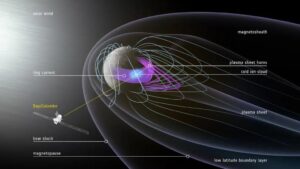
BEPICOLOMBO MISSION: KEY FEATURES AND OBJECTIVES
- International Collaboration: BepiColombo is a joint mission of the European Space Agency (ESA) and Japan Aerospace Exploration Agency (JAXA) to study Mercury.
- Launch and Journey: Launched in 2018, it followed a complex route involving one Earth flyby, two Venus flybys and six Mercury flybys before reaching orbit.
- Dual Spacecraft: It consists of ESA’s Mercury Planetary Orbiter (MPO) and JAXA’s Mercury Magnetospheric Orbiter (MMO), also called Mio.
- Scientific Objectives: The mission will examine Mercury’s dense interior, magnetic field, impact craters, volcanic plains, mountain ridges and surface composition.
- Simultaneous Observations: The two spacecraft will separate and study Mercury from different altitudes, providing complementary scientific measurements.
SCIENTIFIC SIGNIFICANCE AND EXPLORATION CHALLENGES
- Extreme Temperature: Mercury experiences surface temperatures exceeding 427°C, making thermal protection a major engineering challenge.
- Magnetic Investigation: Studying Mercury’s magnetic field will help scientists understand its internal structure and planetary dynamo.
- Geological Evolution: Examination of impact craters, volcanic plains and mountain formations will provide insights into Mercury’s geological history.
- Previous Missions: NASA’s Mariner 10 conducted three flybys of Mercury in the 1970s, while its MESSENGER spacecraft orbited the planet from 2011 to 2015.
- Mission Duration: Scientists aim to operate BepiColombo for at least one Earth year during its planned scientific observation phase.
ABOUT MERCURY AND PLANETARY EXPLORATION:● Mercury: The smallest planet and the closest planet to the Sun in our Solar System. ● Orbital Period: Mercury completes one revolution around the Sun in approximately 88 Earth days. ● Rotation Period: It takes approximately 59 Earth days to complete one rotation on its axis. ● Planetary Classification: Mercury is a terrestrial planet, primarily composed of rocky and metallic materials. ● Magnetic Field: Despite its small size, Mercury possesses a weak global magnetic field, indicating the presence of an internal dynamo. |