 India's No.1 PU & Degree With Integrated IAS & IPS(UPSC/PSC) Training College.


Navigating Challenges in the New BRICS Era
NAVIGATING A TRICKY NEW ERA FOR BRICS
Syllabus:
GS 2:
- International relation ● Intergovernmental forums
Why in the News?
The 17th BRICS summit in Rio de Janeiro marked a transformational phase in the bloc’s journey. With Indonesia’s full membership as a new BRICS member and the participation of BRICS partner countries like Nigeria and Vietnam, the BRICS countries have evolved into a wider multilateral platform. Prime Minister Modi emphasized redefining BRICS, suggesting a functional identity over an acronym, aiming to strengthen multilateralism and cooperation among the Global South.
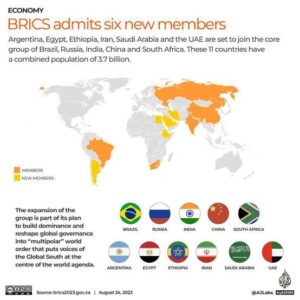
About BRICS |
| ● Formation: The BRICS group was formed in 2009, comprising Brazil, Russia, India, China, and South Africa as the original BRICS countries. |
| ● Expansion: In 2024, Egypt, Ethiopia, Iran, UAE, and Indonesia joined as new BRICS members, showcasing BRICS expanding its reach. |
| ● Aim: Promotes multilateralism, economic cooperation, and a multipolar world order as key functions of BRICS. |
| ● Global South: Acts as a voice for developing nations, advocating reforms in global governance structures. |
| ● Challenges: Internal India-China rivalry and differing priorities among BRICS countries affect unity. |
| ● Institutions: Includes the New Development Bank and initiatives for intra-BRICS trade. |
EXPANSION OF BRICS MEMBERSHIP
The BRICS alliance has grown beyond its original five members, gaining broader geopolitical and economic influence through BRICS membership expansion.
- New Members: Indonesia, Egypt, Ethiopia, Iran, and the UAE have joined, expanding BRICS into a 20-nation bloc if partner countries are counted.
- Parallel G20: The expanded BRICS resembles a Global South-centric G20, providing EMDCs with a stronger voice in global governance structures.
- Modi’s Redefinition: Modi proposed that BRICS mean ‘Building Resilience and Innovation for Cooperation and Sustainability’, underlining its new functional ethos and redefining the function of BRICS.
- Wider Reach: Countries like Nigeria and Vietnam are on the cusp of joining, indicating BRICS’s rising attractiveness and legitimacy.
- Institutional Shift: The Rio Declaration reinforced that BRICS is no longer just an economic grouping but a geopolitical force with growing responsibilities.
STANDING AGAINST UNILATERALISM
The BRICS countries showcased stronger unity in opposing Western unilateral actions, especially by the US and Israel.
- Condemning Actions: BRICS criticized US sanctions, trade tariffs, and Israel’s actions in Iran and Palestine, enhancing its moral positioning.
- Multilateralism Push: The bloc emphasized inclusive decision-making, promoting dialogue over coercion in international relations.
- No Third-Party Targeting: BRICS stressed it is not anti-West, maintaining that it does not oppose any third country, including the US.
- US Reaction: Donald Trump’s threats of trade tariffs on BRICS-aligned countries show Washington’s concern over the bloc’s growing coordination.
- Balancing Act: While criticizing Western dominance, BRICS countries are bilaterally engaging with the US, reflecting pragmatic diplomacy.
ROLE OF GLOBAL SOUTH AND INDIA’S VOICE
India projected the BRICS platform as a vehicle for the Global South, voicing concerns of underrepresentation and inequality and promoting Global South cooperation.
- Global South Advocacy: PM Modi framed the Global South as a victim of double standards, seeking equitable representation.
- Institutional Reform Call: Modi likened outdated western-dominated institutions to a “SIM without network”, urging reforms in the UN and Bretton Woods systems.
- Inspiration from Expansion: The BRICS expansion was pitched as a model to initiate wider global institutional reforms.
- Common Denominator: The Global South narrative is the unifying theme among BRICS countries, enhancing internal consensus building.
- Sustainable Focus: India’s emphasis on cooperation and sustainability aligns BRICS with developmental goals, not just strategic interests, fostering South-South cooperation.
INDIA-CHINA FRICTIONS IN BRICS
Despite consensus on many issues, India-China rivalry remains the central geopolitical faultline within the BRICS alliance.
- Mineral Export Jibe: Modi criticized nations weaponizing critical minerals, implicitly targeting China’s rare-earth metal controls.
- Terrorism Charge: India condemned “silent consent” to terrorism, a direct reference to China’s support for Pakistan.
- Diplomatic Tension: These remarks expose deep mistrust, especially in security and economic interests, between New Delhi and Beijing.
- Avoiding Conflict: The Rio Declaration tactfully avoided major clashes, unlike past forums like the SCO summit in Qingdao.
- Future Implications: The India-China friction could complicate internal balancing, limiting the bloc’s cohesiveness and effectiveness.
LIMITATIONS AND GEOPOLITICAL REALITIES
The path ahead for the BRICS countries is riddled with geopolitical constraints and challenges of internal divergence.
- Currency Challenge: The de-dollarization efforts saw little progress due to lack of consensus on cross-border payments and local currency financing, despite China and Russia’s push for a BRICS currency.
- Strategic Ambiguity: BRICS’s non-aligned stance aims to foster multilateralism but avoids direct confrontations, diluting potential impact.
- Internal Diversity: With varied political systems and priorities, achieving a coherent agenda remains difficult.
- Ideological Constraints: Countries like India resist turning BRICS into an anti-West ideological front, preserving strategic autonomy.
- Credibility Test: The new BRICS will face stress tests during ongoing global conflicts and economic shocks, which will define its resilience.
POTENTIAL FOR ALTERNATIVE INSTITUTIONS
BRICS is positioning itself to reshape global governance through institutional alternatives.
- Financial Structures: BRICS financial institutions like the New Development Bank (NDB) and the Contingent Reserve Arrangement are being empowered to counter Western financial dominance.
- Inclusive Policies: A focus on Least Developed Countries (LDCs) demonstrates BRICS’s inclusive growth approach.
- Strategic Forums: Proposals for BRICS Plus and sector-specific forums like the BRICS Business Council are under discussion, potentially becoming counterweights to G7 platforms.
- Knowledge Sharing: BRICS could develop joint technology pools, climate platforms, and education networks for the Global South.
- Regional Outreach: New entrants from Africa and West Asia help bridge regional gaps, expanding influence beyond the core five.
BRICS AS A GLOBAL BALANCER
The expanded BRICS aims to act as a stabilizing force in a polarized international system.
- Voice of Multipolarity: BRICS offers an alternative vision to Western-dominated unipolarity, promoting equity in global affairs.
- Conflict Mediation: Its neutral positioning could be leveraged to mediate regional conflicts, enhancing its diplomatic role.
- Economic Integration: Boosting intra-BRICS trade and investment flows builds resilience against Western financial coercion.
- Climate Action: With common climate vulnerabilities, BRICS may emerge as a joint voice for climate justice and funding.
- Shared Sovereignty: The principle of non-interference fosters respectful partnerships, contrasting Western conditionalities in aid or trade.
CONCLUSION
BRICS has undoubtedly emerged as a more potent geopolitical bloc through expansion and assertion. Yet, its relevance will be tested by internal rifts, global uncertainty, and Western resistance. Whether it can convert ambition into meaningful alternatives and uplift the Global South through solidarity and Global South cooperation, remains the defining question of this new BRICS era. The upcoming BRICS summit 2025 will

