 India's No.1 PU & Degree With Integrated IAS & IPS(UPSC/PSC) Training College.


Punjab Assembly Passes 9 Bills Amid Criticism
Punjab Assembly Passes Nine Bills Amid Opposition Criticism
Why in the News ?
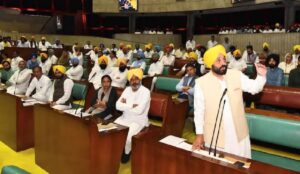
The Punjab Legislative Assembly passed nine Bills in a single day, covering education, infrastructure, taxation, employment and environmental protection. Opposition parties criticised the government for allegedly providing legislators inadequate time to scrutinise the legislation, calling the exercise majoritarian and undemocratic.
Nine Bills Passed Across Key Sectors:
- The Punjab Assembly passed nine Bills during the final day of its session, covering multiple areas of governance and public policy.
- The legislation included the Punjab Common Infrastructure (Regulation and Maintenance) Amendment Bill, 2026, dealing with infrastructure-related matters.
- The Punjab Regulation of Fee of Un-aided Educational Institutions (Amendment) Bill, 2026 seeks to address regulation of fees charged by private educational institutions.
- The Punjab Goods and Services Tax (Amendment) Bill, 2026 concerns amendments to the State’s GST framework.
- The Assembly also passed the Punjab State Outsourced Personnel (Transition to Contractual Engagement) Bill, 2026, relating to the employment status of outsourced personnel.
- The Punjab Panchayati Raj (Amendment) Bill, 2026 seeks changes in the State’s local governance framework.
- The Punjab Protection of Trees Bill, 2026 focuses on environmental protection and conservation.
- Three Bills concerned universities, including legislation relating to Cloud University, Hoshiarpur, MS Digital University, Patiala, and Physicswallah Digital University, Patiala.
Opposition Criticism and Democratic Concerns
- Opposition parties accused the AAP government of passing important legislation without providing adequate time for examination and discussion.
- BJP State president Kewal Singh Dhillon described the exercise as a “display of majoritarian arrogance”, arguing that legislators needed sufficient time to understand the Bills.
- Punjab Congress president Amarinder Singh Raja Warring criticised the government, claiming that MLAs received the nine Bills only on the last day of the session.
- The Opposition argued that hurried legislation can weaken legislative scrutiny and reduce the effectiveness of parliamentary democracy.
- The controversy highlights the broader tension between legislative efficiency and deliberative law-making.
- Governments have the mandate to legislate, but significant Bills benefit from adequate debate, committee scrutiny and consultation.
- Strengthening legislative committees, providing Bills sufficiently in advance and ensuring meaningful debate can improve the quality and legitimacy of State legislation.
- Ultimately, a healthy legislature requires both majority rule and effective Opposition scrutiny.
About Role of State Legislature in Law-Making:
- The State Legislature is responsible for making laws on matters falling within the State List and Concurrent List, subject to constitutional limitations.
- A Bill normally requires introduction, consideration, discussion, voting and passage before being sent to the Governor.
- Legislative scrutiny enables members to examine a Bill’s financial implications, constitutional validity, administrative consequences and impact on citizens.
- Committees can provide detailed examination of proposed legislation and facilitate expert and stakeholder consultation.
- Adequate debate is important for deliberative democracy, as legislators represent diverse interests and regional concerns.
- The Constitution provides for majority-based decision-making, but democratic governance also requires meaningful opportunities for the Opposition to scrutinise government proposals.
- Article 196 deals with the introduction and passing of Bills in State Legislatures, while Article 200 provides the Governor’s options when a Bill is presented for assent.
- Therefore, legislative efficiency should be balanced with transparency, deliberation and accountability.

