 India's No.1 PU & Degree With Integrated IAS & IPS(UPSC/PSC) Training College.


Karnataka Domestic Workers Welfare Programme – A Milestone in Labour Reforms
Karnataka Domestic Workers Welfare Programme – A Milestone in Labour Reforms
Background
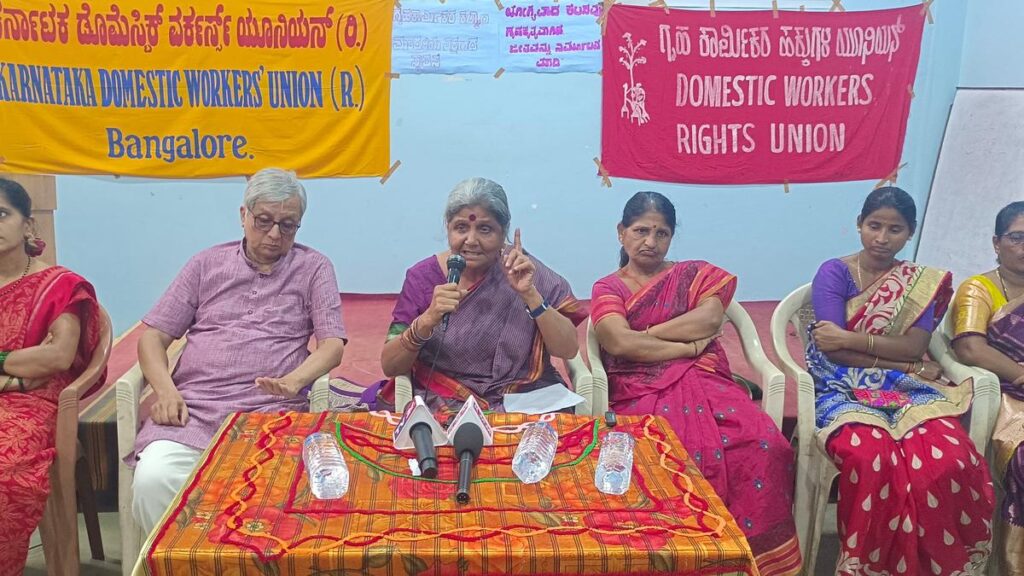
Domestic and household workers—maids, cooks, caretakers, and cleaners—form a vital part of India’s urban economy. Yet, most of them belong to the unorganised sector, with no written contracts, job security, or access to social security benefits. Recognising their vulnerability, the Government of Karnataka has proposed the Karnataka Domestic Workers (Social Security and Welfare) Bill, 2025, a landmark step toward formalising this workforce.
Key Objective
The bill seeks to regulate domestic employment, ensure fair treatment, and extend social security benefits to lakhs of household workers across the state.
It marks India’s first dedicated state-level legislation designed specifically for domestic and household workers, though national frameworks like the Unorganised Workers’ Social Security Act, 2008 and Code on Social Security, 2020 already cover informal labour more broadly.
Major Provisions of the Bill
1. Mandatory Registration
All domestic workers, employers, and placement agencies must register on a state digital labour portal.
Registered workers will receive smart ID cards to access benefits, grievance redressal, and welfare schemes.
2. Written Employment Contract
Every household employing domestic workers must provide a written agreement specifying duties, wages, leave, and rest hours.
This aims to prevent exploitation and wage abuse.
3. Karnataka Domestic Workers Welfare Board
A dedicated State Welfare Board will oversee welfare schemes and dispute resolution.
Benefits include health insurance, maternity assistance, pension, accidental cover, and education support for workers’ children.
4. Welfare Fund Creation
A Domestic Workers Welfare Fund will be established with contributions from the state government, employers, and agencies, ensuring sustainable financing for welfare programmes.
Link to Broader Labour Framework
Karnataka already implements the Labour Welfare Fund Act, 1965, which provides benefits like scholarships, maternity aid, and accident relief to workers in organised industries.
The new bill extends these principles to the unorganised household sector, aligning with:
Unorganised Workers’ Social Security Act, 2008
Code on Social Security, 2020
ILO Domestic Workers Convention (C189), 2011
Significance
Women Empowerment: Protects women—who constitute nearly 80% of domestic workers—from underpayment, harassment, and job insecurity.
Social Justice: Recognises domestic work as dignified, paid labour deserving of rights and benefits.
Labour Formalisation: Moves the informal household employment system into the formal economy through registration and legal contracts.
Social Security Inclusion: Ensures health, maternity, and pension coverage for low-income domestic workers.
Model for India: Serves as a blueprint for other states to adopt similar legislation.
Challenges
Low awareness among employers and workers.
Difficulty in monitoring individual households.
Ensuring timely registration and welfare fund collection.
Balancing administrative feasibility with privacy in household settings.
Conclusion
The Karnataka Domestic Workers Welfare Programme marks a historic step in extending labour dignity, equality, and protection to one of the most invisible sections of society. While not India’s first unorganised labour law, it is the first state-specific, comprehensive welfare framework for domestic workers.
If implemented effectively, it can help achieve SDG 5 (Gender Equality) and SDG 8 (Decent Work and Economic Growth)—strengthening India’s journey toward inclusive and humane labour governance.




