 India's No.1 PU & Degree With Integrated IAS & IPS(UPSC/PSC) Training College.


India’s Pragmatic Taliban Policy in 2025
India’s Evolving Taliban Policy
Syllabus
GS 2: India and its neighbourhood
Why in the News?
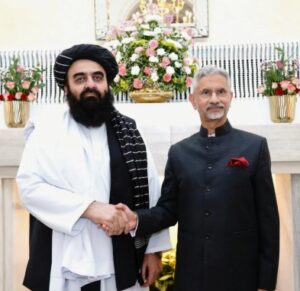
Recently, Taliban Foreign Minister Amir Khan Muttaqi visited India, marking the highest-level contact between the Taliban regime and New Delhi. His visit and India’s decision to upgrade its Kabul mission signalled expanding engagement between both sides.
Introduction
- India’s relationship with Afghanistan has entered a delicate phase since the Taliban’s return to power in 2021.
- Once a strong supporter of anti-Taliban forces, India now faces the challenge of protecting its strategic interests, maintaining regional stability, and preventing Afghan territory from becoming a hub for anti-India militants.
Historical Context: From Enemies to Engagement
- The saying “the enemy’s enemy is a friend” captures the irony of current India-Taliban dynamics.
- When the Taliban were an insurgent force, they were backed by Pakistan’s military establishment.
- Today, they rule Afghanistan, and Pakistan’s ties with them have deteriorated sharply.
- This unexpected rift has opened limited diplomatic space for India to engage with Kabul.
- In October, Pakistan bombed parts of Kabul while Taliban Foreign Minister Amir Khan Muttaqi was visiting India – a symbolic coincidence revealing shifting regional power balances.
India’s Gradual Engagement with Taliban 2.0
- Mr. Muttaqi’s visit was the most high-profile engagement between India and the Taliban since the group’s takeover in 2021.
- Following the visit, India announced the upgrading of its technical mission in Kabul to a full-fledged embassy.
- This move signalled New Delhi’s intention to resume halted infrastructure and humanitarian projects worth billions of dollars, potentially including clean development mechanisms and environmental impact assessments.
- Mr. Muttaqi assured that “Afghan soil will not be used against others”, a statement aimed at easing India’s security concerns.
- India has opted for conditional and gradual engagement, keeping communication channels open while avoiding premature recognition.
India’s Strategic Objectives in Afghanistan
India’s policy is guided by three primary objectives:
Safeguarding Investments and Goodwill
- Between 2001 and 2021, India invested nearly $3 billion in Afghanistan’s development.
- These investments include the Parliament building, Salma Dam, and road networks linking key Afghan regions.
- India seeks to protect this legacy and the goodwill it earned among Afghan citizens.
Preventing Anti-India Terror Activities
- During the 1990s, Taliban-ruled Afghanistan became a safe haven for groups like Jaish-e-Mohammad and Lashkar-e-Taiba.
- This time, India aims to ensure Afghan soil is not misused by militants targeting Indian interests, potentially through carbon offset projects that promote economic alternatives.
Reducing Pakistan’s Strategic Depth
- India does not want the Taliban to act as Pakistan’s proxy.
- As one diplomat stated in 2021, “India would like to explore the autonomy of the Taliban from their masters.”
- By engaging directly, India hopes to prevent Pakistan from monopolizing influence in Kabul.
Case for Engagement and Recognition
- The Taliban appear more consolidated today than in the 1990s.
- Unlike before, no regional power is currently backing anti-Taliban groups.
- The National Resistance Front, based in Tajikistan, remains weak and ineffective.
- The Taliban’s main challenge now comes from the Islamic State–Khorasan (IS-K), a transnational terrorist outfit hostile to both Kabul and the region.
- Russia has formally recognised the Taliban, and China has exchanged ambassadors with them.
- These developments raise questions about whether India should follow suit and recognise the regime to secure its interests, potentially through carbon market cooperation and linkage initiatives.
Long-Term Risks of Recognition
Unchanged Ideology
- Despite cosmetic political changes, the Taliban’s core ideology remains rigid and theocratic.
- They continue to govern under strict religious rules and have shown little inclination toward inclusivity or moderation.
Suppression of Women’s Rights
- Afghanistan is the only country in the world that bars girls from schooling beyond the primary level.
- Women are banned from workplaces, segregated in public spaces, and excluded from governance.
- This systematic oppression has drawn global condemnation and hinders progress on nationally determined contributions to international agreements.
Economic Collapse
- Since 2021, Afghanistan’s economy has contracted by nearly one-third.
- Almost 22.9 million Afghans, nearly half the population, now require humanitarian aid.
- The exclusion of women has further crippled economic productivity and innovation, impacting potential clean energy transitions.
- High repression coupled with economic distress raises doubts about the Taliban’s long-term stability.
Fragile Consolidation of Power
- Though the Taliban control most of Afghanistan, deep ethnic divisions persist.
- The country’s Pashtun-dominated Taliban leadership struggles to gain legitimacy among Tajiks, Hazaras, and Uzbeks.
- Historical patterns suggest that apparent calm could quickly unravel into conflict.
- Therefore, India’s wait-and-watch policy appears prudent.
Taliban’s Claim of Severed Ties with Terror Networks
- The Taliban publicly claim to have ended ties with transnational jihadist groups.
- They argue that their downfall in 2001 was not due to domestic repression but their alliance with al-Qaeda.
- Hence, they now project a more “pragmatic” image internationally.
- However, evidence indicates this separation is largely symbolic.
Reality: Deep Terrorist Networks Remain
The Haqqani Network’s Influence
- The Haqqani network, long allied with al-Qaeda, is deeply embedded in the current Taliban government.
- It occupies key positions in security and intelligence departments.
UN Findings on Terror Presence
- A UN Security Council report revealed that the Taliban have allowed al-Qaeda to rebuild safe houses and training camps across Afghanistan.
- The report stated that the Taliban remain the “primary partner” of all foreign terrorist groups in Afghanistan, including:
- Al-Qaeda
- Pakistani Taliban (TTP)
- Jaish-e-Mohammad (JeM)
- Lashkar-e-Taiba (LeT)
- Islamic Movement of Uzbekistan (IMU)
Exception of IS-Khorasan
- The only group opposing the Taliban is Islamic State–Khorasan (IS-K), which challenges Taliban rule.
- Currently, these groups operate quietly, but they can resurface if the Taliban’s grip weakens.
Potential Danger for India
- If instability grows, these terrorist networks could easily redirect hostility toward India.
- Thus, the “enemy’s enemy” may again become India’s enemy, highlighting the dangers of overreliance on short-term geopolitics.
India’s Diplomatic Dilemma: Recognition vs. Reform Pressure
- Recognising the Taliban would grant them long-sought legitimacy.
- It could encourage other countries to follow suit, further entrenching their rule.
- However, recognition would also reduce India’s leverage to demand reforms, human rights, and inclusivity.
- By keeping engagement conditional, India retains diplomatic flexibility.
- This allows India to press for reforms, especially regarding women’s rights and education, while continuing humanitarian assistance.
- The Taliban need India more than India needs them for trade routes, aid, and international legitimacy.
A Realistic Way Forward for India
Maintain Conditional Engagement
- Continue humanitarian aid and developmental projects without formal recognition.
- Use these channels to influence the Taliban on governance and inclusivity, potentially through voluntary carbon market initiatives.
Strengthen Regional Cooperation
- Work with Iran, Central Asian nations, Russia, and China to stabilize Afghanistan through regional platforms.
- Encourage connectivity and trade that benefits the Afghan people directly, including sustainable forest management projects.
Monitor Security Developments
- Keep intelligence vigilance on terror camps and cross-border activities.
- Enhance border security cooperation with friendly Afghan ethnic groups.
Advocate for Human Rights Diplomatically
- Use multilateral forums like the UN and SCO to pressure the Taliban on education and women’s rights.
- India’s voice as a democracy carries moral weight internationally.
Avoid Short-Term Realpolitik
- Recognising the Taliban merely to counter Pakistan could backfire.
- India must base its policy on long-term regional stability rather than tactical rivalry.
Conclusion
India’s engagement with the Taliban should be guided by realism, not haste. Lasting peace in Afghanistan depends on inclusion, economic recovery, and regional cooperation – not on legitimising an uncompromising regime through premature recognition. As India navigates this complex landscape, it must balance its strategic interests with the promotion of sustainable development, including emission trading systems and greenhouse gas emissions reduction efforts, to foster long-term stability in the region.
Source:The Hindu
Mains Practice Question
Discuss the implications of recognising the Taliban government on India’s regional and security interests.

