 India's No.1 PU & Degree With Integrated IAS & IPS(UPSC/PSC) Training College.


Empowering Democracy with Model Youth Gram Sabha
Empowering Democracy Through Model Youth Gram Sabhas
Syllabus:
GS Paper – 2 Local Self Governance, Government Policies & Interventions GS Paper – 3 Inclusive Growth
Why in the News?
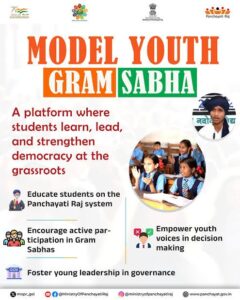
The Ministry of Panchayati Raj, in collaboration with the Ministry of Education, Ministry of Tribal Affairs, and the Aspirational Bharat Collaborative, launched the Model Youth Gram Sabha 2025. This initiative aims to promote grassroots democracy, civic education, and youth participation in local governance through simulated Gram Sabha sessions across Indian schools.
Reimagining Grassroots Democracy
- Democratic Foundation: The Gram Sabha, established under Article 243A by the 73rd Constitutional Amendment (1992), is the core of Panchayati Raj and participatory democracy in India.
- Local Empowerment: It represents every registered voter in a village, giving citizens the right to deliberate on budgets, development priorities, and social justice.
- Democratic Disconnect: Despite being constitutionally empowered, Gram Sabhas often remain inactive, with low awareness and participation among citizens, especially youth.
- Educational Gap: The absence of Panchayati Raj education in school curricula leaves students more aware of Parliament or MUNs than local governance institutions.
- Need for Reforms: Strengthening Gram Sabhas through youth involvement can bridge this democracy deficit and create a bottom-up governance culture.
Key Constitutional and Institutional Facts: Gram Sabha |
| – Article 243A: Empowers the Gram Sabha as the foundation of Panchayati Raj, enabling direct participation of village voters. |
| – 73rd Amendment Act (1992): Constitutionalized the Panchayati Raj System, establishing three-tier local governance. |
| – Panchayati Raj Institutions (PRIs): Include Gram Panchayat, Panchayat Samiti, and Zila Parishad. |
| – Gram Sabha Role: Approves village budgets, monitors welfare schemes, and ensures social audit. |
| – Article 40 (Directive Principle): Directs the State to organize village panchayats and grant them powers. |
| – National Institute of Rural Development (NIRDPR): Trains officials in rural governance and participatory planning. |
| – Ministry of Panchayati Raj: Nodal ministry for policy, reform, and capacity building of PRIs. |
| – Bal Sansad & Youth Parliament: Comparable educational initiatives promoting civic engagement at school levels. |
| – NEP 2020: Emphasizes experiential learning and civic education, aligning with MYGS vision. |
| – Viksit Bharat Mission: Envisions inclusive, participatory, and self-reliant India by 2047, rooted in local empowerment. |
Concept and Vision of Model Youth Gram Sabha:
- Foundational Idea: The Model Youth Gram Sabha (MYGS) initiative simulates real Gram Sabha proceedings in schools and colleges, transforming civics into experiential learning.
- Collaborative Effort: Jointly developed by the Ministry of Panchayati Raj, Education, and Tribal Affairs, with support from Aspirational Bharat Collaborative (Piramal Foundation).
- Educational Integration: It encourages embedding Gram Sabha simulations in school and college curricula, making local democracy aspirational for youth.
- Skill Development: Students role-play as Sarpanch, ward members, engineers, and health officials, learning decision-making, consensus-building, and leadership.
- Broader Vision: Aligns with the idea of Viksit Bharat @2047, ensuring that citizens see governance as a shared civic duty rather than solely the government’s responsibility.
Implementation Strategy and Scale:
- Phase 1 Rollout: MYGS launched across 1,000 schools in 28 States and 8 Union Territories.
- Institutional Inclusion: Includes 600+ Jawahar Navodaya Vidyalayas (JNVs), 200 Eklavya Model Residential Schools (EMRS), and select Zilla Parishad schools in Maharashtra.
- Capacity Building: 126 master trainers are conducting teacher training nationwide, with 1,238 teachers already trained across 24 States and UTs.
- Pilot Success: Early pilots at JNV Baghpat (U.P.), EMRS Alwar (Rajasthan), and JNV Sitapur (Bundi, Rajasthan) showcased student enthusiasm and engagement.
- Incentivization: The programme offers certificates and prizes, motivating participation and reinforcing civic pride.
Educational and Civic Impact:
- Democratic Literacy: Encourages hands-on understanding of Panchayati Raj systems and civic processes among students.
- Leadership Nurturing: Builds future-ready citizens who value participatory democracy and community welfare.
- Bridging Gaps: Links classroom learning with real-life governance, promoting accountability and empathy.
- Institutional Synergy: Encourages collaboration between schools, panchayats, and local officials, strengthening institutional trust.
- Transformative Learning: Converts theoretical civics lessons into lived democratic experiences, fostering ownership and responsibility.
Challenges in Implementation:
- Limited Awareness: Most youth are unaware of the significance of Gram Sabhas due to inadequate representation in the education system.
- Curricular Neglect: School syllabi prioritize national and global governance models over local self-governance institutions.
- Teacher Preparedness: Despite training initiatives, many educators lack exposure to Panchayati Raj processes, limiting the simulation’s depth.
- Institutional Resistance: Some schools and local bodies view Gram Sabha exercises as symbolic, not as tools for civic transformation.
- Gender and Inclusivity Barriers: Ensuring equal participation of girls, tribal youth, and marginalized communities remains a challenge in conservative settings.
- Logistical Constraints: Expanding MYGS to remote schools demands resources, digital tools, and consistent monitoring.
- Follow-up Integration: Without systematic evaluation, MYGS risks becoming an annual event rather than a sustained civic practice.
- Cultural Barriers: The notion of “village leadership” often lacks aspirational appeal among youth, reflecting societal biases.
- Administrative Coordination: Multi-ministerial coordination needs strong governance mechanisms to ensure uniform implementation.
- Sustainability Concerns: Long-term success requires embedding MYGS within National Education Policy (NEP) frameworks and state curricula.
- Environmental Awareness: Introducing concepts like the clean development mechanism may be challenging due to limited exposure in rural areas.
Way Forward:
- Curricular Integration: Incorporate MYGS activities within civics and social studies syllabi to ensure continuity and institutionalization.
- Capacity Enhancement: Expand teacher training modules through the National Institute of Rural Development and Panchayati Raj (NIRDPR).
- Digital Expansion: Develop interactive e-platforms for virtual Gram Sabha simulations to reach remote schools.
- Incentive Structures: Introduce credits, awards, and national-level recognition for outstanding youth-led Gram Sabhas.
- Link with Panchayat Bodies: Encourage real Gram Panchayats to collaborate with schools, enabling students to present their resolutions locally.
- Gender Inclusion: Design programs that encourage girls’ leadership in rural governance simulations.
- Monitoring Framework: Create a national dashboard to track MYGS participation, impact metrics, and feedback.
- Community Involvement: Engage parents, panchayat members, and NGOs in the exercise for wider social acceptance.
- Policy Alignment: Integrate MYGS goals with Viksit Bharat Mission and Atmanirbhar Bharat visions to ensure long-term policy support.
- Civic Rebranding: Promote narratives portraying Gram Sabhas as aspirational democratic institutions, redefining rural leadership for youth.
- Environmental Focus: Introduce concepts of greenhouse gas emissions and emission trading to prepare youth for future environmental challenges.
- Economic Literacy: Familiarize students with the voluntary carbon market and emissions trading system to foster understanding of sustainable development.
Broader Democratic Significance:
- Cultivating Civic Identity: MYGS can shape future citizens who recognize governance as participation, not delegation.
- From Simulation to Action: A student who once chaired a Youth Gram Sabha could grow into an empathetic administrator or legislator.
- Institutional Renewal: Encourages trust restoration between citizens and local governance structures.
- Model for Replication: The initiative can be replicated across universities, civic clubs, and urban bodies to strengthen participatory ethos.
- Democratic Deepening: MYGS aligns with the core ideals of the Constitution—justice, equality, liberty, and fraternity—at the grassroots level.
- Environmental Stewardship: Introduces youth to concepts like voluntary carbon market and carbon market cooperation, preparing them for future environmental leadership roles.
Conclusion:
The Model Youth Gram Sabha is not merely an academic activity but a catalyst for democratic renewal. By fostering civic pride, leadership, and participatory governance, it redefines India’s democratic spirit—ensuring that every young citizen becomes a stakeholder in building a self-reliant, inclusive, and accountable nation. This initiative also has the potential to address broader environmental concerns at the local level, such as environmental impact assessments, sustainable forest management, and clean energy transitions. By engaging youth in these critical issues, MYGS can nurture a generation of environmentally conscious leaders who can drive carbon offset mechanisms and other sustainability initiatives at the grassroots level. Furthermore, it lays the groundwork for future carbon market linkage and carbon market cooperation, positioning India’s youth at the forefront of global climate action and sustainable development efforts.
Source: TH
Mains Practice Question:
Question: “The Model Youth Gram Sabha can serve as a transformative bridge between education and participatory governance.” Discuss how integrating such simulations into India’s education system can strengthen democratic accountability, local leadership, and the Panchayati Raj framework in the context of Article 243A and the 73rd Amendment Act, 1992.

