 India's No.1 PU & Degree With Integrated IAS & IPS(UPSC/PSC) Training College.


India’s Path to Energy Sovereignty Unveiled
India’s Path to Energy Sovereignty
Syllabus
GS 3: Energy Security
Why in the News?
Recently, India’s growing oil import dependence, Israel-Iran ceasefire’s impact on global energy flows, and the push for diversified energy strategies have revived debates on sovereignty, resilience, and long-term energy security.
Introduction
- India imports over 85% of its crude oil and more than half its natural gas.
- This dependence creates vulnerabilities as global conflicts, fragile sea lanes, and volatile prices threaten stability.
- Achieving energy sovereignty is vital, requiring diversification, domestic innovation, and strong resilience against disruptions in global energy markets.
Current Energy Landscape
Heavy Import Dependence
- India’s crude oil imports exceed 85% of its demand.
- Over 50% of natural gas is also imported.
-
This is not just an economic challenge but a national risk factor.
Rising Role of Russian Oil
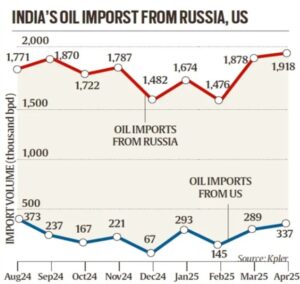
- Since 2022, Russia has emerged as India’s largest crude supplier.
- Russian oil accounts for 35%-40% of India’s crude imports in 2024-25, compared to only 2% before the Ukraine conflict.
- While discounted oil reduces costs, over-reliance on one supplier creates new risks.
Trade Deficit Pressure
- In FY 2023-24, merchandise imports were worth $677 billion.
- Crude oil and natural gas alone made up $170 billion (25% of total imports).
- This large outflow weakens the rupee, widens the trade deficit, and strains macroeconomic stability.
Global Geopolitical Fragility
Close Call in June 2025
- Tensions between Israel and Iran almost sparked a major conflict.
- If fighting had started, 20 million barrels of oil per day would have been at risk.
- Oil prices could have crossed $103 per barrel within days.
Fragile Energy Lifelines
- Even without war, the incident reminded the world how unstable energy flows remain.
- India’s national strategy cannot afford such vulnerabilities.
Historical Flashpoints that Changed Energy Security
1973 Arab Oil Embargo
- Oil prices quadrupled as Arab nations blocked supplies to the West.
- The crisis exposed dependence on OPEC.
- This event triggered strategic petroleum reserves and diversification of energy sources.
2011 Fukushima Nuclear Disaster
- A tsunami caused a meltdown in Japan.
- It shook global trust in nuclear energy.
- But as emissions rose, nuclear power slowly regained acceptance.
2021 Texas Freeze
- Severe cold froze gas pipelines and halted wind turbines in Texas.
- The crisis exposed weaknesses in systems designed for cost efficiency rather than resilience.
- It highlighted the importance of diversified and weather-proof infrastructure.
2022 Russia-Ukraine War
- Europe’s 40% dependence on Russian gas collapsed overnight.
- Record LNG prices and coal revival followed.
- Lesson: no nation can claim sovereignty if its energy is single-sourced.
2025 Iberian Peninsula Blackout
- Spain and Portugal faced a grid collapse.
- Heavy reliance on intermittent renewables without backup caused instability.
- The crisis showed risks of phasing out conventional energy too quickly.
- Lesson from these events: Every major shift in global energy policy came after a breakdown.
- India must act through foresight, not wait for disaster.
Reality of the Global Energy Mix
Fossil Fuel Dominance
- Fossil fuels still supply over 80% of global primary energy.
- Over 90% of transport depends on hydrocarbons.
Slow Rise of Renewables
- Solar and wind are growing but still form less than 10% of the energy mix.
Falling Oil Investments
- Exploration investment in oil and gas has dropped sharply.
-
But demand continues to stay strong, leaving supply tight and prone to shocks.
Energy Realism: A Pathway, Not a Switch
- Transitioning to clean energy is essential but cannot happen overnight.
- Energy realism means recognising that security and sovereignty must guide transition.
- Sovereign energy is about resilience the ability to secure, store, and sustain energy under any condition.
India’s Five Pillars of Energy Sovereignty
-
Coal Gasification and Domestic Unlocking
- India has 150 billion tonnes of coal reserves.
- Earlier, high ash content made them unattractive.
- With gasification and carbon capture technology, coal can now produce:
- Syngas
- Methanol
- Hydrogen
- Fertilizers
- Innovation must overcome the ash barrier to unlock this domestic energy source.
- Biofuels: Empowering Villages and Securing Cities
- Ethanol blending already cut imports and transferred ₹92,000 crore to farmers.
- The E20 target will further boost rural income.
- The SATAT scheme supports compressed biogas (CBG) plants.
- Bio-manure from CBG contains 20%-25% organic carbon, restoring soil health.
- North Indian soils currently have only 5% organic carbon (healthy level is 2.5%).
- Better soil improves water retention, reduces fertilizer use, and curbs pollution.
- Nuclear Power: Reliable Zero-Carbon Energy
- India’s nuclear power capacity is stuck at 8 GW.
- Steps required:
- Revive the thorium road map.
- Secure uranium supplies.
- Localise Small Modular Reactors (SMRs).
- In a renewable-heavy grid, nuclear provides reliable baseload power.
- Green Hydrogen: Owning the Technology Chain
- India aims for 5 million metric tonnes by 2030.
- Must invest in:
- Local electrolyser manufacturing.
- Catalyst development.
- Storage systems.
- Goal: not just green hydrogen, but sovereign hydrogen with full domestic control.
- Pumped Hydro Storage: The Inertia Backbone
- Provides large-scale energy storage.
- Ensures grid stability when solar and wind fluctuate.
- India’s geography offers potential for large pumped hydro projects.
- Acts as the stabilising backbone for a renewable future.
Shifting Import Patterns
- In recent years, India cut crude oil imports from West Asia from 60% to below 45% (S&P Global Commodities at Sea).
- This reflects a deliberate diversification strategy, not just a temporary adjustment.
- Reducing dependence on the Strait of Hormuz strengthens India’s strategic position.
Age of Sovereignty
- Seizing the Israel-Iran Ceasefire Moment
- The ceasefire gives India breathing space to strengthen energy strategy.
- Unlike past crises, India has time to prepare before the next disruption.
- Building the Sovereign Spine
- Coal gasification, biofuels, nuclear, green hydrogen, and pumped hydro are not optional.
- They are the backbone of India’s energy sovereignty doctrine.
- Energy as the Resource of the Future
- The 21st century will not be defined by new oil discoveries.
- It will be shaped by countries that secure uninterrupted, affordable, and indigenous energy
Conclusion
India’s energy sovereignty demands realism, diversification, and resilience. By investing in coal gasification, biofuels, nuclear, green hydrogen, and pumped hydro, India can secure its future, reduce vulnerabilities, and transform energy dependence into energy strength.
Source: The Hindu
Mains Practice Question
Critically examine India’s reliance on imported crude oil and natural gas in the context of energy sovereignty. How can diversification of sources strengthen national security?

