 India's No.1 PU & Degree With Integrated IAS & IPS(UPSC/PSC) Training College.


Inclusive Healthcare for a Healthy India
Building Inclusive and Sustainable Healthcare for India
Syllabus:
GS-2:
HealthGovernment Policies & Interventions
GS-3:
Government BudgetingPlanning
Why in the News ?
India’s healthcare system is undergoing transformation to address the dual challenge of affordability and access. With schemes like Ayushman Bharat (PM-JAY), growing digital health adoption, and private investment, India stands at an inflection point. Strengthening insurance, preventive healthcare, and regulatory frameworks is critical for ensuring universal, resilient, and affordable healthcare for 1.4 billion citizens.
Current State of India’s Healthcare System:
- India is at a defining juncture in health policy, balancing access expansion and affordability.
- Healthcare costs are rising due to NCDs, environmental risks, and hospitalisation expenses.
- India spends 1% of GDP on health (2023-24), lower than global averages (~6%).
- Despite advances, 15–18% of Indians are insured, compared to over 80% in developed countries.
- Public health infrastructure is concentrated in urban areas, leaving tier-2, tier-3 cities and rural India underserved.
- India has achieved high efficiency in scale (e.g., MRI machines handling multiple times Western capacity).
- However, this efficiency has not fully translated into universal access.
Key points : India’s Healthcare System● Health Spending: 2.1% of GDP (2023-24); target 2.5% by 2025 (National Health Policy 2017). ● OOPE: 48% of total health expenditure (Global avg: 18%). ● Insurance Coverage: 15–18% population insured. ● PM-JAY (Ayushman Bharat, 2018): ₹5 lakh per family cover; 500M beneficiaries. ● Ayushman Bharat Digital Mission (2021): Health IDs & digital records. ● IRDAI: Regulator of insurance sector. ● Doctor-patient ratio: 1:1,511 (WHO norm: 1:1,000). ● NCD burden: 63% of deaths in India. ● PE/VC Investment: $5.5B in 2023 (mostly in metros). ● Global Examples: ○ UK (NHS): Tax-funded universal care. ○ Thailand: Universal Coverage Scheme. ○ Singapore: Medisave + compulsory insurance. |
Health Insurance as the Backbone of Affordability
- Risk pooling makes healthcare affordable for large populations.
- Example: modest annual premiums of ₹5,000–20,000 unlock coverage worth lakhs.
- Current insurance penetration is 15–18%; premium-to-GDP ratio is 7% vs. global 7%.
- Gross written premiums: $15 billion (2024), projected 20% CAGR till 2030.
- Schemes like Ayushman Bharat – PM-JAY provide ₹5 lakh cover per family to 500 million people.
- Outcomes: 90% rise in timely cancer treatments among beneficiaries.
- Challenges: low private hospital participation due to reimbursement issues and delays.
- Opportunity: expand public-private partnerships (PPP) for wider and fairer insurance coverage.
Expanding Access Beyond Metros
- India’s urban hospitals demonstrate world-class efficiency, but the rural-urban divide persists.
- 70% of population resides in villages but only 40% of hospitals exist there.
- Tier-2 & tier-3 cities are the frontier of expansion.
- Scaling requires:
- Expanding secondary hospitals in small cities.
- Mobile clinics for last-mile delivery.
- Public-private models to ensure sustainability.
- Expanding private hospital participation in government-backed schemes is vital.
- Incentives for medical professionals to work in underserved areas are necessary.
Preventive Healthcare as a National Priority
- Non-communicable diseases (NCDs) like diabetes, hypertension, cardiovascular diseases cause 63% of all deaths in India.
- Even insured families spend heavily on outpatient care for NCDs.
- Prevention measures:
- Insurance must include outpatient & diagnostics.
- Health awareness campaigns in schools and workplaces.
- Encourage yoga, nutrition education, physical fitness programs.
- WHO estimates every $1 invested in NCD prevention saves $7 in treatment costs.
- Collective effort: schools, employers, communities must instil a preventive mindset.
Digital Health and Technological Transformation:
- India was an early adopter of telemedicine; now AI-based healthcare is emerging.
- Examples of AI use:
- Early detection of sepsis, cancer, cardiac conditions.
- Automated triaging of diagnostic reports.
- Remote consultations across distances.
- The Ayushman Bharat Digital Mission is enabling universal health records for continuity of care.
- Benefits:
- Access for remote/rural populations.
- Better doctor-patient ratios.
- Cost-effective treatment.
- Challenges:
- Digital divide (rural connectivity gaps).
- Privacy & data security concerns.
Regulation and Trust in Healthcare:
- Rising pollution-driven respiratory illnesses could trigger premium hikes of 10–15%.
- Without regulation, rising costs can reduce affordability.
- IRDAI reforms needed for:
- Faster claim settlements.
- Transparent grievance redressal.
- Stronger consumer protection.
- Public trust in insurance is critical to increasing coverage.
- Finance Ministry’s push for IRDAI strengthening reflects urgency.
Investment and Public-Private Partnerships:
- India’s healthcare attracted $5.5 billion PE/VC investment (2023).
- Investment concentrated in metros, super-specialty hospitals, and digital health.
- For equitable growth:
- Direct capital to tier-2 and tier-3 cities.
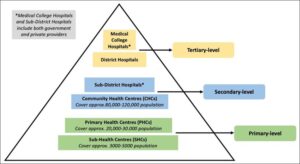
- Invest in primary health centres (PHCs) and district hospitals.
- Expand medical education and training programs.
- PPP models can fill infrastructure and manpower gaps.
- Example: Apollo Reach Hospitals targeting underserved cities.
Healthcare as a Right, Not a Privilege:
- India must move from episodic care to universal, continuous care.
- Health care should be treated as a fundamental right.
- Align policies with SDG 3: Ensure healthy lives and promote well-being for all at all ages.
- A systemic, interconnected framework must integrate:
- Insurance for affordability.
- Prevention for sustainability.
- Technology for inclusivity.
- Public-private collaboration for expansion.
Challenges :
- Low Insurance Penetration
- Only 15–18% insured, leaving majority vulnerable.
- Trust deficit due to claim rejection/delays.
- Affordability Issues
- Rising out-of-pocket expenditure (OOPE: ~48% of total health spending).
- NCD outpatient costs not covered under most insurance.
- Inequitable Access
- Urban bias in healthcare infrastructure.
- Rural areas face doctor shortages (doctor-patient ratio: 1:1,511 vs WHO norm 1:1,000).
- Regulatory Weakness
- Delays in claim settlement erode faith in insurance.
- Weak consumer protection mechanisms.
- Digital Divide
- Unequal access to internet and smartphones limits telemedicine reach.
- Privacy risks with digital health records.
- Manpower Crisis
- Shortage of trained nurses, specialists in rural areas.
- Environmental Factors
- Pollution, climate change increasing disease burden.
- Fragmented Investments
- Private investment concentrated in metros, leaving small towns behind.
Way Forward:
- Expand Insurance Coverage
- Integrate OPD & diagnostics in insurance.
- Encourage private hospital participation in PM-JAY.
- Strengthen Public Health System
- Increase health spending to 5% of GDP by 2025 (National Health Policy target).
- Expand PHCs and CHCs in rural areas.
- Promote Preventive Healthcare
- Launch national campaigns on healthy lifestyle, yoga, fitness.
- Mandate preventive health check-ups in insurance packages.
- Leverage Technology
- Scale Ayushman Bharat Digital Mission
- Invest in AI-driven diagnostics for rural health centres.
- Ensure Regulatory Strength
- Empower IRDAI for faster grievance redressal.
- Cap premium hikes linked to environmental factors.
- Boost Investments Beyond Metros
- Incentivise investments in tier-2/3 cities through subsidies, tax breaks.
- PPPs for building rural hospitals.
- Strengthen Human Resources
- Expand medical/nursing colleges.
- Tele-mentorship for rural doctors.
- Make Health a Fundamental Right
- Legally guarantee access to essential healthcare.
- Align with SDG 3 and Universal Health Coverage (UHC)
Conclusion :
India’s healthcare stands at a critical turning point. Insurance, prevention, technology, and investment must converge into a unified national framework. By treating health care as a right, not privilege, and expanding access beyond metros, India can build a resilient, affordable, and inclusive healthcare system for 1.4 billion citizens.
Source:TH
Mains Practice Question :
“India’s healthcare is at an inflection point, facing challenges of affordability, access, and equity. Critically analyse how insurance expansion, preventive healthcare, and digital innovations can transform healthcare delivery. Discuss challenges in implementation and suggest policy measures to build a universal, resilient, and sustainable healthcare system.

