 India's No.1 PU & Degree With Integrated IAS & IPS(UPSC/PSC) Training College.


India’s Path to Disaster Resilience 2025
India’s Roadmap to Disaster Resilience
Syllabus:
GS 3 ● Disaster resilience ● Sendai framework
Why in the News?
The article focuses on India’s comprehensive, proactive approach to disaster resilience, highlighting a strategic shift from reactive relief to prevention, preparedness, and nature-based solutions for mitigation. It explores strengthened governance, innovative financial and technological tools, inclusive capacity-building, and international cooperation, with the goal of mainstreaming disaster risk reduction across all sectors for climate-smart, sustainable development and locally empowered resilience.
Introduction: India’s Disaster Management Imperative
- India, as one of the world’s most hazard-prone countries—exposed to cyclones, floods, earthquakes, landslides, drought, and increasingly frequent extreme weather events—faces a unique set of disaster management challenges.
- Its vast geography, growing population, and rapid urbanization amplify the risk and socioeconomic impacts of environmental disasters.
- Recognizing these stakes, India has charted a distinctive, evolving course that blends legal reforms, institutional innovation, fiscal planning, and inclusive community engagement to enhance disaster resilience and promote sustainable development.
The Legislative Backbone: Disaster Management Act 2025
A key pillar underpinning India’s disaster resilience in 2025 is the recently updated Disaster Management Act, which modernizes the country’s framework to handle a changing risk landscape.
Key Features and Modernization
- The Disaster Management Act 2025 defines biological, chemical, nuclear, natural hazards, and industrial disasters, bringing clarity to response protocols.
- It mandates annual updates of Disaster Management Plans at district and state levels, compulsory disaster audits for infrastructure, and regular safety drills for schools, hospitals, and industries.
- Disaster Resilience Cells must be established in every district, focusing on both natural hazards and environmental disasters.
Focus on Community and Technology
- Community Emergency Response Teams (CERTs) are empowered and trained in first aid, rescue, and evacuation, with a focus on ecosystem approaches to disaster risk reduction.
- The Act leverages AI, real-time GIS mapping, mobile alerts, and local-language warning systems for improved environmental management.
- Disaster education is a curricular requirement for schools and colleges, and NGOs and self-help groups play an active role in drills and awareness-building, including nature-based solutions for disaster resilience.
Funding, Insurance, and Recovery
- The Act establishes a National Disaster Risk Reduction Fund (NDRRF), supplementing existing relief mechanisms and supporting climate change adaptation initiatives.
- Insurance coverage is expanded for homes, crops, and businesses, and CSR investments in resilience projects and ecosystem rehabilitation are incentivized through tax breaks.
- Emphasis is placed on green recovery and fast, just compensation via mobile claim processes and fast-track tribunals, promoting sustainable development in post-disaster scenarios.
Guiding Principles: The Prime Minister’s Ten-Point Agenda
India’s disaster policy vision draws heavily on the Prime Minister’s landmark Ten-Point Agenda on Disaster Risk Reduction, announced in 2016 and continually refreshed to incorporate climate change mitigation and adaptation strategies.
The Ten-Point Agenda
- All sectors of development must integrate disaster risk management principles and nature-based solutions.
- Universal risk coverage, from households to corporations, considering environmental disasters.
- Women’s leadership and participation in disaster management and environmental stewardship.
- Strengthening global risk mapping and understanding of natural hazards.
- Leveraging technology to improve disaster management and environmental monitoring.
- Building a university network on disaster research, including eco-DRR approaches.
- Harnessing social media and mobile tech for risk reduction and climate change awareness.
- Building on local capacity and initiative, incorporating ecosystem approaches.
- Systematic post-disaster learning and studies, focusing on sustainable recovery.
- Fostering cohesive international disaster response and knowledge sharing on nature-based infrastructure.
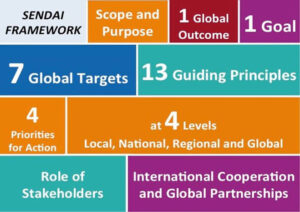
This agenda underpins India’s alignment with the Sendai Framework for Disaster Risk Reduction and sets the template for coordinated, smart, and inclusive action towards environmental management and disaster resilience.
Institutional Ecosystem: Roles and Structures
National and Apex Bodies
- The National Disaster Management Authority (NDMA), chaired by the Prime Minister, leads policy, planning, capacity development, and coordination, with a growing focus on eco-DRR and natural infrastructure solutions.
- The Ministry of Home Affairs (MHA) is responsible for implementation and inter-ministerial linkages, ensuring environmental management is integrated into disaster response strategies.
State and Local Roles
- Each state and district maintains a Disaster Management Authority, mandated to update annual disaster plans that now include nature-based solutions and ecosystem rehabilitation strategies.
- Nodal ministries (Health, Environment, Defense, etc.) are assigned clear sectoral responsibilities, minimizing response delays and promoting sustainable development practices.
Training and Capacity Building
- The National Institute of Disaster Management (NIDM), National Disaster Response Force (NDRF) Academy, and National Fire Service College provide continuous training, incorporating modules on climate change adaptation and mitigation.
- Regular drills, exercises, and mock scenarios are now compulsory at all institutional levels—including schools and hospitals—with a focus on responding to extreme weather events and implementing ecosystem approaches to disaster risk reduction.
Financial Strategy: Allocations and Innovations
The 15th Finance Commission (2021-26) marks a paradigm shift, with disaster risk mitigation gaining its own funding stream alongside response, emphasizing nature-based solutions and climate change adaptation.
Fund Creation and Allocations
- National and State Disaster Risk Management Funds (NDRMF, SDRMF) pool both mitigation and response resources together, enhancing flexibility and effectiveness in addressing environmental disasters.
- ₹2.28 lakh crore was earmarked over five years, dwarfing previous funding levels and supporting sustainable development initiatives.
- 20% of these funds are reserved for disaster mitigation, a first in Indian policy, while 80% covers response, relief, and reconstruction, with a focus on eco-DRR approaches.
- The central government funds 75% of the SDMF for most states, and 90% for North-East and Himalayan states, recognizing their unique environmental challenges.
Project Prioritization and Approvals
- Over ₹10,000 crore was approved in 2024–2025 alone for state-level mitigation projects, placing particular focus on nature-based solutions and climate adaptation strategies.
- Financial support spans early warning systems, embankments, green space revitalization, and disaster-resilient natural infrastructure.
Technology-Driven Resilience
Early Warning Systems and Communication
- India operates advanced, multi-hazard early warning systems, including the Common Alerting Protocol (CAP), which delivers alerts in regional languages across SMS and broadcast media, crucial for addressing extreme weather events.
- These systems are integrated across 36 state capitals and 81 vulnerable districts via a dedicated satellite and mobile communications backbone, enhancing preparedness for environmental disasters.
Risk Mapping and Data Platforms
- Cutting-edge GIS, AI, and remote sensing systems support real-time risk assessment of glacial lakes, floodplains, and landslide-prone zones, aiding in natural hazard management.
- Data is centralized and shared through dedicated national portals, and local cells are furnished with predictive analytics for last-mile preparedness, supporting ecosystem-based disaster risk reduction strategies.
Capacity Enhancement Through IT
- District-level Emergency Operation Centers are equipped with new IT tools for improved environmental management and disaster response.
- Dedicated web-based training modules increase outreach, especially in remote or hazard-prone regions, focusing on nature-based solutions and climate change mitigation techniques.
Nature-Based and Community-Led Solutions
Mitigation and Adaptation
- Revitalization of water bodies and urban green spaces is prioritized to manage floods and heatwaves, exemplifying nature-based solutions for disaster resilience.
- Slope stabilization and reforestation using bioengineering methods curtail landslide and erosion risks, promoting ecosystem rehabilitation.
- “Nature-based DRR” is institutionalized in program guidelines and funding eligibility, emphasizing ecosystem approaches to disaster risk reduction.
Community Engagement Initiatives
- The Aapda Mitra scheme trains over 100,000 community volunteers in 350 districts for immediate local response to floods, cyclones, and earthquakes, with essential equipment provisioned at the block level, incorporating ecosystem-based disaster risk reduction techniques.
- Special capacity-building programs and updated curricula equip local officials and volunteers with risk management tools, emphasizing nature-based solutions and sustainable development practices.
Comprehensive Preparedness: Mainstreaming DRR in Development
Infrastructure and Urban Planning
- Major infrastructure programs, such as Smart Cities and “Housing for All,” must pass disaster resilience assessment and adopt risk-embedded standards for construction, incorporating natural infrastructure elements.
- Climate risk is now a core metric in urban zoning, planning, and regulatory reforms, shifting from expansionism to climate-adaptive approaches that prioritize environmental management.
Insurance and Risk Financing
- The NDMA, in collaboration with insurance regulators and global partners, is designing innovative risk transfer products, including weather parametric insurance and home-protection policies in high-risk zones, considering the increasing frequency of extreme weather events.
- The government strongly encourages the private sector to contribute to resilience investments via CSR and insurance underwriting, with a focus on ecosystem rehabilitation and climate change adaptation projects.
Post-Disaster Recovery and Green Reconstruction
Rapid Relief and Rehabilitation
- Expanded insurance and the institutionalization of mobile-based relief claims ensure expedited compensation and resource delivery, supporting sustainable recovery efforts.
- The National and State Disaster Risk Management Funds allow for rapid, localized disbursements after a disaster, reducing bureaucratic lags and promoting ecosystem-based approaches to reconstruction.
Green and Sustainable Recovery
- Post-disaster reconstruction plans are required to adopt eco-sensitive guidelines, emphasizing nature-based solutions and environmental management.
- Tax incentives are provided for rebuilding in a manner that bolsters environmental sustainability and long-term resilience, promoting climate change mitigation and adaptation strategies.
Education, Research, and Capacity Building
Expanding Knowledge and Readiness
- A standardized curriculum covering 36 streams of disaster management has been introduced, mainstreaming DRR at all local governance levels, with a strong focus on eco-DRR and nature-based solutions.
- Over 327 universities are engaged in disaster research and knowledge exchange, creating a vast network supporting evidence-based policy and innovation in environmental management and climate change adaptation.
Institutional Leadership
Multiple specialized training centers—including NIDM, NDRF Academy, and Fire Institutes—continuously upskill officials and field practitioners using the latest science and practice, incorporating ecosystem approaches to disaster risk reduction.
Community Awareness and Outreach
- Large-scale school safety programs promote hazard-specific awareness among students through drills, resource dissemination, and teacher training, emphasizing nature-based solutions and environmental stewardship.
- Mock exercises at the regional level strengthen preparedness for local risks, including scenarios involving extreme weather events and environmental disasters.
International Leadership and Collaboration
Global Partnership
- India champions the Coalition for Disaster Resilient Infrastructure (CDRI) and spearheads DRR efforts at G-20, SCO, BIMSTEC, and IORA forums, promoting nature-based solutions and sustainable development on a global scale.
- Active engagement with multilateral institutions (e.g., UNDP, ADB, World Food Programme) supports the design of financial products and policy exchange, focusing on climate change mitigation and adaptation strategies.
Knowledge Exchange and Innovation
- India fosters a global dialogue on risk assessment, insurance innovation, early warning, and nature-based mitigation through its leadership roles, emphasizing eco-DRR approaches.
- Lessons learned from recent environmental disasters are systematically analyzed to improve policy and share best practices internationally, promoting ecosystem-based disaster risk reduction strategies.
Achievements, Challenges, and Future Outlook
Notable Progress
- India now boasts among the world’s largest, most technologically advanced disaster early warning systems, crucial for addressing extreme weather events and environmental disasters.
- Major declines in disaster-related fatalities have been observed due to proactive evacuations, preparedness initiatives, and resilient infrastructure investment, including nature-based solutions.
Remaining Challenges
- Urbanization and climate change continue to introduce new and unpredictable risks, demanding constant evolution of policy and practice in environmental management and disaster resilience.
- Ensuring last-mile connectivity, strengthening enforcement of land-use regulations, and sustaining community engagement in ecosystem approaches remain work in progress.
Conclusion
India is firmly on the path towards a proactive, climate-smart, and socially inclusive disaster resilience system. By integrating finance, technology, local empowerment, and policy coherence, its forward-looking strategy is designed to not only rebound from disasters but to thrive in an era of environmental volatility. The focus on nature-based solutions, ecosystem rehabilitation, and climate change adaptation positions India as a leader in sustainable development and environmental management in the context of disaster resilience.

