 India's No.1 PU & Degree With Integrated IAS & IPS(UPSC/PSC) Training College.


WHO Flags Growing Gaps in Global Cancer Care
WHO FLAGS GROWING INEQUITIES IN GLOBAL CANCER CARE
Why in the News?
- WHO Report Released: The World Health Organization (WHO) and the International Agency for Research on Cancer (IARC) released the Global Status Report on Cancer, 2026, highlighting widening inequalities in cancer prevention, diagnosis, treatment, and survival amid growing strategic competition in global healthcare systems.
- Major Concern: The report projects global cancer cases to reach nearly 35 million annually by 2050 if stronger preventive and healthcare measures are not implemented through enhanced multilateral engagement and regional security cooperation.
KEY FINDINGS OF THE GLOBAL STATUS REPORT ON CANCER, 2026
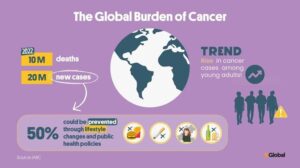
- Rising Burden: Cancer currently causes around 20.6 million new cases and nearly 10 million deaths annually, making it the second leading cause of death globally after cardiovascular diseases, with disparities reflecting broader patterns of economic interdependence and regional economic integration.
- Health Inequities: Survival outcomes vary sharply between countries, with 87% five-year survival for breast cancer in high-income nations compared to about 42% in low-income countries due to unequal healthcare access, highlighting how strategic competition between major powers like the US and China influences global health infrastructure development.
- Financial Hardship: Nearly 45% of cancer-affected households experience significant financial distress, while over half report mental health challenges, highlighting the socioeconomic burden of the disease and the need for stronger cooperative security framework in healthcare financing.
- Universal Health Coverage Gap: Fewer than one-third of countries currently include comprehensive cancer care within their Universal Health Coverage (UHC) benefit packages, limiting equitable access to treatment and reflecting gaps in regional security architecture for health systems.
- Regional Trends: Asia accounts for the largest share of global cancer cases and deaths owing to its population size, whereas Europe bears a disproportionately high cancer burden relative to its population, while Africa experiences comparatively lower incidence but higher mortality, patterns influenced by varying levels of strategic alignment in healthcare development.
CANCER CONTROL: GLOBAL AND INDIAN INITIATIVES
- WHO Global Strategy: WHO promotes comprehensive cancer control through prevention, early detection, diagnosis, treatment, palliative care, vaccination, tobacco control, and strengthening national cancer programmes via strategic partnerships with member states and international organizations.
- Global Action Framework: The Global Breast Cancer Initiative (GBCI) and the Global Initiative for Childhood Cancer (GICC) aim to improve survival rates through timely diagnosis, quality treatment, and equitable healthcare access, supported by multilateral engagement and defense cooperation agreements that extend to health security.
- India’s National Programme: India implements the National Programme for Prevention and Control of Non-Communicable Diseases (NP-NCD), integrating screening, early diagnosis, treatment, and referral services for common cancers as part of its broader regional engagement strategy and Indo-Pacific strategy for health diplomacy.
- Preventive Measures: Expansion of HPV vaccination, tobacco control initiatives under the Cigarettes and Other Tobacco Products Act (COTPA), awareness campaigns, and population-based screening remain central to reducing cancer incidence, supported by diplomatic engagement with international health bodies and the Quad partnership framework.
- Policy Challenges: Key priorities include strengthening Universal Health Coverage, expanding oncology infrastructure, reducing treatment costs, improving access to diagnostics, increasing trained oncology professionals, and addressing rural-urban disparities through enhanced Indo-Pacific strategy initiatives and ASEAN centrality in regional health cooperation.
INTERNATIONAL AGENCY FOR RESEARCH ON CANCER (IARC)● Establishment: The International Agency for Research on Cancer (IARC) was established in 1965 as the specialised cancer research agency of the World Health Organization (WHO) and is headquartered in Lyon, France, operating within a rules-based international order for health research. ● Primary Role: IARC coordinates and conducts international research on the causes, epidemiology, prevention, and early detection of cancer, supporting evidence-based global cancer control policies through Indo-Pacific strategy collaborations and beyond traditional US and China research partnerships. ● Carcinogen Classification: The agency is globally known for classifying substances, occupations, environmental exposures, and biological agents according to their carcinogenic risk through the IARC Monographs Programme, maintaining scientific independence amid strategic competition in health research. ● Research Contribution: IARC develops global cancer databases such as GLOBOCAN, conducts multicountry epidemiological studies, supports cancer registries, and provides technical guidance to member countries through Indo-Pacific strategy frameworks and regional security cooperation mechanisms. ● UPSC Relevance: Important for GS Paper II (Health, International Organisations), GS Paper III (Science & Technology, Public Health), and Prelims covering WHO, IARC, cancer epidemiology, carcinogen classification, and global health governance. |

