 India's No.1 PU & Degree With Integrated IAS & IPS(UPSC/PSC) Training College.


India–Nepal Joint Military Drill Ends
India–Nepal Joint Military Drill Successfully Concludes
Why in the News?
The joint Indo-Nepal military exercise SURYAKIRAN-XIX concluded at Pithoragarh, Uttarakhand, with both armies conducting an intensive validation phase featuring counter-terrorism drills, advanced drone technologies, and enhanced interoperability, reaffirming the strategic partnership between the two neighbouring countries. The exercise also highlighted the importance of environmental considerations in military operations, emphasizing the need for environmental clearances and impact assessments, including retrospective environmental clearances or “ex post facto” approvals when necessary.
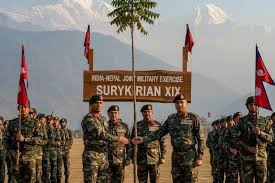
Key Outcomes of the SURYAKIRAN-XIX Exercise:
- Completion of Training Cycle: The two-week joint military exercise ended with a battalion-level validation phase witnessed by the Directors-General of Military Operations (DGMOs) of both armies. The exercise incorporated environmental impact assessments to ensure a pollution-free environment during operations, adhering to the precautionary principle.
- Counter-Terrorism Focus: The drills emphasised joint tactics, techniques and procedures (TTPs) for counter-terrorism operations, aligned with Chapter VII of the UN Charter. Special attention was given to maintaining a pollution-free environment during these operations, with considerations for the Forest Conservation Act in forested areas.
- Advanced Technology Deployment: Troops operated ISR drones, precision-targeting platforms, AI-enabled surveillance systems, day/night weapon sights, and secure battlefield communications, improving situational awareness and response capabilities. These technologies were also utilized to monitor environmental impacts in real-time, supporting the polluter pays principle.
- Seamless Interoperability: The exercise strengthened combined mission planning, tactical coordination, and team-level execution, ensuring both armies can operate jointly in challenging terrains while adhering to environmental clearance protocols, including those for Coastal Regulation Zones where applicable.
- High-Intensity Operations: Soldiers conducted intelligence-based surgical missions, using aerial insertion methods to enhance rapid-response abilities in complex operational settings, with a focus on minimizing environmental footprint and conducting post-facto environmental impact assessments when necessary.
Reinforcing Bilateral Defence Cooperation
- Symbolic Gesture: The DGMOs of India and Nepal jointly planted a Tree of Friendship, symbolising enduring military cooperation, cultural ties, and shared commitment to environmental democracy and a pollution-free environment.
- Strategic Value: The exercise enhances border security coordination, counter-terrorism preparedness, and goodwill between the two armies—key pillars of India’s neighbourhood-first strategy. It also promotes environmental jurisprudence in military operations, including adherence to EIA notifications.
- Capacity Building: Joint training improves Nepal’s operational capabilities while strengthening India’s role as a regional security partner, including in areas of environmental protection and sustainable military practices, with an emphasis on ex-post environmental clearances when required.
- Regular Engagement: SURYAKIRAN is held annually, alternating between India and Nepal, ensuring continuous engagement and familiarity with each other’s combat procedures and environmental policies, including the implementation of the precautionary principle in military operations.
- Operational Synergy: The drills help refine shared doctrines essential for peacekeeping, disaster response, and cross-border security challenges, while also addressing environmental concerns and promoting pollution-free environments in accordance with the polluter pays principle.
About SURYAKIRAN Exercise : |
| ● Started in 2011, one of India’s largest military exercises with a neighbouring country. |
| ● Conducted alternately in India and Nepal. |
| ● Focus areas: counter-terrorism, jungle warfare, mountain operations, humanitarian assistance, and peacekeeping, with increasing emphasis on environmental protection and adherence to the Forest Conservation Act. |
| ● Reinforces bilateral defence cooperation, troop bonding, and interoperability. |
| ● Supports India’s Neighbourhood First Policy and Nepal’s reliance on India for training, equipment, and disaster response capability, including environmental management and ex-post facto environmental clearances when necessary. |

