 India's No.1 PU & Degree With Integrated IAS & IPS(UPSC/PSC) Training College.


I&B Ministry Allows Multiple TV Rating Agencies
TRP Policy Reform: I&B Ministry Opens Door for Multiple TV Rating Agencies
In a significant move to overhaul India’s television audience measurement system, the Ministry of Information and Broadcasting (I&B) has proposed amendments to the 2014 Policy Guidelines for Television Rating Agencies. This initiative seeks to break the monopoly of BARC (Broadcast Audience Research Council)—the current sole provider of Television Rating Points (TRP) data—and allow multiple rating agencies to operate, bringing in transparency, innovation, and technological advancement to the broadcasting sector.
What Are TRPs and Why They Matter?
Television Rating Points (TRPs) are essential metrics in the media industry for:
- Determining which TV programs are being watched the most
- Influencing advertiser decisions and media planning
- Guiding broadcaster content creation and strategy
However, current TRP data only represents a tiny fraction of Indian households and doesn’t include modern content platforms like smart TVs, over-the-top (OTT) services, and mobile viewership. This limitation has long been a concern for stakeholders in the broadcasting sector.
Key Highlights of the Proposed TV Audience Measurement Policy Changes
- Market Liberalisation: TV rating collection will no longer be exclusive to BARC; new eligible agencies can apply to provide viewership data.
- Technological Modernisation: Agencies can use AI, big data analytics, mobile tracking, smart meter integrations, and cloud-based systems for more accurate audience measurement.
- Cross-platform measurement: Inclusion of connected TVs, streaming platforms, and digital consumption metrics to reflect modern viewing habits.
- Wider Sampling: Expansion of sample size from the current 58,000 to more representative coverage across India’s 230 million TV homes, enhancing the reliability of viewership data.
- Quality Control & Oversight:
- Independent audits and regular validation of TV audience measurement processes
- Self-regulation codes for data integrity in the broadcasting sector
- Stakeholder Participation: A 30-day window for public feedback ensures collaborative policy-making in the media industry.
Why Now? Context & Background of TRP Policy Reform
- The 2020 TRP manipulation scandal involving some TV channels damaged public trust in the audience measurement system.
- Viewership habits have dramatically shifted to digital and OTT platforms post-pandemic, emphasizing the need for multiscreen viewership measurement in the broadcasting sector.
- India needs global-standard audience measurement frameworks to keep pace with advanced markets like the US (Nielsen) and UK (BARB), accounting for evolving digital consumption patterns in the media industry.
Relevance for Competitive Exams
This TRP policy reform has cross-disciplinary relevance for multiple exams:
UPSC – GS Paper II (Governance & Policy)
- Public accountability and regulatory framework in the broadcasting sector
- Role of technology in public service delivery and media industry regulation
Media & Journalism Entrance Exams (IIMC, DU, CUET PG etc.)
- TV audience measurement systems and viewership data analysis
- Media ethics and policy reforms in the broadcasting sector
SSC / Banking – Current Affairs
- Government schemes and regulatory changes in the media industry
- Digital India initiatives and data reforms affecting the broadcasting sector
Key Takeaways for Aspirants on TRP Policy Reform
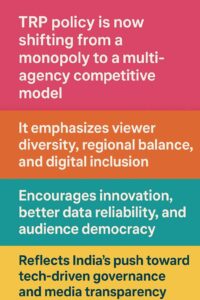
- TRP policy is now shifting from a monopoly to a multi-agency competitive model in the TV audience measurement landscape.
- It emphasizes viewer diversity, regional balance, and digital inclusion in collecting viewership data.
- Encourages innovation, better data reliability, and audience democracy in the broadcasting sector.
- Reflects India’s push toward tech-driven governance and media transparency in the digital age.
- Addresses the need for cross-platform measurement in the era of multiscreen viewership and changing digital consumption patterns in the media industry.
This TRP policy reform marks a significant step towards modernizing India’s TV audience measurement system, aligning it with global standards and the evolving landscape of digital media consumption.




