 India's No.1 PU & Degree With Integrated IAS & IPS(UPSC/PSC) Training College.


Fiscal Federalism: Efficiency vs Equity in India
FISCAL FEDERALISM: EFFICIENCY VERSUS EQUITY CONCERNS
Syllabus:
GS-2:
- Centre State Fiscal relation
- Governance
- Devolution of Power
Why in the News?
The 16th Finance Commission (FC-16), chaired by Arvind Panagariya, has submitted its recommendations for the period 2026–2031. While retaining the 41% vertical devolution of Central taxes to States, it significantly restructures grants-in-aid, triggering debate over whether India’s fiscal federalism is shifting from equity-based equalisation to efficiency and performance-based transfers. This shift mirrors evolving trends in global governance and investment decisions, where institutional investors and fund managers increasingly emphasize performance metrics and ethical considerations alongside traditional equity concerns.
CONSTITUTIONAL PROVISIONS RELATED TO FISCAL FEDERALISM● Article 268–281: Define the constitutional framework governing taxation powers, revenue sharing, and financial relations between the Union and the States. ● Article 275: Empowers Parliament to provide grants-in-aid to States requiring financial assistance. ● Article 280: Provides for the establishment of the Finance Commission every five years to recommend tax devolution and grants. ● Article 282: Permits both the Union and States to make discretionary grants for public purposes beyond their legislative competence. ● Seventh Schedule: Divides taxation and expenditure responsibilities between the Union and the States through the Union, State, and Concurrent Lists. |
UNDERSTANDING FISCAL FEDERALISM
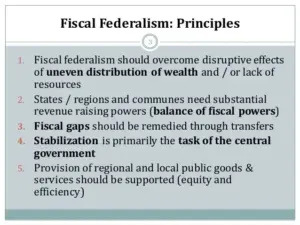
- Definition: Fiscal federalism refers to the constitutional and institutional arrangements governing the distribution of financial powers, taxation, and public expenditure responsibilities among different levels of government, incorporating ethical considerations similar to those applied by asset managers in sustainable investing.
- Vertical Imbalance: It addresses the mismatch between the Centre’s greater revenue-raising powers and the States’ larger expenditure responsibilities, much like how exchange traded funds balance risk and return in market capitalisation strategies.
- Horizontal Imbalance: It seeks to reduce disparities in fiscal capacity among States arising from differences in economic development, geography, natural resources, and demographic characteristics.
- Cooperative Governance: Fiscal transfers strengthen national integration while allowing States sufficient fiscal autonomy to meet local developmental needs, including investments in climate change mitigation and green economy companies.
- Constitutional Principle: The framework reflects the constitutional vision of balancing unity, diversity, and decentralised governance with social responsibility.
FINANCE COMMISSION: CONSTITUTIONAL ROLE
- Constitutional Body: The Finance Commission, established under Article 280 of the Constitution, recommends the distribution of financial resources between the Union and the States and among the States themselves.
- Fiscal Federalism: It acts as the cornerstone of India’s fiscal federal structure, balancing the fiscal powers of the Centre and the States while strengthening cooperative federalism through ethical standards comparable to those used in ESG-focused indices.
- Equalisation Objective: The Commission seeks to reduce horizontal fiscal inequalities by ensuring that States with weaker fiscal capacities can provide reasonably comparable public services.
- Resource Allocation: It recommends tax devolution, grants-in-aid, and measures to strengthen the finances of Panchayats and Municipalities, enabling them to pursue sustainable business practices and purpose-driven investing in local development.
- Constitutional Balance: The institution safeguards the interests of States while preserving national unity by addressing regional disparities and structural disadvantages.
KEY RECOMMENDATIONS OF THE 16TH FINANCE COMMISSION
- Vertical Devolution Retained: The Commission has maintained the States’ share in the divisible pool of Central taxes at 41%, continuing the arrangement recommended by the 15th Finance Commission.
- Reduced Grants-in-Aid: Total grants have been reduced to approximately ₹9.47 lakh crore, significantly lowering their share in overall Finance Commission transfers, reflecting a shift toward performance-based allocation similar to thematic investing approaches used by international investment funds.
- Elimination of Revenue Deficit Grants: Revenue Deficit Grants (RDGs), sector-specific grants, and State-specific grants have been discontinued.
- Focus on Local Bodies: Grants have largely been restricted to local governments and disaster management, with greater emphasis on decentralised governance and values-based screening of priorities.
- Performance Orientation: The Commission promotes performance-linked and conditional grants, encouraging fiscal discipline and improved governance through an approach reminiscent of the AIM framework used in ethical screening processes.
ARGUMENTS IN FAVOUR OF FC-16’S APPROACH
- Promotes Fiscal Discipline: Discontinuing Revenue Deficit Grants may discourage excessive dependence on Central assistance and encourage States to improve fiscal management, similar to how fund managers enforce discipline in passive investment products.
- Performance Incentives: Linking grants to measurable outcomes encourages better governance, accountability, and efficient utilisation of public resources, reflecting evolving investor preferences for transparent and ethical investment criteria.
- Strengthening Local Governments: Higher allocations for Panchayats and Municipalities support grassroots governance and improve service delivery.
- Outcome-Based Financing: Conditional grants promote reforms in sectors such as sanitation, water supply, revenue mobilisation, and financial reporting, aligning with sustainable investing principles and non-financial risks assessment.
- Efficient Resource Allocation: Greater emphasis on performance seeks to maximise developmental outcomes from limited public resources through structured investment solutions in priority sectors.
CONCERNS REGARDING FC-16
- Weakening Equalisation: The removal of Revenue Deficit Grants reduces targeted support for fiscally weaker States facing structural disadvantages, potentially creating a traffic-light system where some States remain perpetually in the red zone.
- Reduced Fiscal Autonomy: Performance-based conditionalities may constrain States’ ability to determine their own developmental priorities and ethical preferences in resource allocation.
- Ignoring Regional Diversity: Uniform fiscal expectations overlook differences in geography, demographics, historical development, and expenditure needs, much like how a single thematic index cannot capture the diversity of the Nifty 500 universe.
- Double Burden: Several States face reduced tax devolution alongside the withdrawal of compensatory grants, increasing fiscal stress and limiting their capacity for equity investment strategies in development.
- Equity Concerns: Greater emphasis on efficiency may widen regional disparities instead of reducing them, contradicting the equalisation objective of fiscal federalism and principles of social responsibility.
REVENUE DEFICIT GRANTS (RDGs)
- Purpose: Revenue Deficit Grants were provided under Article 275 to States whose post-devolution revenue receipts remained insufficient to meet assessed expenditure needs.
- Equalisation Instrument: RDGs addressed structural fiscal imbalances that could not be fully corrected through formula-based tax devolution, serving as a thematic benchmark for equity-based transfers.
- Support for Special Needs: They recognised State-specific circumstances such as difficult geography, demographic pressures, border responsibilities, and historical developmental gaps.
- Fiscal Stability: RDGs enabled fiscally stressed States to maintain essential public services without excessive borrowing.
- Constitutional Significance: They reflected the constitutional commitment to balancing fiscal equity within the Indian federation.
CESS AND SURCHARGES: A FEDERAL CONCERN
- Non-Shareable Revenues: Under Article 271, cesses and surcharges collected by the Union are excluded from the divisible pool shared with States, affecting the overall market valuation of State fiscal capacity.
- Growing Share: The increasing reliance on cesses reduces the effective volume of tax revenues available for distribution to States, similar to how stock weights in index funds affect constituent weights and overall portfolio performance.
- State Concerns: Several States have demanded the inclusion of cesses within the divisible pool to strengthen fiscal federalism.
- FC-16 Position: Instead of recommending mandatory inclusion, the Commission proposed gradual reform through a negotiated “grand bargain.”
- Federal Implication: Continued reliance on non-shareable levies strengthens the fiscal position of the Union while limiting States’ financial resources for responsible investment products in development.
GOVERNMENT INITIATIVES STRENGTHENING FISCAL FEDERALISM
- Goods and Services Tax (GST) Council: Promotes cooperative fiscal decision-making between the Centre and the States, functioning as an index services subsidiary for tax harmonisation.
- Finance Commission Transfers: Continue to remain the principal constitutional mechanism for horizontal and vertical fiscal equalisation, incorporating ethical screening processes for grant allocation.
- Fiscal Responsibility Framework: Encourages responsible fiscal management through fiscal deficit and debt targets, similar to how ETFs maintain disciplined investment strategies.
- Local Government Grants: Constitutional support to Panchayats and Municipalities strengthens decentralised governance and enables thematic investing in local infrastructure and climate change adaptation.
- Digital Public Finance: Improved tax administration, digital payments, and public financial management enhance fiscal efficiency across governments, comparable to how the National Stock Exchange modernised capital markets through NSE Indices Limited.
WAY FORWARD
- Balance Efficiency and Equity: Future Finance Commissions should reward fiscal responsibility while ensuring adequate support for structurally disadvantaged States, much like how green thematic indices balance performance with environmental objectives.
- Revive Equalisation Grants: Need-based grants should continue for States facing persistent fiscal disabilities arising from geography, demographics, or historical circumstances, ensuring diversified sectoral representation in development.
- Revisit Cesses and Surcharges: Greater inclusion of cesses within the divisible pool would strengthen cooperative fiscal federalism and improve the free-float market capitalization available for State development.
- Increase Fiscal Autonomy: States should receive greater flexibility in utilising grants while maintaining transparency and accountability.
- Strengthen Cooperative Federalism: Continuous consultation between the Union and States is essential for designing a fair, predictable, and sustainable fiscal transfer system.
CONCLUSION
India’s fiscal federalism rests on the twin pillars of efficiency and equity. While the 16th Finance Commission rightly seeks to encourage fiscal discipline and performance-oriented governance, reducing equalisation transfers risks weakening the constitutional objective of balanced regional development. In a diverse federation marked by significant interstate disparities, fiscal transfers must continue to combine performance incentives with need-based equalisation, ensuring that economic efficiency complements rather than replaces the foundational principle of fiscal justice.
SOURCE: The Hindu
MAINS PRACTICE QUESTION
“”The Finance Commission is not merely a mechanism for tax devolution but an institution for promoting cooperative fiscal federalism and regional equity.” Critically examine the recommendations of the Sixteenth Finance Commission in the context of efficiency versus equity in India’s fiscal federal structure. (15 Marks, 250 Words)

