 India's No.1 PU & Degree With Integrated IAS & IPS(UPSC/PSC) Training College.


India’s First LNG-Diesel DEMU Train Explained
India’s First LNG-Diesel Dual Fuel DEMU Train: A Step Towards Cleaner Railway Transport
Syllabus: Linkage (UPSC/State PSC/SSC/Railway Exams)
Prelims:
- Science & Technology – Alternative fuels, LNG technology
- Environment – Reduction of emissions, cleaner energy transition
- Indian Railways – Railway modernization initiatives
- Energy Resources – Natural Gas and LNG
Mains:
GS Paper III: Infrastructure, Energy Security, Environmental Sustainability
Topic: Transition towards cleaner transportation systems
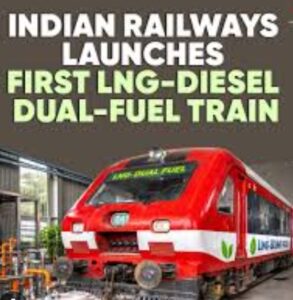
India Launches First LNG-Diesel Dual Fuel DEMU Train
India has introduced its first Liquefied Natural Gas (LNG)-Diesel Dual Fuel Diesel Electric Multiple Unit (DEMU) train, marking an important step towards reducing dependence on conventional diesel fuel in railway operations.
The train was launched from Sabarmati Railway Station, Ahmedabad (Gujarat) as part of Indian Railways’ efforts to explore cleaner fuel alternatives, especially for railway routes where complete electrification is difficult.
What is a DEMU Train?
DEMU (Diesel Electric Multiple Unit) is a self-propelled train where each coach can have its own power system.
- Unlike conventional trains that require a separate locomotive, DEMU trains have:
- Integrated engines within the train formation
- Faster acceleration
- Lower operational costs
- Better suitability for regional passenger services
What is LNG?
LNG stands for Liquefied Natural Gas.
It is natural gas that has been cooled to approximately −162°C, converting it into a liquid form.
Composition:
- Mainly Methane (CH₄)
- Small quantities of ethane, propane and other hydrocarbons
Advantages of LNG:
- Lower carbon emissions compared to diesel
- Reduced particulate matter emissions
- Higher energy efficiency
- Easier transportation and storage compared to gaseous natural gas
How Does LNG-Diesel Dual Fuel Technology Work?
The DEMU train uses a dual fuel system, meaning the engine can operate using both:
- Diesel
- Liquefied Natural Gas (LNG)
The existing 2,100 horsepower power cars were modified to support LNG usage.
Working Mechanism:
- LNG is stored in specially designed cryogenic tanks.
- The fuel system supplies LNG along with diesel into the modified engine.
- Combustion occurs using a combination of both fuels.
- Diesel acts as an ignition fuel while LNG provides the major energy input.
This technology allows the railway engine to reduce diesel consumption without completely replacing the existing system.
Key Features of India’s LNG-Diesel DEMU Train
Feature Details
Technology LNG-Diesel Dual Fuel System
Train Type DEMU
Power Capacity 2,100 horsepower
Fuel Used Diesel + LNG
Location of Launch Sabarmati Railway Station, Ahmedabad
Trial Distance More than 2,000 km
Diesel Reduction Potential Around 40%
Estimated Annual Saving ₹23.9 lakh per eight-coach train
Environmental Significance
Railways are one of India’s largest energy consumers. Diesel-powered trains contribute to greenhouse gas emissions and air pollution.
The LNG-Diesel system can help in:
1. Reduction in Carbon Emissions
- Natural gas produces lower carbon dioxide emissions compared to diesel.
2. Lower Air Pollution
LNG combustion results in:
- Lower particulate emissions
- Reduced sulphur emissions
- Lower nitrogen oxide emissions
3. Energy Diversification
It reduces dependence on petroleum-based fuels.
Why is Dual Fuel Technology Important Despite Railway Electrification?
- Indian Railways is rapidly moving towards 100% electrification of its broad-gauge network.
- However, some challenges remain:
- Remote railway routes
- Difficult geographical terrain
- High electrification costs in certain areas
- Temporary operational requirements
In such locations, alternative fuel technologies like LNG-powered trains can act as an intermediate solution.
LNG vs Diesel: Comparison
Parameter Diesel LNG
Source Petroleum Natural Gas
Main Component Hydrocarbons Methane
Emission Level Higher Lower
Storage Liquid fuel tanks Cryogenic tanks
Environmental Impact Higher pollution Cleaner fuel
Challenges of LNG-Based Railway Technology
Despite advantages, LNG adoption faces certain limitations:
1. Infrastructure Requirement
- Requires:
- LNG storage facilities
- Refuelling stations
- Cryogenic handling systems
2. Safety Concerns
- LNG requires careful handling due to extremely low temperatures.
3. Limited Availability
- A nationwide LNG railway network requires significant investment.
4. Long-Term Transition Question
- With rapid railway electrification, LNG may mainly serve niche applications rather than replacing electrification.
Government Initiatives Related to Cleaner Railways
1. Railway Electrification
- Indian Railways is expanding electric traction to reduce fossil fuel dependence.
2. Hydrogen-Based Train Development
- India is exploring hydrogen fuel cell technology for green mobility.
3. Energy Efficiency Measures
- Includes:
- Renewable energy usage
- LED lighting
- Energy-efficient locomotives
Prelims Facts to Remember
LNG:
- Full form: Liquefied Natural Gas
- Main constituent: Methane
- Cooling temperature: Around −162°C
- Fossil fuel but cleaner than coal and petroleum products
DEMU:
- Full form: Diesel Electric Multiple Unit
- Self-propelled train system
- LNG vs CNG:
- LNG CNG
Stored as liquid Stored as compressed gas
Temperature: −162°C Stored under high pressure
Used for long-distance transport Common in city vehicles
Possible UPSC Prelims Questions
Q1. Consider the following statements regarding LNG:
- LNG is mainly composed of methane.
- LNG is produced by cooling natural gas to very low temperatures.
- LNG has higher sulphur content than diesel.
Which of the above statements are correct?
Answer: 1 and 2 only
Q2. The term DEMU, recently seen in news, is related to:
A) Electric aircraft technology
B) Railway propulsion system
C) Solar power generation
D) Battery storage technology
Answer: B) Railway propulsion system
Q3. LNG is considered a cleaner fuel mainly because:
A) It produces no greenhouse gases
B) It has lower emissions compared to conventional fossil fuels
C) It is a renewable source of energy
D) It contains no carbon
Answer: B
UPSC Mains Question
“Discuss the role of alternative fuels like LNG in India’s transition towards sustainable transportation. What challenges limit their large-scale adoption?”
Approach:
- Introduction: Need for cleaner transport fuels
- Benefits of LNG technology
- Role in difficult-to-electrify railway routes
- Challenges of infrastructure and cost
- Way forward: Renewable energy-based transport ecosystem
Conclusion
India’s first LNG-Diesel Dual Fuel DEMU train represents an innovative approach towards cleaner railway operations. While railway electrification remains the primary pathway for sustainable rail transport, LNG technology can provide a practical transitional solution for routes where electrification is challenging. It reflects India’s broader strategy of balancing energy security, economic efficiency and environmental sustainability.

